


Table of Contents
Quick Answer
Email marketing costs $9 to $2,500 per month, depending on software, list size, and who runs campaigns. Software alone ranges from $9 on an entry plan to $350 on advanced tiers. Adding a freelancer brings the total to $1,200 to $2,000 per month. A fully managed agency retainer averages about $2,500 per month.
Introduction
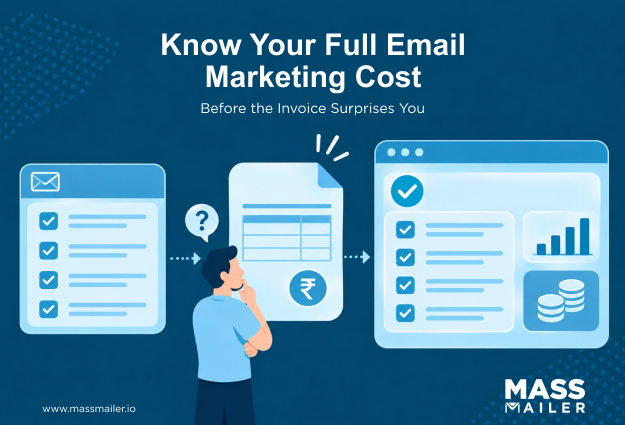
Trying to get a straight answer on how much email marketing costs? Most pricing pages show the software fee. They leave out the freelancer, template design, list cleaning, and the staff time behind every send.
That gap is how teams end up spending double what they planned.
The total depends on how big your list is, how often you send, which features you use, and whether you run campaigns yourself or hire help.
A solo marketer on an entry plan might spend USD 50 a month. A growing team with a freelancer could reach USD 2,000. An agency pushes it past USD 5,000.
This blog breaks down every line so you can build a budget that holds up. If your contacts live in Salesforce, a dedicated section covers what that changes.
Average Email Marketing Cost Per Month
Most businesses spend between $50 and $2,500 per month on email marketing when software, people, and add-ons are included. Email marketing software alone ranges from $9 to $350 per month. The rest depends on whether you run campaigns in-house or hire help.
| Approach | What you typically pay | What it covers | Best fit |
| DIY with email software | $9–350/month depending on plan and list size | Platform subscription, templates, basic automation, and reporting | You have the time and skills to run campaigns yourself |
| Agency-managed | About $2,500/month on average; $100–149/hour | Strategy, content, automation, testing, and reporting | Email drives core revenue and needs full management |
If neither row fits, a freelancer can handle copywriting, design, or campaign setup on a project or retainer basis. Rates vary by scope, so get quotes based on your actual campaign volume.
Most small marketing teams start in the DIY row. Within six months, many move to outside help. The trigger is usually a missed send or a campaign that sat in drafts for two weeks because nobody had time to finish it.
The DIY row hides a cost the agency row doesn’t. You pay less for software, but your team absorbs every hour of planning, writing, building, and reporting. That time has a price, even without an invoice.
Email Marketing Platforms Pricing by List Size
Most email platforms charge by plan level, and the price scales as your contact list grows. Entry plans start low, but the cost jumps as you need more features or store more contacts.
| Plan level | Typical starting price | What it includes |
|---|---|---|
| Entry plans | $9–19/mo | Basic sends, templates, platform branding, send caps |
| Mid-tier plans | $20–49/mo | Segmentation, A/B testing, multi-step automation |
| Advanced plans | $79–350/mo | Advanced workflows, dedicated support, more seats |
| Enterprise | Custom quote | Dedicated IPs, negotiated terms, priority SLA |
Source:Capterra 2026 Email Marketing Software Pricing Guide, based on published vendor data as of July 2026.
Entry plans that start at $9 to $19 per month can reach $120 or more once your list crosses 10,000 contacts. Before picking a plan, check the pricing at your current list size and at the size you expect in 12 months.
One billing detail most pricing pages bury: platforms count every stored contact, including bounced and unsubscribed addresses.Cleaning your list before each campaign keeps you in a lower pricing tier and protects deliverability.
If you send to your full list only a few times a month, a volume-based plan that charges per email sent may cost less than a contact-based plan. The billing model section below covers how to compare.
Enterprise pricing is quote-based. Those contracts typically bundle dedicated IPs, priority support, and higher send limits into a negotiated annual rate.
How Email Marketing Pricing Works: 3 Common Pricing Models
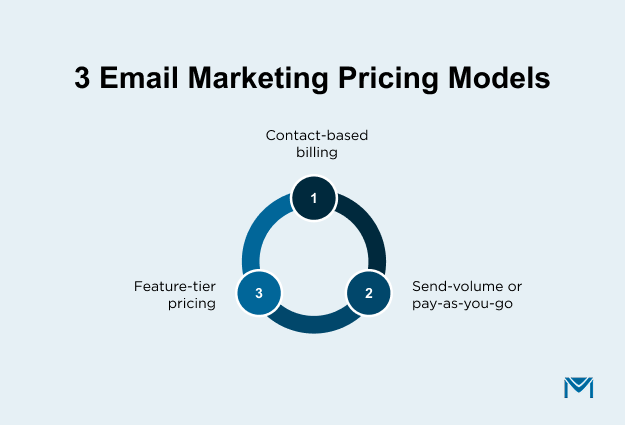
Email marketing platforms bill in three ways: by contacts stored, by emails sent, or by feature tier. The billing model you choose can raise or lower your cost more than the plan itself.
Contact-Based Pricing
Most platforms charge by the number of contacts you store, whether you email them or not. So if your team imports 500 leads from a webinar and never sends them a campaign, the next invoice still goes up.
This model works best when you send to the same list regularly, because every extra campaign goes out at no added cost. On the other hand, it works against you when your list grows faster than your sending. Each imported batch raises the bill, even if marketing never touches those contacts.
Before signing a contact-based plan, read the billing terms closely. Some platforms count contacts that would surprise you, which the hidden fees section below covers in detail.
Send-Volume and Pay-As-You-Go Pricing
If you email a large list only a few times a quarter, paying per send usually costs less than paying for the full list every month. Send-volume plans charge by the number of emails sent, while pay-as-you-go lets you buy credits upfront and spend them per send.
Both suit seasonal campaigns and event-based outreach. However, the trade-off is predictability. Your volume changes month to month, and a product launch or holiday push can blow past your cap. Overages then kick in at a higher per-email rate. So if you need a fixed number to defend your budget, a contract plan gives you that stability instead.
Feature-Tier Pricing
Platforms group features into plan levels. Entry plans cover sends and templates, while automation, A/B testing, and advanced reporting sit in higher tiers.
The problem is that feature tiers stack on top of contact pricing. As a result, you pay for both your list size and your feature level. That means one feature you rarely use can set the price for your entire plan. Before upgrading, check whether you will use that feature every month or just once a quarter.
Multi-step nurture sequences are the most common reason for an unplanned tier jump. If your contacts already sit in Salesforce, you canbuild drip campaigns from CRM data you already have. That keeps automation inside the tool you pay for, without upgrading your email platform.
The Real Cost of Email Marketing Beyond the Software
Beyond the platform fee, email marketing costs include staff time, template and content work, list maintenance, and add-on fees that appear after signup.
Email Campaign Management Cost: In-House, Freelancer, or Agency
The average email marketing specialist in the US earns about$60,554 per year, according to PayScale. That is roughly $5,000 per month. Even if email is only a quarter of someone’s role, the cost attributable to email is still over $1,200 per month.
Freelancers charge$25 to $120 or more per hour on platforms like Upwork, depending on experience.
When comparing these options, price the same scope of work across all three. A software subscription and an agency retainer cover different things. One is a tool. The other is a team running the tool.
Design, Content, and List Costs
Most platforms include basic templates. Custom template design, copywriting, and list maintenance cost extra.
Copywriting is the line most teams miss. The template stays the same, but every campaign needs new words. Give this its own row in the budget, whether you write in-house or hire out.
Buying or renting email lists usually costs more in the long run. Bounces, spam complaints, and compliance risk add up faster than the list price suggests. Growing an opt-in list is slower but cheaper over time.
Hidden Fees That Raise Your Email Marketing Pricing
The price on a pricing page is rarely the final bill.
Overage fees hit when your contact count or send volume crosses the plan limit. Some platforms upgrade your plan automatically. Others charge per contact above the cap.
Inactive contact billing catches teams off guard. Some platforms bill for every stored contact, including unsubscribed and bounced addresses.
Dedicated IP costs make sense only above roughly100,000 messages per month. Below that, ashared IP is safer and cheaper.
Annual billingsaves 10–20% over monthly plans. If you plan to stay on the platform for a year, pay upfront.
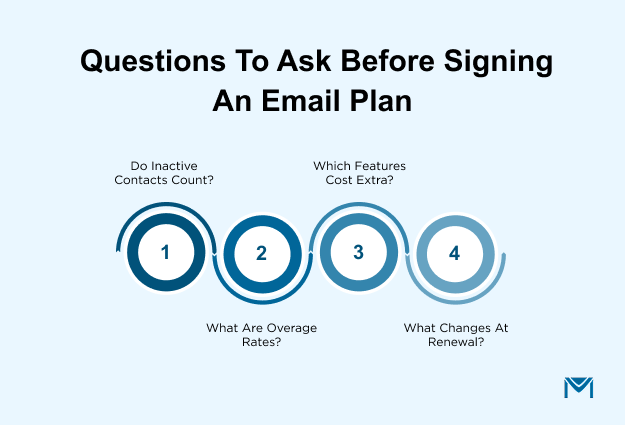
Before signing any plan, ask:
- Do unsubscribed or inactive contacts count toward the bill?
- What are the overage rates?
- Which features are paid add-ons?
- What happens to data and price at renewal?
Email Marketing Cost for Salesforce Users
Salesforce users face three cost paths for email: native Salesforce email at no extra license cost, a third-party platform synced to the CRM, or a native AppExchange app starting at$219 per month. The deciding factor is where your email tool sits relative to the contact database you already pay for.
If your CRM holds 15,000 contacts and marketing emails only 6,000 of them, a contact-priced platform outside Salesforce still bills for all 15,000. You pay for the database in Salesforce and again in the email tool.
What Native Salesforce Email Includes and Its Daily Limit
Salesforce includes built-in email at no extra license cost. Its limits are hard caps.
| Native Salesforce email type | Limit | Scope |
| Mass email and List Email | 5,000 external addresses per day | Per licensed org, resets by GMT day |
| API or Apex single emails | 5,000 external addresses per day | Separate from the mass email limit |
| Developer and trial orgs | 10 external recipients per day | Per org, across all email types |
Every mass and list email send draws from one shared daily pool. Large sends must be split across days, and duplicate addresses count each time.
The cap stays fixed whether your org has ten users or a hundred. So the per-person share shrinks as the team grows. Native mass email also reaches only Contacts, Leads, and Person Accounts. It cannot send to custom objects, and tracking is limited to aggregate counts.
How Email Marketing Platforms Pricing Compares for Salesforce Orgs
Once native email is not enough, three paid paths open up.
| Path | How it is priced | Starting cost | Contact data |
|---|---|---|---|
| Salesforce’s own marketing products | Edition license, plus contacts and send volume | Priced by edition | Separate platform connected to the CRM |
| Third-party email platform synced to Salesforce | Contact-count tiers, plus connector cost | From $9–19/month, scaling with contacts, plus connector fees | Copied into a second database |
| Native AppExchange app | Per user and email volume | From $219/month for one user | Stays in Salesforce |
A native app runs inside the org and sends from records you already have. MassMailer is one such app on the AppExchange. It sends from Leads, Contacts, Campaigns, and custom objects. Opens, clicks, bounces, and unsubscribes write back to those same records.
It is built for email. If your team needs SMS, ads, social, or enterprise lead scoring, a full marketing automation platform may be the better fit.
Before choosing an email marketing solution for Salesforce, ask each vendor:
- Does it work with your Salesforce edition?
- Can it send to custom objects?
- Does it need a separate sync?
- How does pricing change as the CRM grows?
The Ongoing Cost of Keeping Two Contact Databases
Running email outside Salesforce creates three ongoing costs that never show up on a pricing page.
The first is duplicate billing. Your Salesforce licenses already cover that database. A contact-priced email platform charges for the same records again.
The second is admin time. Fixing sync errors, merging duplicates, and reconciling mismatched fields rarely appear in the email budget. They always appear in someone’s week.
The third is compliance risk. When unsubscribes sync back on a schedule rather than instantly, opted-out contacts can still receive emails from the CRM. That gap is a CAN-SPAM and GDPR exposure.
These costs never show on an invoice. They show up in every admin’s calendar.
Is the Cost of Email Marketing Worth It? How to Measure ROI in Salesforce
Yes, but an industry average won’t prove it to your manager. Your own numbers will. Here is how to measure email marketing ROI using data already in your Salesforce org.
Three formulas cover it:
| Metric | Formula | What it tells you |
|---|---|---|
| Cost per subscriber | Monthly email cost ÷ total subscribers | What each contact on your list costs you |
| Cost per email | Monthly email cost ÷ emails sent | The fairest way to compare plans that bill differently |
| ROI | (Email revenue − email cost) ÷ email cost × 100 | A percentage you can stack against other channels |
A quick example: you email 10,000 contacts four times a month. Software costs $100, and a freelancer costs $1,500. Total: $1,600. That works out to $0.04 per email and $0.16 per subscriber. If those campaigns bring in $12,000, your ROI is 650%.
Cost per email is the most useful of the three formulas. It lets you compare plans that bill by contacts against plans that bill by sends, on the same basis.
B2B returns take longer to show, so measure over a full sales cycle rather than a single month. Every Salesforce Campaign record already holds cost and influenced revenue. Campaign Influence links email touches to opportunities, even when a deal touched five other channels first. Pull these numbers from youremail campaign reports instead of building a separate tracking sheet.
What Email Marketing Really Costs Comes Down to Three Choices
How much does email marketing cost? It comes down to three choices: your pricing model, who runs your campaigns, and where your contact data lives.
The cheapest plan on a pricing page is rarely the lowest total cost. With that in mind, compare full email marketing pricing, with people and add-ons included. For Salesforce users, the biggest choice is often whether email runs inside or outside the CRM.
Want to send email from Salesforce without paying twice for contacts, syncing data, or splitting sends around daily caps?Book a demo and see it running on your own records.
Frequently Asked Questions
1. How much does email marketing cost per month for a small business?
2. What is the cheapest way to start email marketing?
3. Why does the cost of email marketing increase as my list grows?
4. Do unsubscribed contacts count toward my email marketing bill?
5. Can I send marketing emails from Salesforce without paying for another tool?
6. Is email marketing worth the cost for B2B companies?
Related Blogs
Email Deliverability Best Practices to Reach the Inbox
Best Time to Send Marketing Emails (2026 Data)
Email Scoring: The Formula Most Guides Leave Out
MassMailer Resources


MassMailer Glossary
About the Author

Siva Devaki 
Siva Devaki is the founder of MassMailer Inc., a tool that helps Salesforce users optimize email marketing. A passionate advocate for email marketing, Siva writes and hosts podcasts on the topic, sharing insights to help businesses drive revenue and enhance customer engagement through Salesforce email automation and tracking.