
Table of Contents
Email marketing for higher education works when you segment students by enrollment stage and automate the messaging around the admissions calendar.
- Segment prospects, applicants, admits, and alumni separately.
- Automate inquiry-to-deposit nurture sequences from Salesforce fields.
- Personalize recruitment with live CRM data, beyond the first name.
- Send natively in Salesforce to clear the 5,000-per-day cap.
Introduction
Do you send the same email blast to prospects, applicants, admitted students, and alumni from one giant list? Email marketing for higher education breaks the moment you treat those audiences as one group.
A prospect comparing majors and a donor weighing a year-end gift need different messages, on different schedules, triggered by different signals. Most institutions know this. Their CRM data and sending tools still make real segmentation hard, so the blast wins by default.
This guide shows you how to segment students by enrollment stage, build nurture sequences that move them from inquiry to deposit, run recruitment and alumni campaigns that actually get opened, and execute all of it inside Salesforce.
What makes email marketing for higher education different
Higher education email marketing manages many distinct audiences on one CRM, each at a different point in a long, calendar-driven decision. A retail buyer decides in minutes. A prospective student decides over 18 months, alongside parents, counselors, and financial aid. That timeline, and the data sensitivity around it, changes how you plan every campaign.
One CRM, many audiences
Your database holds people with little in common except the institution. Each group needs its own cadence, tone, and call to action:
- Inquiries: early researchers who want program details and campus life.
- Applicants: active leads who need deadlines and document reminders.
- Admitted students: high-intent prospects you must convert before deposit day.
- Enrolled students: current members who need operational and retention messages.
- Alumni and donors: a long-term audience for engagement and giving.
- Parents and faculty: influencers who shape the decision and the experience.
The enrollment calendar drives the schedule
Your send calendar follows the admissions cycle. Application deadlines, decision-release dates, deposit deadlines, and orientation windows are set when each sequence fires. Because these dates repeat yearly, you can build sequences once and trigger them from a single date field, then reuse them every cycle.
Compliance shapes what you can send
Student data carries rules that retail lists do not. FERPA governs how you use protected education records, so targeting grades, financial aid, or enrollment status needs care. Operational email to current students differs from promotional email to alumni and donors, who must be able to opt out cleanly.
A managed email preference center lets each group control what they receive without marking you as spam.
Segment your audience by enrollment stage and intent
Segmentation in higher education starts with the enrollment stage, then layers behavior on top. Stage tells you what someone needs next. Behavior tells you how ready they are to act. Together, they decide which sequence a contact enters and what each email says.
Build segments around the funnel
Map every contact to a stage so no message lands on the wrong audience. A clean stage model usually looks like this:
- Inquiry: requested information, attended a fair, or downloaded a viewbook.
- Applicant: started or submitted an application.
- Admit: received an offer, deposit pending.
- Enrolled: deposited and registered.
- Alumni and donors: graduated or gave.
In Salesforce, you can drive these segments from real fields rather than manual tags. A picklist such as Enrollment_Stage__c on the Contact or Lead, or application status on a custom Application object, lets a campaign pull the right people automatically as their record changes.
Layer behavioral signals
Stage alone misses urgency. A prospect who opened three program emails and visited the tuition page is warmer than one who went quiet. When your email engagement writes back to the CRM, you can score those signals and move hot contacts into a faster track. Use email open and click tracking on each record to spot who is leaning in.
Keep segments clean
Stale data quietly wrecks higher-ed sends, because graduating classes churn every year. Suppress hard bounces, sunset contacts who have not engaged in 12 months, and never buy outside lists, since purchased addresses spike spam complaints and damage your sender reputation. Run addresses through email verification before large recruitment pushes to cut bounces before they start.
Build a higher ed enrollment email nurture sequence
An enrollment email nurture sequence is a series of automated messages that moves a contact from one stage to the next, triggered by record changes rather than sent by hand. You build three connected sequences, one per major transition, and let stage fields move people between them. Each drip sequence built in Salesforce fires the moment a contact qualifies.
Inquiry to application
Start the moment someone requests information. The goal is a submitted application, so each email removes one barrier:
- Day 0: welcome, set expectations, link the program page that matches their interest.
- Day 3: answer the top question for that program, with a student or faculty story.
- Day 7: cost and aid overview, since price is the most common silent objection.
- Day 12: application walkthrough and the next deadline, with one clear button.
If the contact starts an application, the stage field flips to Applicant, and this sequence stops, so they never get a redundant "apply now" after they already have.
Applicant to admit
Once an application opens, switch from persuasion to completion. Send document reminders tied to what is missing, a deadline countdown as the date nears, and a reassurance email that names the decision timeline. Trigger each message from the application status so a student who submits everything skips the chase emails automatically.
Admit to enrollment
After an offer goes out, every email should reduce friction toward the deposit. Lead with the decision the admit is weighing, then make the next step obvious: deposit instructions, a financial aid summary, orientation dates, and a connection to current students. Stop the sequence the instant the deposit posts, and roll the contact into onboarding.
Run recruitment campaigns that get opened
Recruitment email works when it feels written for one student, because students now expect that. In a recent EAB survey, 93% of students said a personalized message from a college would make them more likely to explore that school. Generic blasts move the opposite way. The mechanics below decide whether your campaign earns the open and the click.
Subject line and sender identity
The open happens before anyone reads a word. Use a real sender name, such as an admissions counselor, rather than a no-reply alias, because a human name lifts opens. Keep subject lines short and specific to the student's stage and program. A line that names their intended major beats a campus-wide announcement every time.
Personalize from CRM fields beyond the first name
Merge a first name, and you have done the bare minimum. Pull intended major, campus of interest, application status, and event history from Salesforce so the body reflects where the student actually is. A prospect interested in nursing should see nursing outcomes and faculty, so the email reflects their actual interest. This depth is only possible when your email tool reads live CRM data.
Design for mobile and one action
Most students open email on a phone, so a single-column layout and a tappable button matter more than a polished desktop design. Give each email one job. When you ask a student to apply, visit, and follow social in the same message, you split their attention and lose the click you actually wanted.
Engage alumni, donors, and parents
Post-enrollment audiences reward relevance and patience. Constant asks wear them down fast. Alumni open email for class news, events, and impact, so lead with value and let giving requests follow a relationship rather than open it. Segment alumni by graduation year, school, and giving history, then time appeals around reunions and the year-end window.
Parents form a separate audience with separate consent. They want deadlines, payment dates, and safety updates, so keep their stream operational and clear. Because parents influence both the enrollment decision and the tuition payment, an accurate, low-noise parent list protects trust during the moments that matter most.
Execute it all inside Salesforce with MassMailer
Everything above depends on one thing: sending segmented, stage-based email against live CRM data without exports or send caps. MassMailer is a Salesforce-native email application built for exactly that, which is why institutions running on Education Cloud use it as their execution layer. It runs inside Salesforce, so campaigns target live Contact, Lead, and custom Application records directly, with no CSV export and no second database to reconcile.
Get past the Salesforce send and attachment limits
Standard Salesforce mass email caps you at 5,000 external addresses per day per org, which a single recruitment push can blow through in one morning. MassMailer sends high volume on dedicated infrastructure, so a 60,000-contact prospect campaign goes out on schedule instead of stalling at the cap.
Attachments hit a different wall: a single Salesforce email tops out around 25 MB total, and Base64 encoding inflates a file by roughly a third before it counts, so a 20 MB viewbook can fail to send. MassMailer handles large files so admissions packets and orientation guides reach the inbox.
Keep engagement and compliance on record
Opens, clicks, and bounces write straight back to each Salesforce record, so your nurture sequences can branch on real behavior, and your team scores leads without manual data pulls. Sending stays inside your existing Salesforce roles and permissions, which keeps student data governance intact.
What this looks like at UMass Boston
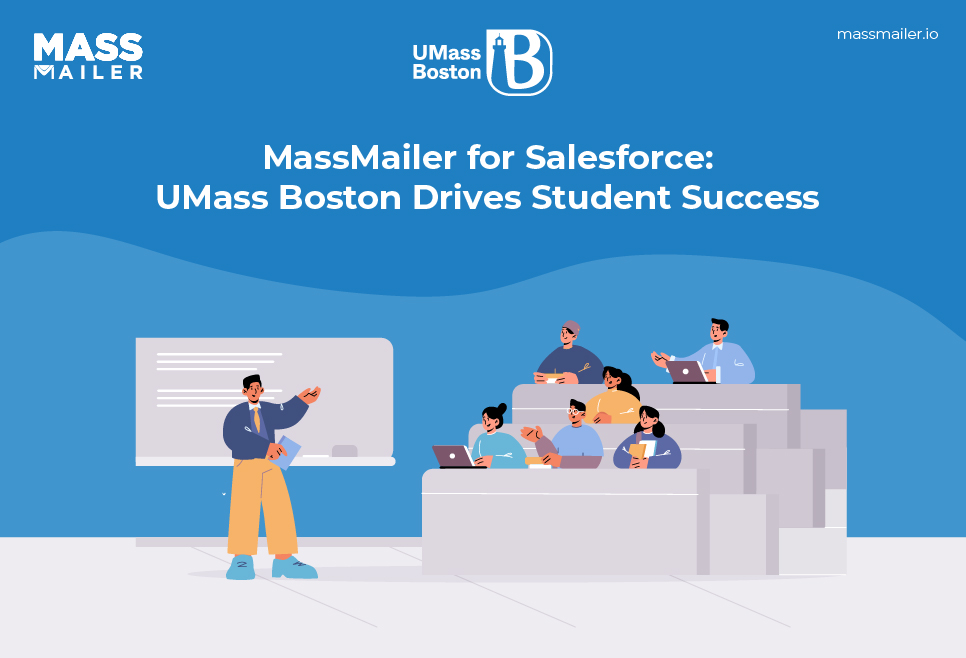
UMass Boston shows how this plays out at scale. The university ran its advising outreach on native Salesforce email plus manual workarounds, which capped volume and ate staff hours.
After moving to MassMailer, the team built bulk sends in minutes and reached more than 15,000 students with advising reminders, registration deadlines, and program updates, all without hitting daily limits.
Its Early Alert Campaign shows the payoff. When faculty flag students mid-semester, MassMailer reads each student's academic program record and personalizes the follow-up with the correct Academic Dean's name and details.
Real-time open and click metrics then land back in Salesforce, so advisors see who engaged and who still needs a call. That mix of scale, record-level personalization, and live tracking is hard to reach with standard tools.
Conclusion
Effective email marketing for higher education comes down to four moves: segment by enrollment stage, automate nurture sequences across each transition, personalize recruitment from real CRM fields, and keep alumni and parent streams relevant.
Each one depends on sending against live data at scale, which is where standard Salesforce email runs out of room. MassMailer gives Education Cloud teams that execution layer, clearing the 5,000-per-day cap and writing engagement back to every record.
To see how your enrollment sequences would run on live Salesforce data, book a MassMailer demo and walk through your funnel with the team.
Frequently Asked Questions
1. What is email marketing for higher education?
2. How often should you email prospective students?
3. What is a good email open rate for higher education?
4. Does FERPA apply to email marketing for universities?
5. How do you keep a student email list from hurting deliverability?
6. Which email tool works best for Salesforce Education Cloud?
Related Blogs
How to Build Salesforce Drip Campaigns That Nurture and Convert
Salesforce Mass Email: How to Enable, Send, and Scale in 2026
MassMailer Resources


MassMailer Glossary
About the Author

Siva Devaki 
Siva Devaki is the founder of MassMailer Inc., a tool that helps Salesforce users optimize email marketing. A passionate advocate for email marketing, Siva writes and hosts podcasts on the topic, sharing insights to help businesses drive revenue and enhance customer engagement through Salesforce email automation and tracking.