


Table of Contents
Every time someone on the team pulls up Salesforce Marketing Cloud pricing, the numbers look different. The website says one thing, the quote says another, and the renewal somehow costs more than both. Line items shift between calls, and nobody can get a straight answer on what's actually required versus what's optional.
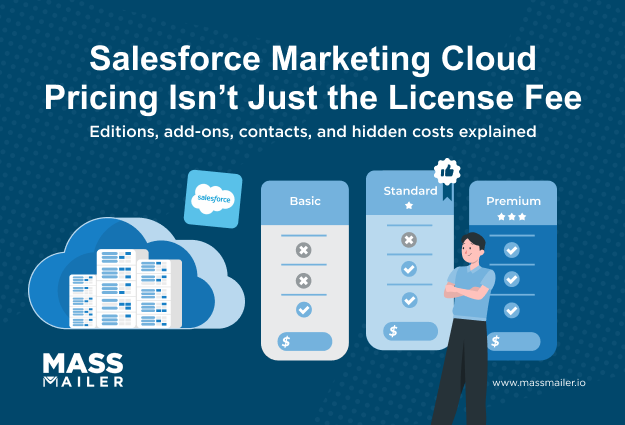
It keeps happening because Marketing Cloud bills across two product lines, multiple editions, contact bands, and add-ons that quietly stack with every renewal. The pricing page only tells part of the story.
This guide covers every edition across both product lines, breaks open the hidden costs that grow the bill, and puts the real spend next to aSalesforce-native alternative like MassMailer. Built to help make sense of the quote before signing anything.
How Does Salesforce Marketing Cloud Pricing Work?
Salesforce Marketing Cloud pricing runs on a combination of product line, edition, contact volume, and add-ons. There's no single price list. The quote changes depending on which product line the sales rep puts the team on, which edition inside that line, how many contacts sit in the database, and which extras get stacked on top.
That's why the same company can get wildly different quotes from two different reps.
Marketing Cloud Product Lines and Editions
Salesforce sells Marketing Cloud across two product lines.
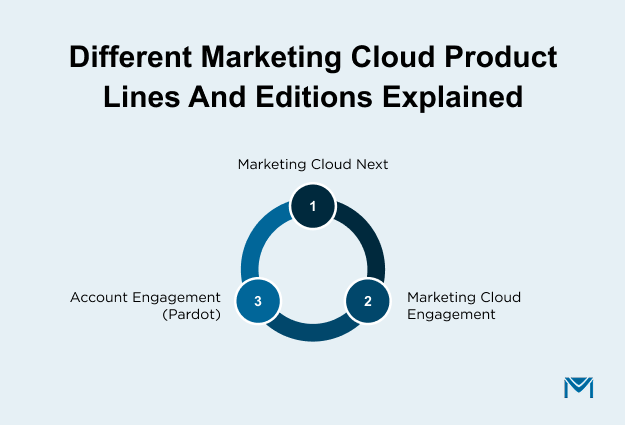
Marketing Cloud Next is the newer line built on the core Salesforce Platform, with three main editions for new buyers: Salesforce Starter, Growth Edition, and Advanced Edition.
Marketing Cloud Engagement is the older platform, now sold as upgraded "+" editions (Pro+, Corporate+, Enterprise+) that bundle legacy Engagement features with Marketing Cloud Next.
A third product, Account Engagement (formerly Pardot), is a separate B2B tool with its own pricing.
When a quote feels too high, the first question isn't "which tier?" It's "which product line?" That mismatch explains most of the sticker shock.
How Do Contacts and Active Subscribers Affect the Bill?
Most editions price against a contract ceiling, and crossing it bumps the next renewal into a higher band. The number that catches teams off guard is active subscribers, not total contacts. A team that signs for 50,000 contacts but imports a 90,000-record list from Salesforce is already over the line before sending a single campaign.
Even suppression lists and unsubscribed records can count toward the total depending on storage. Get that confirmed in writing before the contract is signed.
How Do Annual Contracts and Billing Work?
Marketing Cloud bills on annual contracts, often with multi-year terms that lock in both the edition and the contract band. That lock cuts both ways. A three-year deal at a lower rate sounds good until the team's sending patterns shift and there's no room to downgrade.
If the contact count crosses the band mid-term, Salesforce can charge the difference to match the higher tier. Get that overage math spelled out in the contract before signing.
Is Marketing Cloud Account Engagement (Pardot) the Same Product?
Account Engagement is a completely separate product built for B2B lead nurture and scoring. Marketing Cloud Engagement is built for B2C and transactional email at scale. The name overlap causes confusion, but they run on different platforms with different pricing.
How Much Do Marketing Cloud Next Editions Cost?
Marketing Cloud Next editions cost between $25 per user per month and $3,250 per organization per month. If the quote sitting in the inbox doesn't match any of these numbers, it's probably bundling add-ons or quoting the wrong product line. Here's what each edition actually costs on its own.
| Edition | Price | Billing |
|---|---|---|
| Salesforce Starter | $25/user/month | Monthly or annual |
| Salesforce Pro | $100/user/month | Annual contract required |
| Growth Edition | $1,500/org/month | Annual |
| Advanced Edition | $3,250/org/month | Annual |
Salesforce Starter Cost
Salesforce Starter costs $25 per user per month, billed monthly or annually. It covers basic email marketing, campaign analytics, and lead management. A five-person team pays $125 per month or $1,500 per year.
The cap shows up fast. No journey orchestration, no Agentforce campaigns, no segment creation. If the team needs anything beyond simple email sends and tracking, Starter won't hold.
Salesforce Pro Cost
Salesforce Pro costs $100 per user per month, billed annually, with a contract required. It layers on customization, automation, sales forecasting, and AppExchange access.
Here's where the pricing model starts working against larger teams. Ten people cost $12,000 per year. Fifteen costs $18,000, which is exactly what Growth Edition charges as a flat org fee with no per-user scaling. At that crossover point, the per-user model stops making sense.
Growth Edition Cost
Growth Edition costs $1,500 per organization per month, billed annually. That's $18,000 per year before add-ons. The flat org fee covers Agentforce campaign creation, multi-channel journeys, forms, landing pages, segment creation, and automated customer journeys.
SMS and WhatsApp sit outside the org fee at $10 per 1,000 credits each. Additional email sends beyond the included limit also cost $10 per 1,000. For teams running heavy messaging alongside email, those charges add up by month three. Factor them into the annual number before comparing editions.
Advanced Edition Cost
Advanced Edition costs $3,250 per organization per month, billed annually. That's $39,000 per year, more than double Growth's $18,000.
What the extra $21,000 per year adds: Path Experimentation for testing variations across channels, subject lines, and audiences, along with Predictive Scoring, Predictive Engagement Frequency, and Unified Conversations that turn one-way SMS and WhatsApp sends into two-way exchanges.
How Much Do Marketing Cloud Engagement Editions Cost?
Salesforce has restructured Engagement pricing into "+" editions that bundle the legacy platform with Marketing Cloud Next, starting at $2,000 per organization per month. Older sources still list standalone editions (Professional at $1,250, Corporate at $4,200, Enterprise custom-quoted), but Salesforce's own page no longer shows those. If a quote references the old names, ask the rep which model the contract actually follows.
| Edition | Price | Includes |
|---|---|---|
| Pro+ | $2,000/org/month | MC Growth, 2.5M emails, 15K contacts |
| Corporate+ | $5,500/org/month | MC Advanced, 10M emails, 45K contacts |
| Enterprise+ | $30,000/org/month | Multi-BU, highest API and messaging limits |
Pro+ Cost?
Pro+ costs $2,000 per organization per month, coming to $24,000 per year. It bundles Marketing Cloud Growth with the legacy Engagement email and journey tools, 2.5M email messages, and 15,000 contacts.
The contact and message caps are where this tier gets tight. Teams planning to add SMS or run multi-step journeys within the first year should price Corporate+ upfront rather than upgrading mid-contract.
Corporate+ Cost?
Mid-market teams that need Journey Builder, Mobile Studio, and serious API throughput usually land onCorporate+ at $5,500 per organization per month, or $66,000 per year. It pairs Marketing Cloud Advanced with the Engagement platform, 10M email messages, 1M mobile app messages, and 45,000 contacts.
Pin down the API limits before signing. High-volume integrations can exhaust the ceiling mid-quarter, and adding capacity after the contract is signed typically costs more than building it into the original deal.
Enterprise+ Cost?
Enterprise+ costs $30,000 per organization per month, totaling $360,000 per year. It opens up multi-business-unit orchestration, role-based access at scale, and the highest messaging and API thresholds in the Engagement line.
At this price, the question isn't whether the features exist but whether the team will use enough of them to justify a 5x jump over Corporate+. If the primary need is managing multiple brands or geographies from one org, Enterprise+ earns its cost. If the driver is just API headroom, negotiate a higher ceiling on Corporate+ first.
Is Marketing Cloud Engagement Being Phased Out?
No official end-of-life date, but the direction is clear. New capabilities like Agentforce and Data Cloud integration are shipping in Next, not Engagement. Salesforce partners likeArkus andHorizontal Digital document the shift to Marketing Cloud on Core as Salesforce's strategic direction.
For teams signing a new multi-year Engagement deal, ask for contract language that covers the cost of moving to Next if Salesforce retires the platform before the term ends. New buyers should price Next first.
And for teams whose primary need is Salesforce-native email rather than omnichannel orchestration, the right answer may not be any Engagement tier at all.
What Are the Hidden Costs of Salesforce Marketing Cloud?
The hidden costs sit in five places: implementation, support tiers, add-on modules, duplicate contacts, and negotiation leverage the team never used. A Corporate+ contract at $66,000 per year can easily cross $100,000 once these extras stack up.
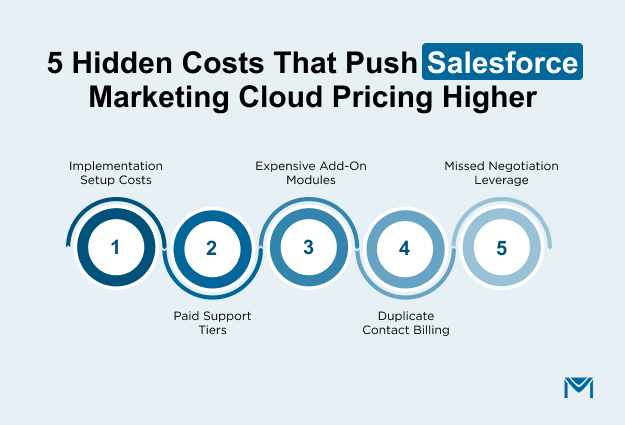
Implementation Cost
Marketing Cloud rarely works out of the box. Implementation coverssender authentication (SPF, DKIM, DMARC), IP warm-up, data extension setup, journey design, and training. Most teams need a partner for 4 to 12 weeks.
Costs scale with complexity. A single-business-unit setup with standard integrations is a different project from an enterprise rollout across regions with ERP connections and multiple data sources. Either way, skipping a proper IP warm-up to cut costs is the most common cause of deliverability problems in year one.
Support Tiers Cost
Standard support is included.Premier Success Plans cost 30% of net license fees. On a $66,000-per-year Corporate+ contract, that's $19,800 annually just for support. Signature plans are custom-quoted and higher.
The expense that never shows up on an invoice: internal admin time. List hygiene, journey QA, deliverability monitoring, and renewal prep all need dedicated hours. Teams without a Marketing Cloud admin frequently underspend on support upfront and overspend on partner consulting later.
Add-Ons Cost
Add-ons are where a manageable contract turns expensive. StackPersonalization at $8,000 per month on top of a Growth Edition contract, and the annual spend jumps from $18,000 to $114,000. Intelligence adds another $10,000 monthly. Business Units run $2,500 each. Flex Credits for Agentforce cost $500 per 100K requests.
Before upgrading to a pricier edition, check whether an add-on on the current tier covers the gap at a lower total. Some unlock capabilities that used to come bundled in higher editions.
Why Can Duplicate Contacts Inflate the Bill?
Marketing Cloud counts contacts by Contact Key, typically an email address or external ID. Duplicates in Salesforce become separate billable contacts. A 50,000-record database with15% duplicates becomes 57,500 active contacts, enough to push the team into a higher band at renewal.
Run a deduplication audit before negotiating the contract count.Validating addresses before they enter the system keeps the number clean from the start.
Negotiating Your Marketing Cloud Quote
Most quotes have negotiable line items. Walk in with three numbers: forecast active-contact count for the full contract term, projected annual send volume by channel, and a realistic add-on roadmap. Then ask four questions:
- What's the overage cost if contacts cross the band mid-term?
- Which add-ons unlock features bundled into the next edition up?
- Is Premier support required or recommended?
- Can the implementation scope be documented in writing before signing?
Timing helps. Salesforce'sfiscal year ends January 31. End-of-quarter and end-of-fiscal pushes typically give the rep more flexibility.
For teams that needSalesforce-native email marketing without the implementation overhead, tools like MassMailer install directly from the AppExchange and run inside your existing Salesforce org with no external setup.
How Does Marketing Cloud Compare to MassMailer on Cost?
MassMailer and Marketing Cloud serve different scopes at very different price points. The comparison holds when both tools fit the use case: Salesforce-native email marketing.
How Do the Pricing Models Compare Side by Side?
Marketing Cloud charges by edition and contact band. MassMailer charges by send volume.
| MC Growth | MC Corporate+ | MassMailer Premier | |
|---|---|---|---|
| Monthly license | $1,500/org | $5,500/org | $521 (100K sends) |
| Annual license | $18,000 | $66,000 | $6,252 |
| Billing basis | Edition + contacts | Edition + contacts | Send volume tier |
| Setup | Partner implementation | Partner implementation | AppExchange install |
MassMailer does not replace Journey Builder, SMS, or ad audience orchestration. If your team needs omnichannel, the comparison shifts.
What Does Each Tool Cost per Contact and per Send?
On a 50,000-contact list, Marketing Cloud Corporate+ works out to $1.32 per active contact per year on license alone. Before support or add-ons.
MassMailer Premier at 100,000 sends per month costs roughly $0.13 per contact per year on the same list. About a 10x difference on the license line.
That gap holds when both tools cover the same job: sending emails from Salesforce and tracking engagement on CRM records. If you also need push notifications, SMS, and predictive scoring, Marketing Cloud bundles capabilities you would otherwise buy separately.
What Does 12 Months Actually Cost?
For a 50,000-contact team, here is year one on each option.
Marketing Cloud Corporate+: $66,000 license. AddPremier Support at 30% ($19,800) and implementation. Year one crosses $85,000 before add-ons.
MassMailer Premier at 100K sends:$6,252 license. No separate support tier. No partner implementation. Installs from theAppExchange and runs inside the existing Salesforce org. Year one stays under $7,000.
The gap narrows if the team adds SMS, ad activation, or journey orchestration later. It widens if the actual need is a high-volume Salesforce email with deliverability tracking and nothing more.
How Do You Choose Between Marketing Cloud Editions and MassMailer?
Match the tool to three things: your actual send pattern, the volume band you'll hit in the next 18 months, and how tightly your email setup needs to live inside Salesforce.
Matching the Tool to Your Send Behavior
Pull your last 12 months of sends. Count the active journeys, channels, and integration points.
If your team sends newsletters, campaign blasts, and nurture sequences from Salesforce, MassMailer covers that without a separate platform.
If your team runs 20+ active journeys across email, SMS, and ad audiences, you need the orchestration layer in Engagement or Advanced. No lightweight tool replaces Journey Builder at that level of decision-split complexity.
If the pattern is shifting fast because of a new product line or region, forecast six months out. Overbuying on a guess is how teams pay for features they evaluate "next quarter" for two years straight.
Volume and Contact Thresholds by Edition
- Under 50K contacts, email-only:MassMailer or Marketing Cloud Growth. Scale up only when the use case demands it.
- 50K to 500K contacts, multi-channel:Pro+ or Corporate+ gives you the contact management and journey tools this range requires.
- 500K+ contacts, multiple business units: Advanced or Enterprise+ handles the data architecture and sender isolation this scale demands.
Crossing a contact band mid-contract is the most common cost surprise. Forecast your active count 18 months out and negotiate the band before signing.
How Do Compliance and Salesforce-Native Fit Affect the Decision?
Google andYahoo both enforce DMARC alignment for bulk senders, so your tool choice directly determines how you pass authentication checks.
If your Salesforce org already handles SPF, DKIM, and consent fields on standard objects, MassMailer plugs into that setup with no migration.
If you need dedicated sending infrastructure with separate IP warm-up and domain isolation, Marketing Cloud owns that by design.
One rule either way: one sending domain, one platform controlling it. Teams that split a domain across both tools hit conflicts that tank deliverability within weeks.
Conclusion
Salesforce Marketing Cloud pricing comes down to more than the edition sticker. Your real cost is the edition plus contact band plus add-ons plus support tier. Once you break the quote into those pieces, comparing alternatives becomes math instead of guesswork.
If your roadmap genuinely needs omnichannel orchestration, predictive scoring, or ad audience activation in the next 12 months, Marketing Cloud is the right investment. Do not switch on price alone.
If the job is sending email from Salesforce with deliverability tracking on your CRM records,MassMailer handles that at a fraction of the cost. A 50,000-contact team pays under $7,000 a year instead of $66,000+.
Compare MassMailer pricing against Marketing Cloud for your send volume, orbook a live demo to see it inside Salesforce.
Frequently Asked Questions
1. Can you switch Marketing Cloud editions mid-contract?
2. Does Marketing Cloud require a separate Salesforce CRM license?
3. What happens if you exceed your contact limit mid-contract?
4. Does Salesforce offer Marketing Cloud discounts for nonprofits or education?
5. What is the minimum contract length for Marketing Cloud?
6. Does Marketing Cloud charge separately for SMS and push notifications?
Related Blogs
How to Build Salesforce Drip Campaigns That Nurture and Convert
Salesforce Mass Email: How to Enable, Send, and Scale in 2026
MassMailer Resources


MassMailer Glossary
About the Author

Siva Devaki 
Siva Devaki is the founder of MassMailer Inc., a tool that helps Salesforce users optimize email marketing. A passionate advocate for email marketing, Siva writes and hosts podcasts on the topic, sharing insights to help businesses drive revenue and enhance customer engagement through Salesforce email automation and tracking.