




Table of Contents
Introduction
The first time a cold email campaign stops working, it doesn’t fail loudly. It fades. Replies slow down, open rates dip, and the pipeline starts to thin without any clear reason why. Teams tweak subject lines, rewrite copy, and swap tools.
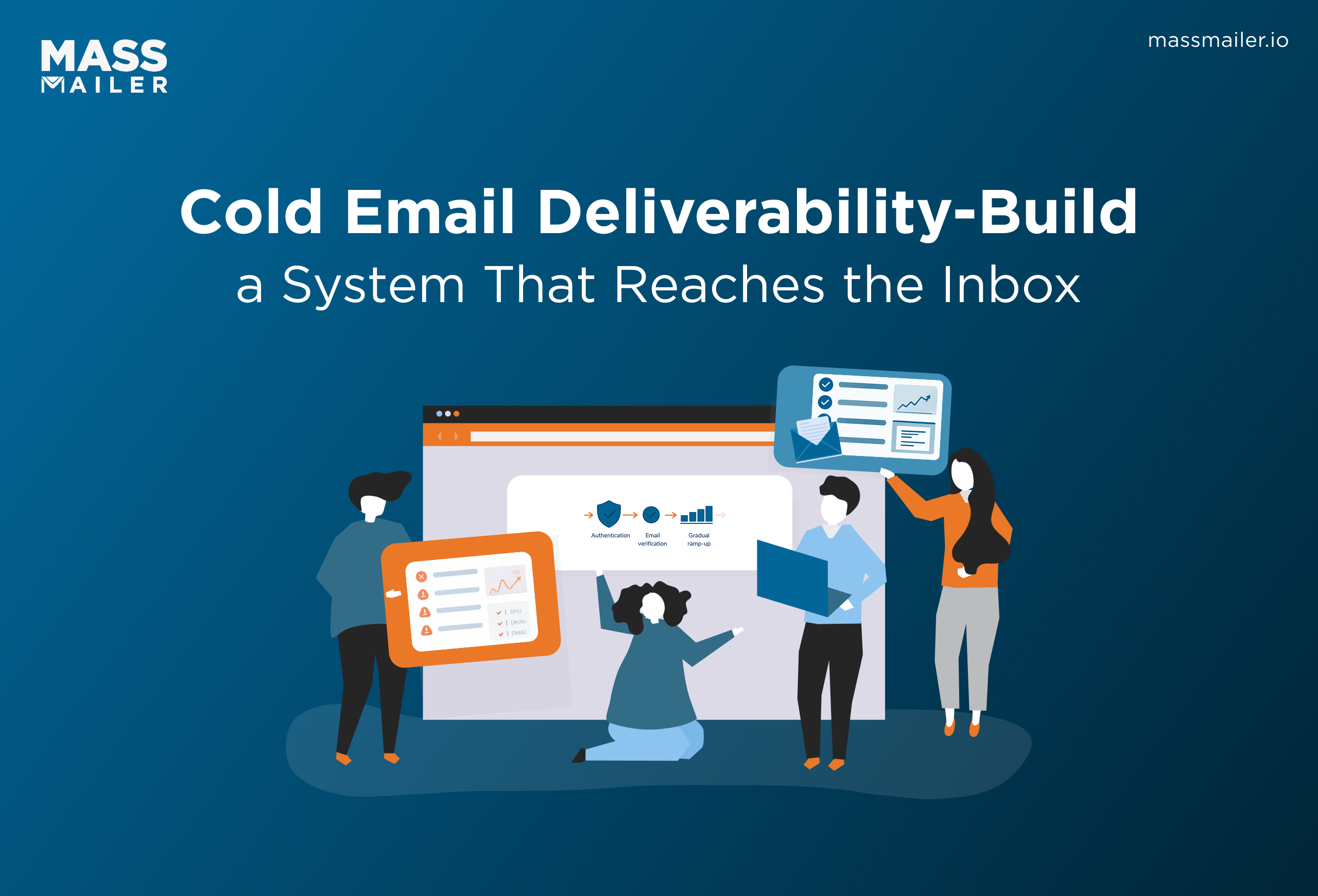
That’s where most teams get stuck with cold email deliverability. They focus on what’s visible, like messaging, while overlooking the factors that actually control outcomes.
According to Validity’s Email Deliverability Benchmark Report 2023, 1 in 6 emails fail to reach the inbox, often due to filtering and sender reputation issues.
The reality is straightforward. Copy alone does not drive deliverability. The way you structure the entire system determines performance.
This guide explains how to build a reliable outbound setup that protects sender reputation, supports safe scaling, and improves the chances of emails consistently reaching the inbox.
Why cold email infrastructure determines deliverability
Cold email performance rarely breaks because of what’s written inside the message. It breaks because of how the sending system behaves behind the scenes. Inbox placement is not a creative decision. It’s a trust decision made by mailbox providers evaluating risk at scale.
Most people underestimate this. They assume inbox placement depends on how persuasive their email sounds. In reality, mailbox providers don’t think like marketers. They think like risk managers.
How mailbox providers evaluate infrastructure patterns
Mailbox providers don’t evaluate a single email. They assess the entire sending environment behind it. Every campaign contributes to a broader pattern that determines whether a sender is trusted or filtered.
They look for consistency across sending domains, inbox accounts, and IP associations. They also track behavioral patterns over time. Sudden spikes in volume, inconsistent sending frequency, or low engagement signals can quickly trigger filtering.
Key signals include:
- Stable sending frequency and volume
- Natural distribution across inboxes
- Positive engagement, like replies
Trust signals add another layer. Proper authentication, domain history, and low complaint rates all reinforce credibility. The core idea is straightforward. Deliverability depends on how stable and predictable the system looks.
Platforms likeMassMailer are built around this principle. They help distribute sending across multiple inboxes, maintain consistent volume patterns, and ensure proper authentication. This creates a controlled environment that aligns with how mailbox providers evaluate trust.
Why poor infrastructure leads to domain and IP reputation damage
Poor infrastructure doesn’t fail immediately. It breaks when volume increases, and patterns start to look unnatural.
One of the biggest issues is using a single domain for all outreach. Every campaign shares the same reputation pool. If one campaign underperforms, it impacts everything tied to that domain.
Overloading inboxes creates another problem. Sending too many emails from a limited number of accounts leads to irregular patterns that spam filters quickly detect.
Lack of segmentation makes this worse. Without separating campaigns, negative signals spread across the entire system instead of staying contained.
The result is predictable:
- Domain reputation declines
- Emails increasingly land in spam
- Performance drops across all campaigns
Once this happens, recovery becomes slow because reputation is built on historical behavior.
A structured system prevents this from happening. Solutions like MassMailer support multi-domain setups, controlled sending limits, and campaign-level segmentation. This helps isolate risk, maintain stable patterns, and protect the sender's reputation as outreach scales.
How IP and domain segmentation improve cold email deliverability
IP and domain segmentation improve cold email deliverability by distributing sending activity across multiple domains, inboxes, and IPs. This reduces risk, maintains consistent sending patterns, and prevents reputation damage from affecting the entire system.
If infrastructure forms the foundation, segmentation is what keeps it stable under scale. By spreading activity across controlled units, sending behavior remains predictable and easier to manage.
The difference becomes clearer when comparing both approaches:
Segmented vs Non-Segmented Sending Setup
| Factor | Non-Segmented Setup | Segmented Setup |
|---|---|---|
| Domain usage | Single domain handles all campaigns | Multiple domains distribute the load |
| Risk exposure | High, one issue affects everything | Isolated issues stay within segments |
| Sending patterns | Often uneven and spiky | Controlled and consistent |
| Performance tracking | Hard to diagnose issues | Clear visibility by segment |
| Scaling ability | Limited and risky | Gradual and predictable |
| Reputation impact | Easily damaged across all campaigns | Contained and manageable |
With segmentation, risk stays contained, performance becomes easier to track, and scaling remains controlled without triggering spam filters.
In practice, this requires structured domain allocation, balanced inbox distribution, and clearly defined sending limits, similar to how systems like MassMailer organize outbound activity across multiple sending identities to maintain consistency and control.
Email sending domains strategy for scalable outbound
A strong email sending domains strategy turns segmentation into a structured, scalable system. Without clear rules, multiple domains can create inconsistency and increase risk.
Step 1: Separate your primary domain from cold email infrastructure
The primary domain should remain dedicated to core business communication, such as customer conversations and internal emails. Cold outreach carries a higher risk due to lower engagement and higher complaint rates, which can negatively impact the domain's reputation.
Keeping outbound activity on secondary domains ensures that any reputation impact from cold campaigns does not affect the primary domain.
Step 2: Choose and register secondary sending domains
Select domains that are:
- Similar to the primary brand domain
- Clean with no prior usage history
- Free from spam-like naming patterns
Instead of concentrating activity on one domain, distribute sending across multiple secondary domains. This keeps volume balanced and prevents any single domain from getting overloaded.
MassMailer approaches this by enabling outbound activity to be spread across multiple sending identities, ensuring that volume is evenly distributed and sending patterns remain consistent. This helps maintain domain health while supporting higher outreach scale without triggering deliverability issues.
Step 3: Set up inboxes across domains for distributed sending
Create multiple inboxes under each domain so you can spread sending activity instead of concentrating it. Each inbox develops its own reputation, which helps maintain stable sending behavior.
Instead of sending large volumes from a single inbox, spreading emails across multiple accounts keeps patterns consistent and reduces the likelihood of triggering spam filters.
Step 4: Configure authentication for each sending domain
Proper authentication is essential for deliverability.
Set up:
- SPF to authorize sending sources
- DKIM to verify email integrity
- DMARC to align domain identity
Misconfigured authentication can lead to immediate deliverability issues, as mailbox providers rely on these signals to verify sender legitimacy.
MassMailer handles this by ensuring SPF, DKIM, and related configurations are properly aligned within Salesforce environments, helping maintain consistent sender identity and improving trust signals for outbound emails.
Step 5: Map domains and inboxes to campaigns or segments
Assign domains and inboxes using a clear structure instead of random usage. This can include mapping by campaign type, target audience, or internal team ownership.
For example, dedicate one domain to a specific industry segment and use another for a different campaign. This separation isolates performance. If one segment underperforms or generates negative signals, it does not affect the entire system.
This approach also improves visibility. Analyze performance at the domain or inbox level so you can identify issues and optimize campaigns without disrupting others.
Step 6: Define sending limits and volume distribution rules
Define sending limits at both the inbox and domain levels to maintain consistency.
Set a daily send limit for each inbox and distribute total volume evenly across domains. This prevents sudden spikes that often trigger spam filters.
Consistent sending patterns are more important than high volume. Gradual increases in activity help build trust with mailbox providers, while uneven or aggressive scaling can lead to filtering issues.
Step 7: Monitor domain performance and rotate when needed
Track key performance signals such as:
- Reply rates
- Bounce rates
- Spam placement indicators
If a domain shows declining performance, reduce its usage instead of increasing volume. Continued sending from a weakened domain can accelerate reputation damage.
Gradual rotation is important. Replacing underperforming domains with new ones in a controlled manner helps maintain overall system stability while ensuring sending patterns remain consistent.
How real prospecting workflows impact email outreach deliverability
Real prospecting workflows impact email outreach deliverability by influencing engagement signals, list quality, and sending behavior. Mailbox providers prioritize how recipients interact with emails, making targeting and campaign structure critical to inbox placement.
Prospect list quality and targeting structure
Deliverability starts with list quality. Sending to invalid or poorly targeted contacts increases bounce rates and reduces engagement, both of which negatively affect sender reputation.
Effective prospecting requires:
- Verified email addresses
- Clearly defined audience segments based on role, industry, or intent
Email verification is a critical step in this process. Identifying invalid, outdated, or risky email addresses before sending helps prevent unnecessary bounces and protects domain reputation.
MassMailer approaches this by verifying email lists within Salesforce, flagging invalid contacts, and reducing bounce rates significantly. This ensures that outreach is directed only toward valid recipients, improving both engagement and deliverability.
Targeted and verified lists lead to higher engagement, which directly strengthens deliverability over time.
Engagement signals and reply-driven deliverability
Mailbox providers evaluate how recipients respond to emails. Positive engagement strengthens sender reputation, while negative signals reduce inbox placement.
Key signals include:
- Replies and ongoing conversations
- Opens and interactions
- Spam complaints and ignored emails
Emails that generate replies are treated as meaningful interactions, while consistently ignored emails signal low relevance.
Tracking these signals is essential for maintaining deliverability. Systems like MassMailer provide visibility into opens, replies, and engagement trends, making it easier to identify which campaigns are generating positive signals and which require adjustments.
Sequence design and follow-up timing strategy
Sequence structure affects how emails are perceived. Poor timing can create unnatural patterns that impact engagement.
Effective sequences maintain:
- Balanced follow-up intervals
- Consistent but non-aggressive frequency
- Logical progression across touchpoints
Well-spaced follow-ups support steady engagement without triggering negative signals.
Campaign monitoring and real-time optimization
Deliverability depends on continuous monitoring and timely adjustments. Performance trends need to be tracked and acted on quickly to prevent reputation decline.
Key metrics include:
- Reply rates
- Bounce rates
- Spam indicators
When performance drops, actions should focus on refining targeting, pausing underperforming campaigns, and improving message relevance.
Centralized tracking systems like MassMailer help consolidate campaign data across domains and inboxes, making it easier to monitor performance, identify issues early, and maintain consistent deliverability.
Conclusion
Cold email deliverability improves when infrastructure, domain strategy, and prospecting workflows operate as a single system. Unstructured sending, overused domains, and inconsistent patterns often lead to declining performance as outreach scales.
The next step is to audit the current setup. Identify where risk is concentrated, review domain and inbox usage, and ensure sending patterns remain stable over time. Fixing these gaps creates a more predictable and trusted sending environment.
MassMailer supports this by enabling multi-domain sending, centralized tracking, and controlled outbound workflows within Salesforce, helping maintain consistency as volume grows.
If deliverability is becoming unpredictable, the issue lies in the system, not the message. Book a demo with MassMailer to see how structured outbound can improve inbox placement and build a more reliable pipeline.
Frequently Asked Questions
1. How do you know if your cold email deliverability is declining?
2. Does using multiple domains affect email outreach deliverability negatively?
3. What role does domain age play in cold email deliverability?
4. How often should you rotate sending domains in cold email campaigns?
5. Can automation tools impact cold email deliverability?
6. What is the difference between inbox placement and deliverability?
Related Blogs

How to Fix Salesforce Emails Going to Spam (2026)
How to Improve Email Deliverability in Salesforce in 2026
How to Avoid Spam Filters in 2026
MassMailer Resources




MassMailer Glossary
About the Author

Siva Devaki 
Siva Devaki is the founder of MassMailer Inc., a tool that helps Salesforce users optimize email marketing. A passionate advocate for email marketing, Siva writes and hosts podcasts on the topic, sharing insights to help businesses drive revenue and enhance customer engagement through Salesforce email automation and tracking.