



Table of Contents
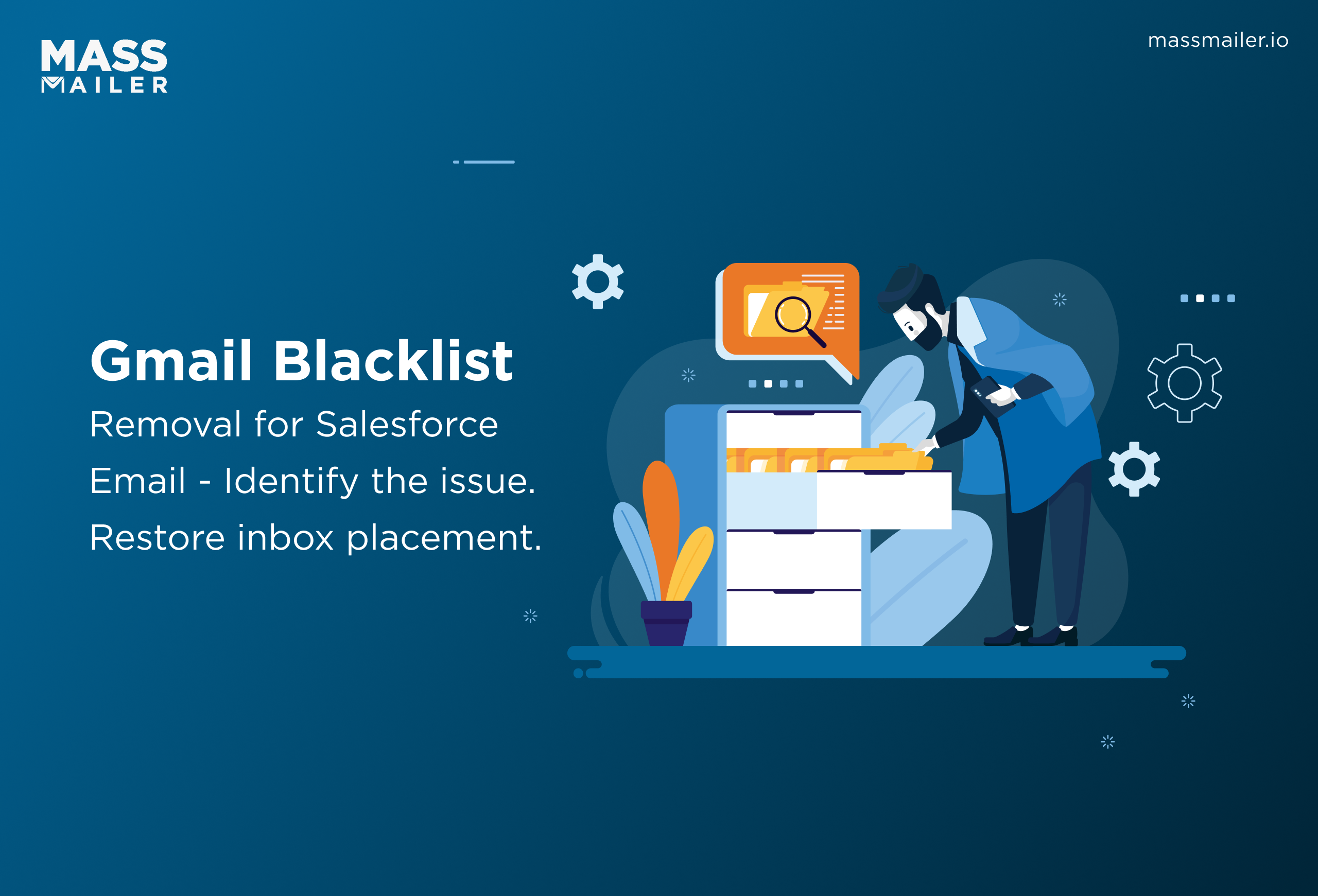
Salesforce email blacklist removal for Gmail becomes critical when Gmail starts filtering Salesforce emails into spam or rejecting them outright. This can quietly damage pipeline, revenue, and customer trust across sales and marketing teams.
This is a high-impact problem because Gmail dominates global inbox usage, with over 1.8 billion active users worldwide, according to Statista. For most B2B teams, that means a large share of prospects, leads, and customers live on Gmail. If your Salesforce emails lose Gmail’s trust, a meaningful portion of your outbound communication may never reach the inbox.
Many teams describe this as being “blacklisted by Gmail.” In reality, Gmail does not operate like traditional public blacklists. It evaluates senders based on IP and domain reputation, SPF, DKIM, and DMARC authentication, engagement behaviour, complaint rates, and sending patterns.
Fixing Salesforce deliverability is not about pressing a delist button. It is about understanding Gmail’s signals, correcting technical issues, improving list quality, controlling send volume, and rebuilding sender reputation over time.
This guide shows you how to do that step by step.
How Gmail blacklisting affects Salesforce email deliverability
Salesforce email blacklist removal for Gmail involves identifying the blocked IP or domain, fixing sender reputation issues, and aligning Salesforce email settings with Gmail’s authentication and sending guidelines to restore inbox placement.
Gmail does not rely on traditional public blacklists alone. It evaluates sender trust using multiple signals, including:
- IP and domain reputation
- SPF, DKIM, and DMARC authentication alignment
- User engagement and spam complaints
- Sending behaviour and volume patterns
Because of this, Salesforce configuration and email practices play a direct role in how Gmail treats your messages.
When Gmail loses trust in Salesforce-driven emails, delivery quality drops. Emails may be delayed, pushed to spam, or rejected altogether. This impacts sales outreach, marketing campaigns, and automated CRM workflows.
What happens when Salesforce emails go to Gmail spam
- Transactional emails (alerts, password resets) may still reach inboxes more reliably
- Marketing and nurture emails are often affected first due to higher volume
- One-to-one sales emails usually perform better than automated sends, but can also degrade over time
- A common scenario is lead follow-ups landing in spam, slowing replies, and stalling deals
Business impact of Gmail spam filtering for Salesforce users
- Lower open and reply rates
- Missed leads and delayed conversations
- Unreliable CRM engagement data
- Weaker campaign performance reporting
Reduced confidence in Salesforce as a revenue channel
How to check if Salesforce emails are blacklisted by Gmail
Before trying to “remove a blacklist,” you need to confirm what Gmail is actually doing with your Salesforce emails. Gmail rarely labels something as a formal blacklist. Instead, it either rejects messages outright or delivers them to spam based on sender reputation and trust signals.
The first step is to determine whether you’re facing a hard block or a spam placement issue, since each requires a different fix.
Identify Gmail-specific blocks vs global blacklists.
Gmail does not publish a single public blacklist like traditional blocklist providers. Its filtering decisions are driven by internal reputation systems tied to:
- Your sending IP and domain
- Authentication setup (SPF, DKIM, DMARC)
- Engagement patterns and complaint rates
- Historical sending behaviour
Know the difference:
- Rejection (hard block): Gmail refuses delivery and returns an SMTP error
- Spam placement: Gmail accepts the email but routes it to the Spam folder
A bounce usually signals a technical or reputation block. Spam placement points to trust, content, or engagement issues.
Tools to diagnose Gmail deliverability issues
- Google Postmaster Tools: Shows domain reputation, spam complaint trends, and delivery errors
- Gmail bounce messages in Salesforce: Review SMTP error codes like 421, 450, 550, or 5.7.x
- Email headers: Check SPF, DKIM, DMARC results, and Gmail filtering signals
Salesforce reports and logs to review
- Email log files to analyse bounces and delivery outcomes
- Bounce management settings to prevent repeated sends to bad Gmail addresses
- Campaign performance metrics, especially for Gmail-heavy segments
If Gmail performance is significantly worse than that of other providers, it’s a strong sign of Gmail-specific filtering or reputation issues.
Step-by-step process to remove Salesforce emails from Gmail blacklist
This recovery plan is designed for Salesforce teams who are seeing Gmail bounces, temp-fails, or Salesforce emails landing in Gmail Spam. The goal is not to “delist” from Gmail. It’s to fix what caused Gmail to lose trust, then rebuild its reputation in a controlled way.
Before you start: confirm what “blacklist” means in Gmail
Gmail issues usually fall into one of two buckets:
- Spam placement: Gmail accepts the email, but it lands in the Spam folder. This is usually reputation, engagement, content, or list quality.
- Hard blocks: Gmail rejects the email with SMTP error codes. This is usually authentication, IP reputation, or policy-related.
Once you know which one you’re facing, follow the steps below.
Step 1: Pause risky sends to stop reputation damage
If Gmail trust is already low, continuing high-volume sending makes recovery slower.
- Pause Gmail-heavy campaigns, sequences, and Mass Emails
- If a full pause isn’t possible, reduce volume sharply
- Send only to recently engaged contacts (last 30–60 days)
- Stop sending to inactive, purchased, or unverified lists
This stabilises your sender reputation before deeper fixes begin.
Step 2: Gather the minimum data you need (quick check)
Collect just enough evidence to avoid guessing.
From Gmail
- One bounce message (if rejected)
- One full email header (if emails land in spam)
From Salesforce
- Sending source (Salesforce Email, Mass Email, Pardot, Marketing Cloud, integrations)
- From the domain and the bounce domain
- Shared IP vs dedicated infrastructure
Step 3: Fix authentication (SPF, DKIM, DMARC)
Gmail prioritises authenticated and aligned senders.
- Ensure one clean SPF record (no duplicates, no lookup overflow)
- Enable DKIM signing and confirm emails are signed
- Set up DMARC (start in monitoring mode, enforce later)
- Make sure the From domain aligns with SPF or DKIM
Authentication issues are one of the most common causes of Gmail blocking.
Step 4: Standardise sender identity and domains
Gmail trusts consistent senders, not constantly changing identities.
Avoid:
- Switching from domains frequently
- Creating new subdomains per campaign
- Mismatched reply-to or bounce domains
Aim for:
- One primary sender domain
- Consistent sender names and mailbox formats
- A dedicated bulk subdomain if needed (example: mail.yourcompany.com), fully authenticated
Step 5: Clean list quality and tighten targeting
List quality is often the real root cause of Gmail spam filtering.
- Remove hard-bounced and invalid addresses
- Stop emailing contacts inactive for 90–180 days
- Focus on engaged Gmail recipients only
- Segment customers, warm leads, and active opportunities
- If your list is old, send a reconfirmation email and drop non-responders
Higher engagement = stronger Gmail trust signals.
Step 6: Simplify email content during recovery
For 7–14 days, reduce anything that looks risky to Gmail.
Prefer
- Plain text or light HTML
- One main link
- Minimal images
Avoid
- Aggressive CTAs
- Too many links or heavy tracking
- Image-only emails or link shorteners
Also:
- Use branded tracking where possible
- Keep a clear sender name
- Include an easy unsubscribe option
- Monitor the reply-to inbox
Step 7: Pace sending, monitor results, and scale safely
Recovery is gradual. Gmail responds to consistent good behaviour over time.
- Start with low daily volume
- Increase sending gradually week by week
- Track bounce rate, spam placement, replies, and complaints
- If metrics worsen, reduce volume again
Simple ramp plan
- Week 1: Highly engaged Gmail users only
- Week 2: Add moderately engaged segments
- Week 3: Expand further if the spam rate stays low
Common reasons Salesforce emails get blacklisted by Gmail
When Salesforce emails start landing in Gmail spam or getting blocked, the root cause is usually a mix of reputation, authentication, list quality, and sending behaviour. Gmail rarely punishes a single mistake. It reacts to patterns over time.
Here are the most common reasons Salesforce-driven emails lose Gmail trust.
1. Poor sender reputation from Salesforce shared IPs
Many Salesforce products send email from shared IP pools. This means your deliverability can be influenced by other senders on the same infrastructure.
How shared IP pools affect Gmail trust
- If other senders generate spam complaints or low engagement, Gmail may downgrade the entire IP pool.
- Even if your own lists are clean, a neighbour's reputation can still impact inbox placement.
Why this matters for Salesforce teams
- You have limited control over IP reputation on shared infrastructure
- Your strongest levers become authentication, engagement quality, list hygiene, and sending consistency
If deliverability is mission-critical and volume is high, moving to dedicated sending infrastructure may provide more control, but it only works if underlying hygiene issues are fixed.
2. Missing or misconfigured SPF, DKIM, and DMARC
Gmail places a heavy weight on authentication alignment. Salesforce emails often run into problems because multiple systems send mail from the same domain.
Why Gmail prioritises authentication
- Confirms the sender is authorised
- Helps Gmail detect spoofing and domain abuse
- Improves trust scoring when alignment is clean
Salesforce-specific authentication pitfalls
- Multiple SPF records are published instead of one
- SPF lookup limits exceeded due to too many sending tools
- DKIM is not enabled in Salesforce or Marketing Cloud
- DMARC is failing because the From domain does not align with DKIM or SPF
Even small misalignments can push Gmail to treat Salesforce emails as suspicious.
3. High spam complaints or low engagement
Gmail learns from user behaviour. If recipients frequently ignore, delete, or mark Salesforce emails as spam, Gmail will reduce inbox placement.
Common Salesforce-driven causes
- Sending to old or purchased lists
- Over emailing inactive leads and contacts
- Bulk campaigns without a clear opt-in
- Sales sequences sent to cold prospects with low relevance
How does this affect Gmail's reputation
- Low opens and replies signal poor sender quality
- Spam complaints carry a long-term negative impact
- Unengaged audiences slowly drag down domain trust
Improving engagement is often more impactful than changing content alone.
4. Gmail sending limits exceeded via Salesforce
Even if Salesforce allows sending, Gmail may flag behaviour that looks like spammy volume patterns.
Where Salesforce teams run into trouble
- Large Mass Email sends to Gmail heavy lists
- Burst sending from sales sequences
- Automated workflows are generating sudden spikes
Why bursts trigger Gmail filters
- Rapid volume increases resemble spam campaigns
- Gmail expects stable, predictable sending patterns
Pacing and warming up volume is critical when sending at scale from Salesforce.
5. Poor list hygiene and repeated bounces
Repeatedly emailing invalid Gmail addresses damages a reputation quickly.
Salesforce-related hygiene issues
- Not removing hard-bounced addresses
- Re emailing contacts with long inactivity
- Importing scraped or outdated lists
- Weak bounce management configuration
High bounce rates signal to Gmail that list acquisition and maintenance are poor.
Salesforce-specific settings to improve Gmail inbox placement
Fixing Gmail deliverability is not only about DNS and reputation. Salesforce has platform-level settings that directly influence how Gmail evaluates your emails. Small configuration mistakes here can quietly undermine inbox placement.
This section focuses on Salesforce native controls that help stabilise sender trust and reduce Gmail filtering.
1. Configure Salesforce deliverability settings correctly
Salesforce has global deliverability controls that determine how outbound email is handled.
Recommended access level
- Set deliverability to All Email (not System Email Only)
- Ensure outbound email is enabled for your environment
Bounce management configuration
- Enable bounce tracking and ensure hard-bounced addresses are not repeatedly emailed.
- Automatically suppress invalid or repeatedly bouncing contacts
- Regularly review bounce reports to identify Gmail-specific issues
Poor bounce handling can lead to repeated sends to invalid Gmail addresses, which damages reputation.
2. Use dedicated sending domains in Salesforce
Using your own branded domain instead of default Salesforce domains improves trust and long-term Gmail reputation.
Benefits of a dedicated sending domain
- Stronger brand recognition in Gmail inboxes
- Better alignment for SPF, DKIM, and DMARC
- More control over sender reputation and identity
Best practice setup
- Use your primary brand domain for one-to-one sales emails
- Use a dedicated subdomain for bulk or marketing emails (example: mail.yourcompany.com)
- Ensure SPF, DKIM, and DMARC align for both domains
This separation protects your core brand domain if marketing campaigns face deliverability issues.
3. Align Salesforce From address, reply to, and authentication domains
Gmail looks for consistency between visible sender identity and technical authentication.
What to avoid
- From address on one domain, DKIM on another
- Reply to domains that differ from the From domain
- Frequent changes to sender email formats
What to aim for
- The domain aligns with the DKIM signing domain
- SPF authorises the same domain used in the From address
- Reply to the mailbox is real, monitored, and consistent
Alignment reduces the risk of Gmail treating Salesforce emails as spoofed or untrustworthy.
4. Manage Salesforce Mass Email and campaign behaviour carefully
Mass Email is one of the most common sources of Gmail filtering.
Risk factors
- Sending to large, unengaged lists
- Repeated campaigns to inactive leads
- High frequency without engagement filtering
Improvement actions
- Limit Mass Email to engaged segments only
- Suppress contacts with no activity in the last 90 to 180 days
- Gradually ramp volume instead of sending in bursts
Treat Mass Email as a reputation-sensitive channel, not a volume engine.
5. Managing Einstein Activity Capture and Gmail sync
If Salesforce is syncing Gmail activity, consistency and identity matter.
Potential trust issues
- Gmail synced emails appear different from Salesforce native sends
- Inconsistent sender patterns between manual Gmail sends and Salesforce sends
- Duplicate or confusing message threads
Best practices
- Keep sender name and signature consistent across Gmail and Salesforce
- Avoid mixing multiple sending identities across tools
- Ensure synced emails come from real, monitored inboxes
Consistency across Salesforce and Gmail interactions reinforces sender trust signals.
How MassMailer helps Salesforce teams improve Gmail deliverability
SPF, DKIM, and DMARC decide whether Gmail will accept your emails. They do not decide whether Gmail will continue to trust them. Once authentication is correct, inbox placement is shaped by behaviour, not configuration.
If authentication is unstable, fix that first through email security, and verify your SPF record before changing anything else. After that point, deliverability becomes an operational problem.
List hygiene that protects sender trust
Gmail does not penalise senders for list size. It penalises them for repeatedly emailing people who do not engage. When inactive contacts keep receiving campaigns, Gmail interprets that as low recipient interest, even if no one clicks “spam.”
MassMailer helps teams enforce list hygiene by automatically suppressing bounces and opt-outs, filtering out long-term non-engagers, and prioritising recipients who have shown recent activity. This turns engagement from a reporting metric into a gating rule for sends.
These practices align with proven email list management principles and directly support sender reputation, where fewer ignored emails lead to stronger inbox trust over time.
Volume and pacing Gmail expects to see
One of the most common deliverability mistakes in Salesforce is inconsistent volume. Large sends after quiet periods often trigger filtering because they resemble burst behaviour Gmail associates with spam.
Experienced teams avoid this by spreading campaigns across days, applying daily caps during recovery or warm-up, and increasing volume only after engagement stabilises.
MassMailer enables this level of control directly inside Salesforce. Teams can pace campaigns instead of blasting them, throttle Gmail-heavy segments independently, and scale volume deliberately rather than reactively.
This approach follows the same logic used in IP warming and domain warm-up, where consistency matters more than speed.
Engagement data as an early warning signal
Deliverability problems rarely appear overnight. They usually start with subtle signals, declining engagement in specific segments, rising soft bounces, or changes in Gmail delivery patterns.
MassMailer exposes these signals clearly inside Salesforce. Instead of relying on campaign averages, teams can review performance by segment, see which suppression rules are actively protecting reputation, and identify trends that suggest risk before inbox placement drops.
This complements email reporting best practices and adds context to open rate tracking, helping teams act early rather than troubleshoot after damage is done.
What this means in practice
When Gmail deliverability slips, the fix is rarely another DNS change. It is usually about sending less to the wrong people, controlling volume instead of spiking it, and letting engagement decide who should receive the next email.
MassMailer helps Salesforce teams apply those rules consistently. Combined with proper sender configuration, it supports a sending pattern Gmail recognises as stable, predictable, and low risk over time.
Conclusion
Salesforce emails landing in Gmail spam or getting blocked can feel like a blacklist problem. In reality, it’s usually a trust, reputation, and sending behaviour issue that builds up over time.
Gmail does not offer a single “delist” button. Recovery comes from fixing authentication, cleaning list quality, controlling send volume, improving engagement, and maintaining a consistent sender identity. When Salesforce teams approach deliverability methodically, results are predictable. Hard blocks can often be resolved within days once technical issues are fixed, while spam placement typically improves over weeks as Gmail sees stable, positive signals.
But fixing deliverability once is only half the job. The real challenge is preventing the problem from coming back. That requires ongoing list hygiene, smart suppression, disciplined pacing, and visibility into Gmail-specific performance.
If Salesforce email is critical to your pipeline, MassMailer helps you protect inbox placement at scale. From cleaner segmentation and automated suppression to better volume control and Gmail performance insights, MassMailer is built to support sustainable deliverability.
Start sending Salesforce emails with confidence.
Get started with your MassMailer trial today and keep your emails where they belong: in the inbox.
Frequently Asked Questions
1. Can Gmail permanently block Salesforce emails?
2. How long does Gmail blacklist recovery take for Salesforce?
3. Does switching IPs fix Gmail spam issues?
4. Are Salesforce Mass Emails more likely to hit Gmail spam?
5. What is the most common cause of Gmail filtering Salesforce emails?
6. Can Gmail blocks happen even if SPF, DKIM, and DMARC are set up correctly?
Start Your Free Trial Today
Experience MassMailer the easiest way to send personalized emails from Salesforce.
Related Blogs
MassMailer Resources
About the Author

Siva Devaki 

Siva Devaki is the founder of MassMailer Inc., a tool that helps Salesforce users optimize email marketing. A passionate advocate for email marketing, Siva writes and hosts podcasts on the topic, sharing insights to help businesses drive revenue and enhance customer engagement through Salesforce email automation and tracking.