


Table of Contents
Picking a marketing automation platform ties up your budget, team, and data for years.
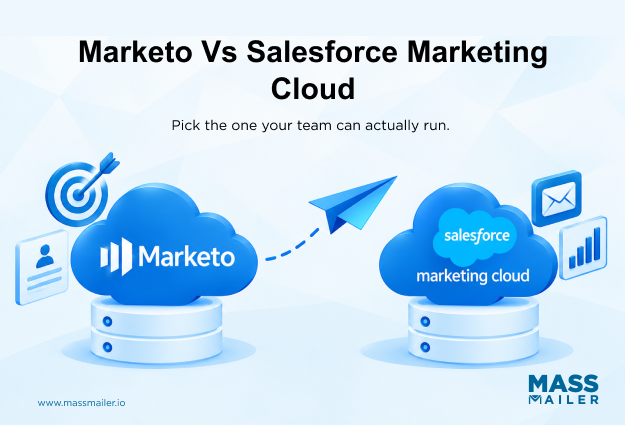
And when it’s Marketo vs. Salesforce Marketing Cloud, the two can look alike on paper. Under the hood, both usually keep your contact data outside your core Salesforce records. As a result, your team must keep two databases in sync.
Here is the core difference. Marketo is built for B2B teams that score leads and nurture them over long sales cycles. Marketing Cloud, on the other hand, suits brands that reach large consumer audiences across email, SMS, and mobile. Once you see this split, the right choice becomes much clearer.
This guide covers features, pricing, CRM integration, and what changes when email runs inside Salesforce.
Marketo vs Salesforce Marketing Cloud: Quick Comparison
Marketo is Adobe’s B2B lead nurturing platform.Salesforce Marketing Cloud, however, is built for high-volume, multi-channel engagement. The table below shows the main Marketing Cloud vs. Marketo differences at a glance.
| Category | Marketo | Salesforce Marketing Cloud |
|---|---|---|
| Owned by | Adobe | Salesforce |
| Best for | B2B lead nurturing and scoring | High-volume, multi-channel customer engagement |
| Typical use case | Long sales cycles with sales handoff | Large consumer audiences |
| Core automation | Smart campaigns and engagement programs | Journey Builder |
| Lead scoring | Built in | Through Account Engagement or Salesforce |
| Channels | Email-first | Email, SMS, push, WhatsApp, ads |
| Salesforce integration | Native two-way sync on a cycle | Same vendor, connection varies by product |
| Pricing | Quote only, four packages, perAdobe's Marketo pricing page | Starting prices from $1,500 per org per month, perSalesforce's Marketing Cloud pricing page |
| Team needed | Marketing operations specialist | Certified admin, often a partner |
In short, the right choice depends on how you market and who runs the platform.
Next, let’s break down each row, starting with features.
Marketo vs Salesforce Marketing Cloud Features
Both platforms automate marketing, but each one leads in a different area. When you compare Marketo vs Salesforce on features, four areas matter most: lead scoring, automation, segmentation, and channels.
Lead Scoring and Lead Management
Lead scoring gives each lead points based on who they are and what they do. Marketo scores behavior, like clicks, page visits, and form fills, plus profile details, like job title and company size. Leads move through lifecycle stages, and sales gets an alert when a lead crosses a set score.
Marketing Cloud Engagement, by contrast, has no built-in lead scoring because it works with contacts and subscribers, not sales leads. On the Salesforce side, scoring and grading sit in Account Engagement or Salesforce itself.
So Marketo beats Marketing Cloud Engagement at passing leads to sales and roughly matches Account Engagement.
Smart Campaigns vs Journey Builder
Marketo’s smart campaigns run on triggers or schedules, while engagement programs send nurture content in streams. Campaigns can also call each other, which is powerful but harder to maintain.
Journey Builder, on the other hand, is a visual canvas where each customer follows a path of waits, splits, and messages across channels.
Both platforms process actions in cycles, so some steps run minutes after the event. And when a Salesforce record change triggers a message, that change must reach the marketing platform first. That’s why teams sometimes send time-sensitive messages withSalesforce Flow email alerts.
Overall, Marketo handles lifecycle logic better, while Journey Builder wins for multi-channel journeys.
Segmentation and Data Model
Marketo’s smart lists filter its single lead database by fields and behavior, and they update automatically. Marketing Cloud, instead, builds audiences from data extensions, often with SQL, or from Data 360 (formerly Data Cloud) segments.
Marketo’s model is easier to learn, while Marketing Cloud’s handles more data types and volume. A marketer can build a smart list alone, but data extensions usually need a data-savvy teammate.
So Marketo suits quick lead segmentation, and Marketing Cloud suits complex data from many sources.
Multi-Channel Orchestration and Personalization
Email is Marketo’s core, with landing pages, forms, web personalization, and webinars around it, but other channels often need add-ons. Marketing Cloud, however, puts email, SMS, push, WhatsApp, and ad audiences in one journey.
Marketo personalizes with tokens and segment-based dynamic content. Marketing Cloud adds scripting and AI for send time and recommendations.
In short, Marketing Cloud leads for cross-channel scale, while Marketo fully covers email-led B2B programs.
Next, let’s see how each platform connects to Salesforce.
Marketo Integration With Salesforce vs Marketing Cloud’s CRM Connection
Both platforms connect to Salesforce, but neither one simply reads your Salesforce records in place. So the real question is where your customer data lives and how it moves between systems. This matters because sync delays, duplicate records, and reporting gaps all come from how the connection is built.
How the Marketo Salesforce Sync Works
Native CRM integration with Salesforce comes with every Marketo package. To set it up, Marketo connects through a dedicated sync user in Salesforce. From there, it keeps its own copy of your data.
Leads, contacts, and campaign membership sync in both directions. Accounts and opportunities, however, flow only from Salesforce into Marketo. The sync also runs in cycles, every five minutes by default, so changes aren’t instant. On top of that, large updates can queue, since Marketo syncs objects one at a time.
There’s one more detail to know. A new lead created in Marketo reaches Salesforce only when a sync step sends it. Beyond that, your team must manage field mapping, sync errors, duplicates, and Salesforce API usage.
Overall, the Marketo Salesforce integration is mature and reliable, but it needs a clear owner.
How Marketing Cloud Connects to Salesforce
The same vendor doesn’t always mean the same database. In fact, Marketing Cloud Engagement is a separate platform. It links to Salesforce through a connector called Marketing Cloud Connect. With it, chosen Salesforce objects are copied into Marketing Cloud on a schedule. Email results are then written back to Salesforce records.
Account Engagement, on the other hand, sits closer to Salesforce. It syncs prospects with leads and contacts through its own connector. Meanwhile, Marketing Cloud Next editions are built natively on the Salesforce platform. So they work on the same records, with no copy needed.
| Product | Where data lives | How it reaches Salesforce |
|---|---|---|
| Marketing Cloud Engagement | Separate platform | Marketing Cloud Connect (scheduled copy) |
| Account Engagement | Separate, but closer to Salesforce | Own connector syncs prospects with leads and contacts |
| Marketing Cloud Next editions | Salesforce platform | Works natively on the same records |
All in all, Marketing Cloud offers the tighter Salesforce fit. Still, how tight it is depends on which product you buy.
Where Both Platforms Leave Gaps for Salesforce Teams
With Marketo and Marketing Cloud Engagement alike, the same person exists as two records. One lives in Salesforce, while the other lives in the marketing platform.
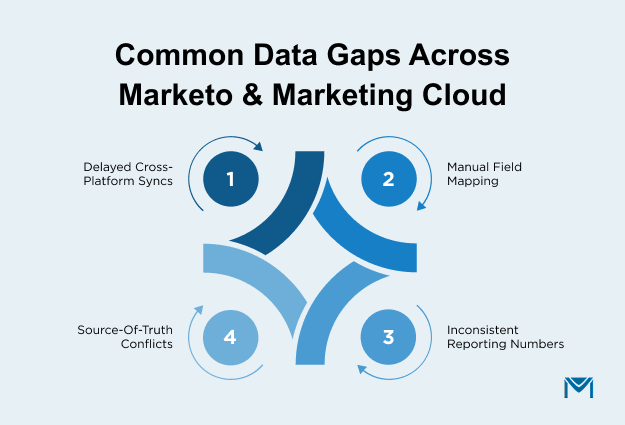
In daily work, that means:
- Updates take time to show up on the other side.
- Someone has to map fields and confirm each sync went through.
- Salesforce reports and marketing reports can show different numbers.
- Your team must pick which system is right when the data doesn’t match.
For full marketing automation, this trade-off is normal and usually worth it.
However, some teams mainly need campaign email, not a full automation platform. For them, a Salesforce-native email app can close this gap altogether. Because it runs inside Salesforce, it works on the records you already have. As a result, there’s no second database to sync, no fields to map, and no lag between systems.
MassMailer is one suchAppExchange app. It sends emails straight from Salesforce Leads, Contacts, and Campaigns. Every send logs to the Salesforce record it came from. Campaign Members also update in the same place, so your reports stay in one system.
MassMailer is built for campaign email, not full marketing automation. So if you need lead scoring models, multi-channel journeys, or consumer-scale messaging, Marketo or Marketing Cloud is the better fit.
Of course, the data setup is only one part of the decision. Next, let’s see what each platform really costs.
Marketing Cloud vs Marketo Pricing and Total Cost of Ownership
When you compare Marketing Cloud vs Marketo on price, the license is only part of the cost. On top of that, the two vendors publish very different amounts of pricing information.
Marketo Pricing
Marketo is sold in four packages: Growth, Select, Prime, and Ultimate. However, Adobe publishes no prices, so every package needs a quote. That quote depends on your database size, the package you choose, and any add-ons.
In terms of limits, Growth includes 10 users and 20,000 API calls a day. Select, Prime, and Ultimate each include 25 users and 50,000 API calls a day.
Salesforce Marketing Cloud Pricing
Salesforce, by contrast, publishes starting prices for its main editions:
- Marketing Cloud Next Growth Edition: $1,500/org/month, billed annually
- Marketing Cloud Next Advanced Edition: $3,250/org/month, billed annually
- Account Engagement+: $1,250/org/month, billed annually
- Engagement+: $2,000/org/month, billed annually
Note that the “+” editions are upgrades for teams already using Account Engagement or Engagement. Add-ons are also priced separately. For example, Personalization is listed at $8,000 and Marketing Intelligence at $10,000 per org per month.
Even so, finalSalesforce Marketing Cloud pricing depends on contacts, messages, and products, so you’ll still need a quote.
Total Cost of Ownership
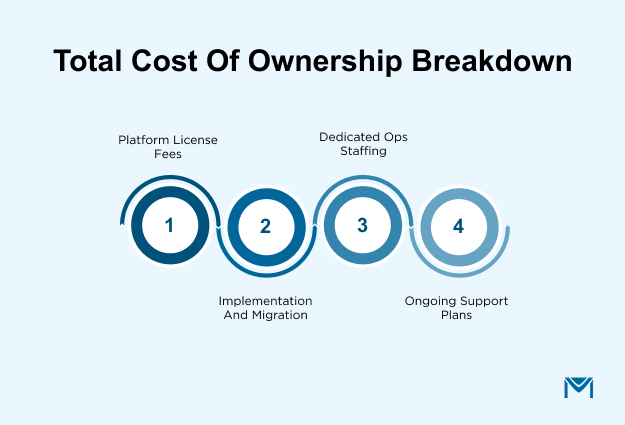
Beyond the license, the total cost breaks into four parts:
- License: the platform fee and add-ons
- Setup: implementation, data migration, and partner fees
- People: a marketing ops specialist for Marketo, or a certified admin and often a developer for Marketing Cloud
- Support: paid plans for faster help, covered in the Customer Support section below
There’s also one cost that neither pricing page shows: sync upkeep. If the platform keeps its own copy of your Salesforce data, someone has to look after it. That means mapping fields, fixing sync errors, and removing duplicates.
Salesforce-native tools such as MassMailer skip this cost because they send from Salesforce records directly. Since these tools focus on campaign email, this saving matters most for teams with that main need.
Overall, for both platforms, people and services often cost more than the license over three years.
| Factor | Marketo | Salesforce Marketing Cloud |
| Pricing model | Quote only | Published starting prices, plus a quote |
| Published prices | None | Marketing Cloud Next from $1,500/org/month |
| Main cost drivers | Database size, package tier | Contacts, messages, products |
| Typical extra costs | Marketing ops specialist, partner, sync upkeep | Certified admin, developer, partner, support plan |
In short, Marketo is often the lower total cost for an email-led B2B team. Marketing Cloud’s cost, on the other hand, makes sense when your team uses its channels and scale.
With the budget picture clear, the next question is who will run the platform day to day.
Ease of Use and Implementation Complexity
Both platforms need trained people to set them up, run them, and fix problems. So in the Marketo vs Salesforce decision, your team’s skills matter as much as the features. Here’s how daily use, setup, and support compare.
Day-to-Day Use and Learning Curve
Marketo puts emails, landing pages, forms, and campaigns in one interface. Once marketers learn smart lists and smart campaigns, they can build programs alone. However, nested campaigns and scoring rules pile up over time.
Marketing Cloud Engagement, by contrast, spreads work across several studios. Audiences and personalization often need SQL and scripting, so changes usually go through an admin or developer. As a result, quick edits take longer.
Overall, Marketo is easier for marketers to learn, while Marketing Cloud handles more complex work.
Implementation Complexity
Marketo setup covers the Salesforce sync, field mapping, scoring, and lifecycle stages. Most teams need a marketing ops specialist, in-house or through a partner. Launch typically takes about 4 to 8 weeks.
Marketing Cloud Engagement setup, on the other hand, covers the data model, connector, sender authentication, and journeys. It also needs clean data first, so most teams hire a partner. Launch typically takes about 8 to 16 weeks. Both are estimates that vary by data quality and scope.
Knowing Salesforce CRM helps either way. Still, Marketing Cloud Engagement is a separate skill with its own certifications.
In short, Marketo is the lighter lift for a small B2B team, while Marketing Cloud needs a larger, more technical one.
Customer Support Options
Marketo includes standard support, with faster responses in paid tiers. Its user community, formerly Marketing Nation, is large and active, and partners handle deep technical fixes.
As perSalesforce’s Marketing Cloud pricing page, Salesforce offers three support levels:
- Standard Success Plan: It’s included with all licenses and covers documentation, Trailhead, and the Trailblazer Community.
- Premier Success Plan: It costs 30% of net license fees and adds expert guidance and 24/7 support for critical issues.
- Signature Success Plan: It’s custom-priced and adds a designated success manager and the fastest responses.
For self-help, use Adobe Experience League for Marketo and Trailhead for Salesforce. Either way, get response-time commitments in writing and budget for the support plan.
All in all, Salesforce has more structured tiers, while Marketo leans on its community and partners. On both sides, fast support costs extra. Next, let’s bring it all together and pick a platform.
Marketo vs Salesforce: Which One Should You Choose?
Marketo vs Salesforce Marketing Cloud comes down to how you market, who runs it, and where your data lives.
Both are strong platforms, but they solve different problems. Choose Marketo if you sell to businesses with long sales cycles and need lead scoring and sales handoff. It suits email-led teams with a marketing ops specialist. On the other hand, choose Salesforce Marketing Cloud if you reach large consumer audiences across email, SMS, push, and ads. It works best with a certified admin or partner.
Either way, write down your database size, channels, and team skills before asking for a quote.
If your contacts already live in Salesforce and you mainly send campaign email, do you need a second database at all? Book a demo to see how MassMailer sends campaign email straight from your Salesforce records.
Frequently Asked Questions
Start Your Free Trial Today
Experience MassMailer the easiest way to send personalized emails from Salesforce.
Related Blogs
Salesforce Alternative Guide: Replace, Fix, or Stay?
HubSpot vs Mailchimp: CRM Depth, Pricing, and Fit
Brevo vs Constant Contact: Pick the Pricing Model Before the Features
MassMailer Resources




MassMailer Glossary
About the Author

Siva Devaki 
Siva Devaki is the founder of MassMailer Inc., a tool that helps Salesforce users optimize email marketing. A passionate advocate for email marketing, Siva writes and hosts podcasts on the topic, sharing insights to help businesses drive revenue and enhance customer engagement through Salesforce email automation and tracking.