




Table of Contents
Are you pricing out Salesforce Marketing Cloud for your team? The feature list looks great. Then you see the real numbers: $25,000 to $200,000 for implementation, on top of licensing that starts at $1,250 a month. The rollout takes 4 to 9 months. And your current Salesforce admin cannot run it without new training or a new hire.
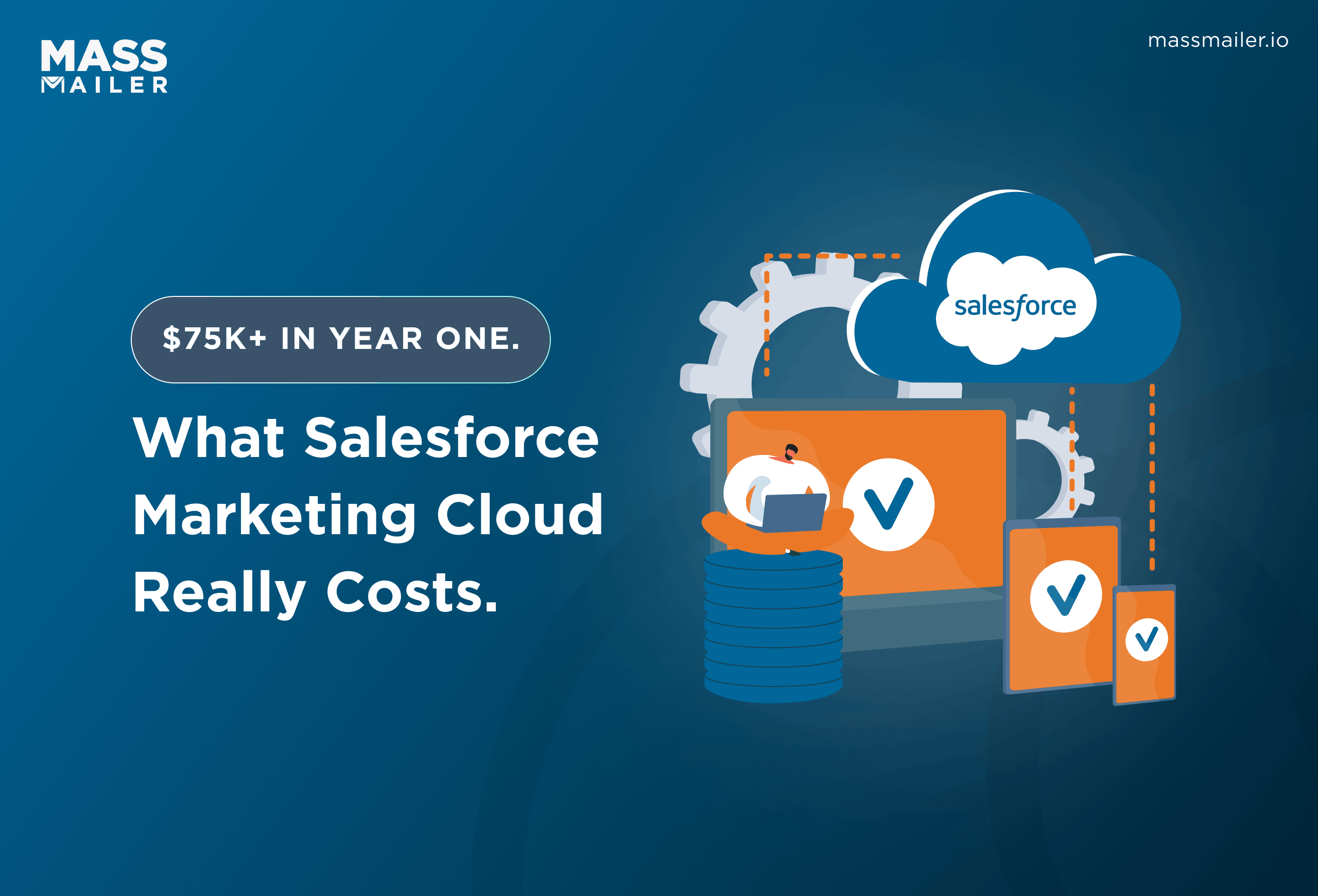
If your team runs campaigns across email, SMS, push, and ads, that spend makes sense. Marketing Cloud is built for that scale. But most Salesforce teams just need to send targeted emails straight from their CRM data. No separate platform, budget, or team.
This guide covers what Marketing Cloud really costs, the staffing gap it creates, and when a native Salesforce email tool is the smarter pick.
What Salesforce Marketing Cloud Is (and What It Requires)
Salesforce Marketing Cloud is a digital marketing platform for running campaigns across email, SMS, mobile push, social media, and digital advertising. It sits inside the Salesforce ecosystem. It does not sit inside your Salesforce CRM.
Here is what catches teams off guard: Marketing Cloud runs on a separate platform with its own login and data model. Your leads and contacts do not sync automatically. You need the Marketing Cloud Connector to push records between the two systems, and that connector requires its own setup and ongoing maintenance.
That separation shapes how your team works day to day. Marketing Cloud stores data in Data Extensions instead of standard Salesforce objects like Leads and Contacts. Campaigns run through Journey Builder and Automation Studio, not Salesforce Flows.
The scripting language is AMPscript, not Apex. So your current Salesforce admin cannot manage Marketing Cloud without specialized training or a new hire.
If your team sends millions of messages across multiple channels, that infrastructure earns its Salesforce Marketing Cloud pricing. If you mainly need to send targeted email campaigns from Salesforce, the cost and complexity deserve a closer look.
What Salesforce Marketing Cloud Actually Costs
Salesforce Marketing Cloud pricing starts at $1,500 per month for the platform license. Add implementation, add-ons, and specialist staffing, and the first-year cost for a mid-market team lands between $75,000 and $170,000.
Here is how to break that number down before you commit.
Salesforce sells Marketing Cloud in two editions, both billed annually at the org level:
| Edition | Monthly Cost | What You Get |
|---|---|---|
| Growth | $1,500/org | Email campaigns, multichannel journeys, forms, landing pages. SMS and WhatsApp as add-ons. |
| Advanced | $3,250/org | Everything in Growth plus AI scoring, path experimentation, unified messaging. SMS and WhatsApp credits separate. |
The base license covers the platform. The add-ons can double it: SMS credits run $10 per 1,000 messages, Salesforce Personalization starts at $8,000/month, Marketing Intelligence at $10,000/month, and Premier Support adds 30% of total license fees per year.
Run the math on a mid-market team: 1.500/month Growthlicense (18,000/year), SMS credits for 50,000 messages (500), and Premier Support at 30% of license (5,400). That is $24,000 before you add Personalization or Intelligence.
One cost most pricing pages leave out: the Marketing Cloud Connector that syncs your CRM data requires its own setup, and most consulting partners bill that separately from the main implementation.
What It Costs to Get Marketing Cloud Running
The license gets you into the platform. It does not get you a working instance. A basic Growth Edition setup runs from $10,000 to $30,000. Complex deployments with custom data models, multi-system integrations, and Journey Builder automation reach $100,000 or more. Skip the consulting partner, and a 4-month rollout stretches to 9.
Then there is staffing. A mid-level Marketing Cloud specialist costs $60,000 to $100,000 per year. Training existing team members runs several thousand dollars per person. Enterprise deployments regularly exceed $400,000 in the first year.
Here is the question that matters: does your team need multichannel orchestration across email, SMS, push, and ads at that price point? If the answer is targeted email campaigns from Salesforce, a native Salesforce email tool starts at $219/month with no implementation cost, no separate platform, and no specialist hire.
The Staffing and Timeline Gap
Salesforce Marketing Cloud requires certified specialists and 4 to 9 months of deployment time that most Salesforce teams do not have. That gap between what your team knows today and what Marketing Cloud demands is where the hidden cost sits.
Here is how to tell if your team is ready. If your admin manages Flows, validation rules, and reports today, they know the CRM side. Marketing Cloud does not use any of that. Sends run through Journey Builder. Data lives in Data Extensions. Troubleshooting deliverability means reading Marketing Cloud-specific logs, not Einstein Activity Capture. The skill sets do not overlap.
Most teams solve this in one of two ways: hire a certified Marketing Cloud specialist or contract a consulting partner for the first 6 months. Either way, your team is not self-sufficient on day one. And the certification path itself takes time: the Marketing Cloud Administrator and Email Specialist exams each require weeks of study on a platform your team has never touched.
What a 4-to-9-Month Deployment Actually Looks Like
A basic Growth Edition deployment takes 4 to 6 months from contract to first campaign. Complex setups stretch to 9 months or longer.
First, your team migrates records from standard Lead and Contact objects into Data Extensions. Then they configure the Marketing Cloud Connector to sync data between the two platforms.
After that come rebuilding email templates in Content Builder, setting up Journey Builder automations, training users, and running UAT cycles. Nothing goes live until every step clears.
During that window, your team runs two systems at once. The old tool handles live campaigns. Marketing Cloud handles setup and testing. That split creates real problems: reporting fragments across platforms, unsubscribes processed in one system do not sync to the other, and contacts risk receiving duplicate messages if both systems send to the same lists.
That staffing and timeline overhead disappears with a Salesforce-native tool.MassMailer installs from the AppExchange, runs inside the same Setup menu your admin already knows, and sends the first campaign the same week. No specialist hire or 6-month rollout.
Salesforce Marketing Cloud vs. Native Email Tools: Side by Side
The biggest difference between Salesforce Marketing Cloud and a native Salesforce email tool is not the feature list. It is where your data lives and who on your team can run the tool. Marketing Cloud copies CRM data into a separate platform that requires a specialist to operate. A native tool sends straight from the Lead and Contact records already in your org.
Here is the comparison of the factors that actually drive the decision:
| Factor | Marketing Cloud | Native Salesforce Email Tool |
|---|---|---|
| Where data lives | Separate platform (Data Extensions) | Inside your Salesforce CRM |
| Monthly cost | From $1,500/org | From $219/org |
| Time to first campaign | 4 to 9 months | Same week |
| Who runs it | Certified MC specialist | Your current Salesforce admin |
| Segmentation | SQL queries on Data Extensions | Salesforce reports and list views |
| Sending capacity | Volume-based contract tier | Past the 5,000/day org cap |
| Channels | Email, SMS, push, social ads, web | Email primary, SMS via add-ons |
| Engagement tracking | Marketing Cloud Analytics Studio | Directly on Lead and Contact records |
When Marketing Cloud Earns Its Price Tag
Marketing Cloud pays off in one specific scenario: your team sends millions of messages across multiple channels, and each contact follows a different path based on real-time behavior. A retail brand running post-purchase sequences across email, SMS, and push that branch on open/click/purchase signals needs that orchestration layer.
So does a company managing separate journeys for onboarding, renewal, and win-back across different business units. Einstein Engagement Scoring optimizes send times per contact based on past behavior. Consent management tracks opt-ins separately for SMS, email, and push. At that scale, the complexity earns its cost.
The catch that trips teams up: Marketing Cloud's power only shows at scale. Below 100,000 contacts or without a true multichannel need, most of that infrastructure sits unused while you still pay for it.
What a Native Tool Gives You Back
The math changes when your primary job is targeted email campaigns from Salesforce. A native tool removes three operational costs at once.
First, your segmentation runs on the reports and list views your team already builds. No SQL. No Data Extension imports. A new segment takes minutes, not a support ticket to your MC specialist.
Second, engagement data lands directly on Lead and Contact records. Your sales team sees opens, clicks, and bounces on the same record they work from every day. No switching platforms to check campaign performance.
Third,drip sequences respond to pipeline changes in real time because they read from the same Salesforce objects that your Flows and automation already update. A contact moves to "Closed Won," and the sequence stops on its own. No Connector lag. No sync delay.
MassMailer sends past the 5,000-per-day org cap and writes every open, click, and bounce straight to the Lead or Contact record. Your admin configures it from Setup.
Top Salesforce Marketing Cloud Alternatives
The most common Salesforce Marketing Cloud alternatives are external platforms that connect to Salesforce through an integration. Each one solves a different piece of the marketing stack, but they all share one structural trade-off.
| Alternative | Best For | Key Trade-Off |
|---|---|---|
| HubSpot Marketing Hub | Teams that want marketing automation with a built-in CRM | Runs its own CRM. Syncing two CRMs creates duplicate records and data conflicts. |
| Adobe Marketo Engage | Enterprise teams with complex lead scoring and nurture programs | Implementation cost and complexity rival Marketing Cloud. Requires its own specialist. |
| Account Engagement (Pardot) | B2B teams already on Salesforce who want lead scoring and nurture | Closer to Salesforce than Marketing Cloud, but still uses its own Prospect objects, not standard Leads and Contacts. |
| Mailchimp | Small teams sending newsletters and basic automations | Salesforce sync is limited and breaks on large lists. No real-time CRM data in campaigns. |
| ActiveCampaign | Mid-market teams that need automation without enterprise pricing | Salesforce integration is an add-on. Contact and deal sync requires ongoing maintenance. |
One pattern runs through every alternative on this list: each one adds a second data layer. Contacts live in Salesforce and in the external platform.Bounce reports generated in one system do not always reach the other. Unsubscribes fall out of sync. Engagement data sits in a dashboard your sales team never checks because it is not on the Lead or Contact record they work from every day.
That gap disappears when the email tool runs inside Salesforce itself.
When a Salesforce-Native Email Tool Fits Better
A native Salesforce email tool fits better than Marketing Cloud when your primary job is sending targeted email campaigns from CRM data. No second platform or data model. No second team to run it.
Here is how to know if that describes your situation:
- Your campaigns are email-focused. You do not need Journey Builder sequences across SMS, push, and ads.
- Your team runs on Salesforce admins, not certified marketing automation specialists.
- You need to send campaigns this quarter, not after a 6-month implementation.
- Your annual email budget sits under $50,000, not in the six figures.
- Your segmentation already works through Salesforce reports and list views.
If three or more of those match, Marketing Cloud's complexity costs you more than it gives back.
What MassMailer Adds Beyond Standard Salesforce Email
Standard Salesforce email caps at 5,000 sends per org per day. MassMailer removes that ceiling and adds the capabilities teams outgrow native sending for.
Email verification validates addresses before a campaign goes out. Bad addresses burn your sender reputation and inflate your bounce reports. Catching them pre-send keeps your deliverability clean.
The template builder is drag-and-drop inside Salesforce. No HTML and no external editor. Templates pull merge fields directly from Lead and Contact records for personalization.
Campaigns run on live Salesforce data, including custom objects.UMass Boston uses MassMailer to reach 16,000 students across enrollment stages, financial aid deadlines, and academic milestones. Their admissions and student success teams segment and send from the same Salesforce objects they already manage. Every campaign targets the right students at the right stage without exporting a single list or syncing to an outside platform.
Dedicated sending infrastructure with IP warm-up support means your sender reputation builds on your own IP, not a shared pool.
See what it looks like on your data.Book a MassMailer demo and send a test campaign from your live Salesforce records in under 30 minutes.
Salesforce Marketing Cloud or a Native Tool: Making the Right Call
Salesforce Marketing Cloud earns its cost when your team sends millions of messages across email, SMS, push, and ads. The orchestration, the AI scoring, and the multichannel journeys justify the budget and the staffing.
Most Salesforce teams do not need that. They need to send targeted email campaigns from the CRM data they already have, managed by the admin they already trust.
That is exactly what MassMailer does. It runs inside Salesforce, uses live Lead and Contact records, and puts engagement data where your sales team actually looks for it.
Schedule a walkthrough with your Salesforce data and see how the cost, staffing, and timeline compare to Marketing Cloud for your team.
Frequently Asked Questions
1. Is Salesforce Marketing Cloud the same as Account Engagement?
2. Can you send mass emails from Salesforce without Marketing Cloud?
3. Does Salesforce Marketing Cloud support custom objects?
4. What is the minimum contract length for Salesforce Marketing Cloud?
5. Can you use Salesforce Marketing Cloud without Salesforce CRM?
6. How many emails can you send per day with Salesforce Marketing Cloud?
Start Your Free Trial Today
Experience MassMailer the easiest way to send personalized emails from Salesforce.
Related Blogs
CRM Email Marketing: How CRM Data Drives Every Campaign Decision
8 Salesforce Marketing Cloud Alternatives Worth Your Budget
B2B Email Marketing Examples That Actually Work
MassMailer Resources


MassMailer Glossary
About the Author

Siva Devaki 
Siva Devaki is the founder of MassMailer Inc., a tool that helps Salesforce users optimize email marketing. A passionate advocate for email marketing, Siva writes and hosts podcasts on the topic, sharing insights to help businesses drive revenue and enhance customer engagement through Salesforce email automation and tracking.