

Table of Contents
Salesforce Marketing Cloud Engagement now starts at $2,000/month, not the $1,250 most comparison guides still quote. SMS credits, push notifications, Journey Builder, and premium support all cost extra. Most mid-market teams spend six figures in year one and barely touch half the platform.
That is why Salesforce Marketing Cloud alternatives keep getting stronger. This guide covers 8 platforms matched by use case, a pricing comparison, when fixing your setup beats switching, and how to migrate.
Quick Verdict: Best Salesforce Marketing Cloud Alternative by Use Case
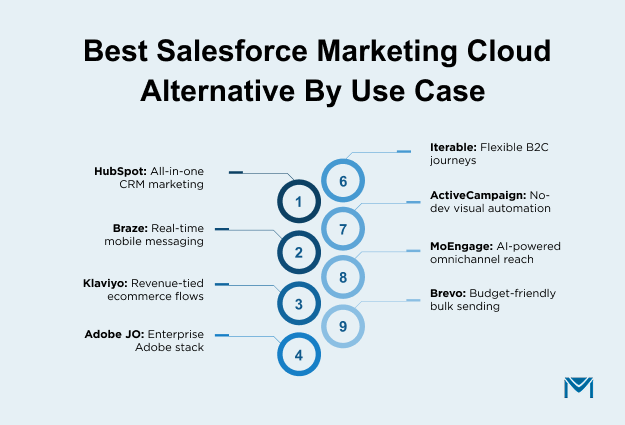
- HubSpot Marketing Hub (from $890/month): best for teams that want CRM and marketing in one platform without a separate SFMC admin
- Braze (custom, typically 60K- 200K/year): best for mobile-heavy B2C brands that need real-time push and in-app messaging
- Klaviyo (free up to 250 profiles, paid from $20/month): best for e-commerce stores that tie every email and SMS flow to purchase revenue
- Adobe Journey Optimizer (custom enterprise pricing): best for enterprises already running Adobe Analytics or Experience Platform
- Iterable (custom, quote-based): best for growth-stage B2C teams that need flexible journey orchestration without SFMC’s learning curve
- ActiveCampaign (from $19/month): best for mid-market teams that need visual automation and CRM without specialist developers
- MoEngage (MTU-based pricing): best for B2C brands that need 16+ channels with AI send-time optimization built in
- Brevo (free tier, paid from $9/month): best for high-volume senders on a tight budget who need email, SMS, and WhatsApp in one place
1. HubSpot Marketing Hub: Best for CRM-Led Marketing and Sales Alignment
HubSpot bundles email, automation, forms, landing pages, and a free CRM into one login. Your marketing department builds campaigns, segments lists, and runs A/B tests without writing SQL or waiting on a developer.
What it replaces in Marketing Cloud
HubSpot covers Email Studio, basic Journey Builder workflows, and the CRM layer. Marketing Cloud assumes you already pay for Salesforce Sales Cloud underneath. HubSpot includes its own CRM for free.
Pricing starts at $15/seat/month (Starter). Professional jumps to $890/month. Enterprise hits $3,600/month.
One common comparison before switching isPardot vs HubSpot. HubSpot connects to Salesforce through a native connector. But running both means two databases and ongoing sync issues.
G2 rating: 4.4/5
Most reviewers praise how fast they can launch campaigns without technical help. The most common complaint is limited customization. Once workflows get complex, the platform starts pushing you toward higher-priced tiers to unlock what you need.
Where it falls short
No native push notifications or in-app messaging. Klaviyo handles e-commerce flows better. At Enterprise pricing, the cost gap with Marketing Cloud shrinks fast.
2. Braze: Best for Mobile-First Customer Engagement
Braze replaces Marketing Cloud’s MobileConnect and Journey Builder for companies where the mobile app is the primary channel. Marketing Cloud can handle mobile messaging. But real-time in-app triggers, Content Cards, and event-based push all take heavy configuration. Braze handles them natively through its SDK and Canvas journey builder.
- Channels: push, in-app, email, SMS, Content Cards, web push
- Pricing: custom, quote-based. No public pricing or free tier.
- G2 rating:4.5/5
Reviewers highlight easy journey building and strong segmentation. The consistent downside: you need developers for SDK setup and event tracking. This is not a self-serve platform for a marketing-only department.
No built-in CRM or loyalty engine. Revenue attribution is weaker than Klaviyo. Pick Braze over Iterable when your app drives most of your customer engagement. Pick Iterable when you need the same cross-channel flexibility, but your engagement is more evenly split across web and mobile.
3. Klaviyo: Best for E-commerce Email and SMS
An abandoned cart flow that takes weeks to build in Marketing Cloud goes live on Klaviyo in under an hour. Once you connect your Shopify, WooCommerce, or Magento store, Klaviyo pulls in purchase history, browsing data, and cart activity automatically. As a result, revenue attribution shows up in every report from day one. Marketing Cloud needs custom data extensions and API work for the same visibility.
Klaviyo is free for up to 250 profiles. Paid plans scale with list size. OnG2, it holds a 4.6/5 rating. Reviewers praise the setup speed most.
However, pricing climbs steeply as your contact list grows. The data model also expects product catalogs and order events. B2B companies without that data will struggle to get value. Pick Klaviyo when store revenue is the metric that matters. Pick HubSpot when pipeline and lead scoring come first.
4. Adobe Journey Optimizer: Best for Adobe Ecosystem Enterprises
Adobe Journey Optimizer is not a simpler alternative to Marketing Cloud. It matches SFMC in complexity, cost, and implementation timelines. The reason to switch is ecosystem fit, not simplification.
Adobe Journey Optimizer replaces Journey Builder and Email Studio for enterprises already on Adobe Experience Platform.
- Channels: email, push, SMS, in-app, web personalization
- Pricing: custom, enterprise-only. No public rate card.
What users say (G2: 4.2/5)
Reviewers praise the real-time profile depth. The recurring complaints are long implementation timelines and the need for Adobe Professional Services or a certified partner just to get started.
Pick Adobe Journey Optimizer when your stack is already Adobe. Pick Iterable or ActiveCampaign when faster deployment matters more.
5. Iterable: Best for Flexible Cross-Channel Automation
Most Marketing Cloud alternatives either push you toward a CRM (HubSpot) or demand heavy developer involvement (Braze). Iterable does neither. Your marketing department gets a visual workflow builder for email, SMS, push, and in-app, and deployment takes weeks instead of the months Marketing Cloud requires.
Who it fits
Companies that send across multiple channels but aren’t centered around a single mobile app. The workflow builder supports branching, behavioral triggers, and A/B testing. No SQL or AMPscript. No certified specialist needed on staff.
Who should skip it
Reporting is Iterable’s weak spot. Built-in analytics cover campaign basics. Anything deeper means exporting to a separate BI tool. Also, if your primary channel is a mobile app, Braze goes deeper on that front. And for pure e-commerce, Klaviyo’s revenue attribution is stronger.
Pricing is custom and quote-based. No free tier. On G2, Iterable holds a 4.4/5. Reviewers call out the workflow flexibility and support responsiveness as standout strengths.
6. ActiveCampaign: Best for Mid-Market Automation Without Salesforce Marketing Cloud Complexity
ActiveCampaign answers a specific question: what if you need Marketing Cloud’s automation depth but not its complexity or cost?
The visual automation builder handles branching logic, lead scoring, site tracking, and conditional content. That puts it closer to Journey Builder than any other tool under $100/month. Pricing starts at $15/month and includes a built-in CRM.
Here’s the tradeoff. ActiveCampaign was built for small and mid-market businesses. On G2, it holds a 4.5/5, but 92% of its reviewers are small businesses. Multi-brand governance, complex permissions, and enterprise-scale segmentation aren’t its strength. If those matter to you, HubSpot or Iterable are better options.
It connects to Salesforce CRM through a native integration. But like every external tool on this list, that means two databases and ongoing sync work.
7. MoEngage: Best for Omnichannel B2C Engagement
MoEngage is strongest in APAC, Southeast Asia, and mobile-first markets where WhatsApp and push notifications drive most customer engagement. North American B2C brands should also evaluate it, but compare against Braze and Iterable first.
The platform replaces Journey Builder, MobileConnect, and Email Studio. AI picks the best channel and send time for each customer automatically. Pricing is based on Monthly Tracked Users. A free tier covers up to 10,000 MTUs.
On G2, MoEngage holds a 4.5/5. Reviewers praise the segmentation depth and funnel analytics. The top complaints are slow performance under heavy load and integration setup complexity with third-party tools.
8. Brevo: Best for Multi-Channel Messaging on a Budget
Brevo is not a Marketing Cloud replacement. It covers maybe 20% of what Marketing Cloud does. That’s the point. Most mid-market companies don’t use the other 80%.
What you get
- Email, SMS, and WhatsApp from one workflow builder
- Volume-based pricing instead of contact-based. Store 100,000 contacts for free.Pay only when you send.
- Paid plans from $9/month for 5,000 emails
- Built-in automation with branching and behavioral triggers
What you give up
- Advanced segmentation. No SQL-level queries.
- Deep analytics. Open and click rates only. Anything further needs external tools.
- Deliverability control. Lower-tier plans run on shared IPs. Sender reputation is pooled.
- Native Salesforce sync.Connecting Brevo to Salesforce needs third-party connectors.
On G2, Brevo holds a 4.5/5 across 2,500+ reviews. Pricing transparency is the top-praised feature. Deliverability is the top complaint.
Brevo works when email and SMS are your only channels, and you need to keep costs under four figures. The moment you need journey orchestration, mobile push, or enterprise-grade reporting, look at Iterable or ActiveCampaign instead.
Before You Switch: When Fixing Your Salesforce Marketing Cloud Setup Is the Better Move
Not every Marketing Cloud problem requires a new platform. Some just need a better setup.
When the Problem Is Implementation, Not the Platform
Ask yourself three questions:
- Does your team use Journey Builder? Or just batch campaigns?
- Does anyone on staff write AMPscript or build relational data models?
- Has anyone optimized the setup since the implementation partner left?
If the answer is no across the board, you’re paying for features nobody configured. A dedicated SFMC admin or a focused re-implementation might solve the problem for less than a migration costs.
Comparing what Pardot and Marketing Cloud each deliver is also worth doing before switching. Account Engagement may already cover your actual needs at a lower price.
The $1,500/Month Salesforce Option Most Reps Don’t Mention
Athread on r/salesforce captures a situation that’s probably familiar. A user at a small commercial real estate firm was already on Sales Cloud. Marketing Cloud was too expensive. They posted asking for affordable alternatives. Nobody on the Salesforce sales side had mentionedMarketing Cloud Growth, a $1,500/month edition that sits directly inside Sales Cloud. Same org. No separate platform. No sync layer.
If Growth doesn’t cover your needs and switching is the right call, here’s how to do it without breaking what’s already running.
How to Migrate From Salesforce Marketing Cloud
A Marketing Cloud migration runs in three stages. Audit what currently sends, rebuild templates and journeys on the new platform, then cut over channel by channel. Both systems run side by side until the new one proves stable.
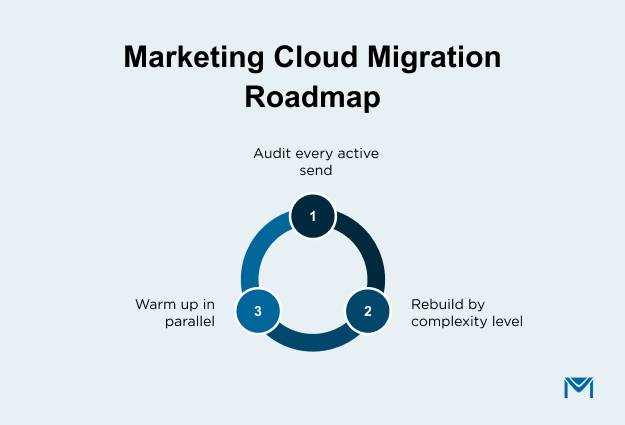
Audit What Currently Sends
List every active journey, triggered email, and transactional message. Note which Data Extensions feed each one. Flag AMPscript logic and custom SQL queries.
Most teams find they actively use less than half their automations. Dead journeys and legacy templates inflate migration scope. Cut them before rebuilding anything.
Migration Timeline by Complexity Level
Triggered and transactional sends cut over in days. These are already API calls. Point them at the new platform, verify delivery, and retire the Marketing Cloud version.
Journey migrations take longer. Rebuild each journey individually. Test it against a small audience. Then shift the full entry source once delivery metrics stabilize. Most mid-market teams finish the send-layer migration within a single quarter.
Complex setups add months. Deep AMPscript logic, multi-step Data Extension automations, and cross-journey dependencies each need untangling first. Expect 3 to 6 months for these environments.
Running Parallel and Warming Up Deliverability
Run both platforms at the same time during transition. Split your audience so each system handles a portion. Monitor bounce rates and complaint rates daily.
Start low on the new platform. Send to your most engaged contacts first. Then increase volume by roughly 25% each week. Sudden spikes from an unfamiliar domain trigger spam filters.
Move your SPF, DKIM, and DMARC records before the first send. Broken authentication tankssender reputation faster than anything else during a migration.
How to Pick the Right Salesforce Marketing Cloud Alternative for Your Team
The right alternative depends on three things: your channel mix, your monthly budget, and your Salesforce dependency.
Start with channel mix. Email-only senders can use ActiveCampaign or Brevo at a fraction of Marketing Cloud’s cost. But once you add push, SMS, or in-app messaging, the shortlist narrows to HubSpot, Braze, Iterable, or MoEngage.
From there, consider your Salesforce dependency. Platforms like Klaviyo and ActiveCampaign sync through connectors, and that works for standard campaigns. However, connectors fall short when segmentation runs on custom objects, or journeys trigger from real-time field changes. In those cases,a native Salesforce email tool removes the sync layer entirely.
Then let budget set the floor. Free tiers from Brevo and Klaviyo serve small lists well. For mid-market, HubSpot Professional starts at $890/month. Meanwhile, Braze and Adobe require custom quotes that typically run higher.
Ultimately, the strongest pick matches what you send today while leaving room for the channels you plan to add next. If high-volume email inside Salesforce is the priority, MassMailer runs natively in your org with no sending limits.
Skip the six-figure platform.Book a demo and send unlimited emails right inside your Salesforce org.
Frequently Asked Questions
1. Can I send marketing emails from Salesforce without Marketing Cloud?
2. What happens to my data when I leave Salesforce Marketing Cloud?
3. Can I cancel my Salesforce Marketing Cloud contract early?
4. What is the difference between Marketing Cloud Engagement and Account Engagement?
5. Will switching from Salesforce Marketing Cloud hurt my email deliverability?
6. Do Salesforce Marketing Cloud alternatives integrate with Sales Cloud?
Related Blogs
B2B Email Marketing Examples That Actually Work
How to Build Salesforce Drip Campaigns That Nurture and Convert
Salesforce Mass Email: How to Enable, Send, and Scale in 2026
MassMailer Resources


MassMailer Glossary