

Salesforce Email Program: Build a CRM-Driven Email Strategy That Scales
This guide walks through every layer—strategy tied to CRM outcomes, live-data segmentation, Flow automation, deliverability management, unified reporting, and where native tools hit their ceiling.
A Salesforce email program is more than a collection of campaigns—it’s a structured, data-driven approach to planning, sending, measuring, and optimizing email directly inside your CRM. When email execution lives alongside sales pipeline, customer records, and engagement history, every message can be targeted, every response can trigger a follow-up, and every result feeds back into reporting that the entire organization trusts. Salesforce provides the foundation through Campaigns, templates, Flow automation, and tracking—but building a program that scales requires understanding where native capabilities end and where AppExchange email solutions begin. This guide walks through every layer of a Salesforce email program, from strategy to optimization.
Defining Your Email Program Strategy Around CRM Data
A Salesforce email program starts with objectives tied to CRM outcomes—pipeline influence, lead nurturing velocity, customer retention, or event registration—not just open rates. Salesforce’s Campaign object is the structural backbone: each email initiative becomes a Campaign with a defined type, status, start/end dates, and expected revenue, making it reportable alongside Opportunities and revenue. As Salesforce’s own email campaign best practices guide emphasizes, a clear objective and a segmented audience are prerequisites before any email is sent.
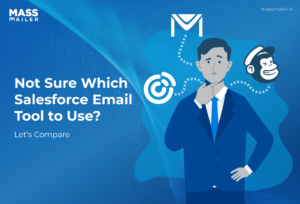
Program planning also means deciding which tools handle each function. Native Salesforce covers individual and List Email sends, basic templates, and Flow-based automation. Marketing Cloud and Account Engagement (Pardot) add journey orchestration and lead scoring at enterprise pricing. For teams that want campaign-level execution, advanced tracking, and drip sequencing without leaving Salesforce, native AppExchange tools like MassMailer fill the middle ground. See our email marketing tool comparison for an architecture-level breakdown of each option.
Audience Segmentation: Reports, Campaigns, and Dynamic Lists
Effective segmentation is where a Salesforce email program separates itself from generic email platforms. Because your audience data already lives in the CRM—industry, deal stage, engagement history, custom fields—you can build segments using Salesforce Reports and List Views without exporting a single record. Add filtered Leads or Contacts to a Campaign as Campaign Members, assign statuses, and your email sending tool targets live CRM records rather than a stale export. The Trailhead Email Marketing Strategies module reinforces that segmentation and personalization are foundational to every send.
Native List Email is limited to 200 recipients per send and cannot target custom objects. For programs that need dynamic segments refreshed automatically via Flow, sends to custom objects (registrants, donors, patients), or suppression logic based on past engagement, tools like MassMailer build lists directly from Salesforce Reports and Campaign Members with no recipient caps. See our Salesforce email campaigns guide for a step-by-step walkthrough of audience setup.
Automation and Drip Campaigns: Flow Builder, Sequences, and Triggers
Automation transforms a Salesforce email program from manual batch sends into a responsive communication engine. Flow Builder’s Send Email action—enhanced in 2025 with attachment support and a rich-text composer—triggers messages on record changes, scheduled dates, or platform events. Record-Triggered Flows with scheduled paths enable multi-step sequences: Email 1 on Lead creation, Email 2 three days later, Email 3 one week later. For full details on automation architecture, see our email automation glossary.
Native Flow automation works well for transactional and notification emails but lacks visual drip builders, engagement-based branching (send Email 3 only if Email 2 was opened), and A/B testing within sequences. Our drip campaign guide covers how to build multi-step nurture sequences using both native Flows and MassMailer’s drip campaign feature—including engagement-based triggers, automatic opt-out handling, and Campaign Member status updates that keep sales and marketing aligned.
Deliverability Management: Authentication, Reputation, and List Hygiene
No email program succeeds if messages land in spam. Salesforce provides foundational email deliverability tools: DKIM key generation, SPF configuration guidance, a Test Deliverability utility, and bounce management that marks hard bounces on Contact and Lead records. The Email Deliverability settings page controls org-wide access levels and compliance headers. Proper authentication setup prevents spoofing and signals legitimacy to receiving servers.
However, native Salesforce sends from shared IP addresses—your sender reputation depends partly on other tenants’ behavior. There is no built-in email verification, no content scanning for spam triggers, and no real-time DMARC monitoring. Bounce handling is basic with no automated suppression lists. MassMailer addresses every gap with dedicated IP infrastructure, Email Monitor for SPF/DKIM/DMARC oversight, built-in email verification, and content analysis tools—all operating natively within Salesforce. Our email marketing guide includes a full deliverability optimization checklist.
Performance Measurement: Tracking, Reporting, and Campaign Influence
A Salesforce email program’s advantage over external platforms is unified reporting. When email tracking data lives on the same records as Opportunities and Cases, you can build Campaign Influence reports that tie email engagement directly to pipeline and revenue. Native Salesforce captures opens and basic delivery status, but detailed metrics—link-level clicks, unique opens, bounces, unsubscribes, and spam reports—require AppExchange tools or Marketing Cloud. For email reporting best practices, see our glossary entry on building actionable dashboards.
Key program metrics include delivery rate, unique open rate, click-through rate, bounce rate, unsubscribe rate, and—most importantly—Campaign-Influenced Opportunity revenue. MassMailer logs every engagement event as a permanent Salesforce record, making all these metrics available in standard reports and dashboards without exports or external analytics. Our email tracking deep dive compares native vs. AppExchange tracking capabilities in detail.
Scaling Your Email Program Beyond Native Salesforce Limits
Every growing Salesforce email program eventually hits native constraints: the 5,000 daily email limit, List Email’s 200-recipient cap per send, object restrictions (no custom object sends), basic templates without drag-and-drop design, and limited A/B testing. Marketing Cloud addresses all of these, but starts at $1,250+/month and requires specialized administration. For a detailed feature and pricing comparison, see our best email marketing tool for Salesforce analysis.
MassMailer provides the scaling layer most programs need: unlimited sending beyond the 5,000 cap, mass email to any standard or custom object, a visual email template builder with drag-and-drop design, drip campaigns with engagement-based branching, A/B testing, dedicated IP infrastructure, and granular tracking—all 100% native to Salesforce with zero external sync. Programs that outgrow native tools but don’t need Marketing Cloud complexity find that MassMailer bridges the gap without adding a second platform to manage.
Your email program should run where your data lives. MassMailer gives you unlimited sending, advanced tracking, drip campaigns, and a visual builder—all native to Salesforce, no middleware required. Schedule a call to see how MassMailer scales your program.
Key Takeaways
- A Salesforce email program ties strategy to CRM outcomes using the Campaign object for structure, reporting, and revenue attribution.
- Segmentation leverages live CRM data—Reports, List Views, Campaign Members—eliminating stale exports and external list management.
- Flow Builder is the recommended automation tool; drip campaigns need visual builders or AppExchange apps for engagement-based branching.
- Deliverability requires SPF, DKIM, and list hygiene—native tools cover basics but lack dedicated IPs, verification, and real-time monitoring.
- Unified reporting is the key advantage—email engagement data on CRM records enables Campaign Influence and revenue attribution dashboards.
- MassMailer scales programs past native limits with unlimited sends, custom object support, drip campaigns, and granular tracking—all inside Salesforce.