


Table of Contents
Pardot is the stronger fit for Salesforce-first orgs that want marketing and CRM on one platform with no third-party connector to manage. Marketo is the stronger fit for teams that need deeper automation and can invest the implementation time and admin bandwidth the platform requires.
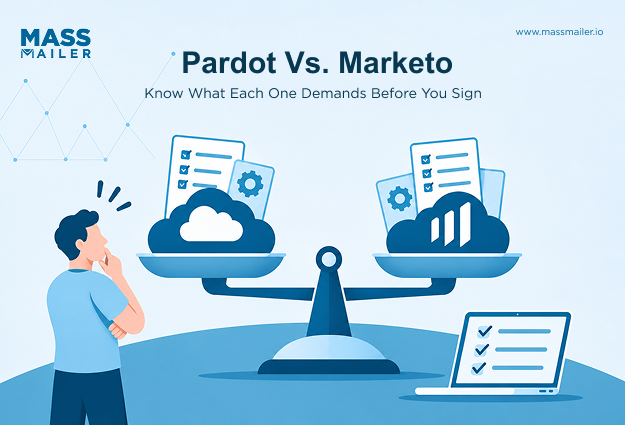
Most teams take months on this decision because both platforms downplay what they demand after the contract is signed. Pardot’s native Salesforce sync is a real advantage, but its automation is split across three features you piece together yourself. Marketo’s smart campaigns are the most flexible in B2B automation, but the platform runs outside Salesforce and needs a specialist most mid-market orgs don’t have on payroll.
Both cost over $15,000 a year fully loaded. The real question is which one your team can realistically run.
Pardot vs Marketo: Feature Comparison
Pardot wins on Salesforce integration and time to value. Marketo wins on automation depth and multi-CRM flexibility. The gap matters because each platform builds automation and qualifies leads in fundamentally different ways.
| Feature | Pardot (MCAE) | Marketo Engage |
|---|---|---|
| Automation | Split across 3 tools you stitch together | Unified Smart Campaigns in one place |
| Lead Scoring | Separate Score (activity) + Grade (fit) | Single combined score |
| CRM Integration | Native Salesforce only, syncs every 2-4 min | Salesforce + Dynamics + others, 5-min batch sync |
| Reporting | Basic native; advanced needs add-on licenses | Revenue Cycle Modeler + 6 attribution models included |
| Pricing (entry) | $1,250/mo + mandatory Sales Cloud license | ~$895/mo, custom at higher tiers |
| Implementation | 4-12 weeks | 3-14 weeks, needs dedicated admin |
| User Ratings | 3.9/5 onG2 (1,805 reviews) | 4.1/5 onG2 (3,264 reviews) |
| Best For | Small B2B marketing teams on Salesforce | Larger ops teams needing multi-channel depth |
Salesforce admins and small marketing teams care less about feature lists and more about which platform creates less work after setup.
Where Pardot Outperforms Marketo
Pardot’s biggest edge is lower platform overhead for Salesforce-first teams. If your org runs Sales Cloud and your marketing team is small, Pardot fits naturally. You stay inside one system instead of managing two.
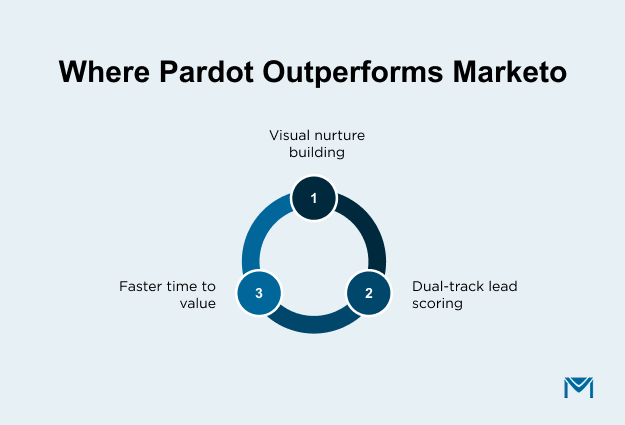
Visual Nurture Building With Engagement Studio
Engagement Studio lets you build nurture programs with a visual drag-and-drop canvas. You pick triggers and add wait steps. You set branching conditions without writing code.
For a small marketing team, that matters. You don’t need a Pardot specialist to launch a drip campaign. Salesforce-familiar admins pick up the builder in a few sessions. The interface follows the same patterns as the rest of the platform.
A typical flow starts when a prospect downloads a whitepaper. Pardot waits three days, then checks if they visited the pricing page. Based on that action, the flow branches into two paths. You build this entire sequence in the visual canvas in minutes.
The trade-off is branching depth. Engagement Studio caps out sooner than Marketo’s Smart Campaigns. If your nurture programs need 10+ decision paths, you’ll feel the limits. For most mid-market B2B nurture sequences, though, the visual builder handles the job.
Dual-Track Scoring That Separates Engagement From Fit
Pardot splits lead qualification into two metrics: Score and Grade. Score is a number that tracks engagement activity. Grade is a letter (A through D) that measures how closely a prospect matches your ideal customer profile.
This separation gives sales reps a clearer signal. A prospect with a high Score and a low Grade might be a student downloading whitepapers. A prospect with a low Score and a high Grade might be an ideal-fit account that needs nurturing first. Sales can tell the difference in seconds without interpreting a composite number.
Marketo rolls engagement and demographic data into one combined score. That approach works when you have dedicated resources building custom scoring models. For smaller teams, Pardot’s two-track system is simpler to configure and easier for sales to act on.
Faster Time to Value for Salesforce-Familiar Teams
Most Salesforce-native teams reach proficiency with Pardot in 2-4 weeks. Marketo’s Expert certification recommends 12-18 months of hands-on experience.
That gap is real when nobody on your team carries the title “Marketing Operations Manager.” Pardot lives inside the Salesforce UI your admin already knows. Trailhead offers structured learning paths at no extra cost. There’s no separate login and no connector to debug.
Campaigns go live sooner. Reporting flows into the same Salesforce dashboards your sales team already checks. The learning curve doesn’t eat your first quarter.
Pardot is the easier platform to adopt. Where it falls behind is the depth of what you can build once campaigns get complex.
Where Marketo Outperforms Pardot
Marketo’s core advantage is automation depth. Where Pardot splits campaign logic across three separate tools, Marketo consolidates everything into one Smart Campaign. That depth comes with a cost: more setup time, steeper learning, and a bigger team to run it.
Smart Campaigns That Consolidate Triggers, Filters, and Actions
A Marketo Smart Campaign holds your entire automation in one place. You define who qualifies, what happens to them, and when it runs. There’s no switching between tools to stitch a workflow together.
This structure pays off when campaigns grow past basic drip sequences. Marketo supports nested programs, multi-level trigger branching, and custom flow steps that connect to external systems.
Pardot’s equivalent requires coordination between automation rules, segmentation rules, and Engagement Studio. Each tool handles part of the logic. That’s manageable for simple campaigns. It turns into a bottleneck when one trigger event needs to score a lead, update a field, assign an owner, and fire a follow-up.
For a Salesforce admin running a small marketing team, though, most of this flexibility goes unused. Smart Campaigns need someone who lives in the platform daily. If that’s not a role your team has, the power sits idle.
Revenue Cycle Modeler and Six Built-In Attribution Models
Marketo ships its Revenue Cycle Modeler (RCM) with standard licensing. You map every stage from first touch to closed deal and see exactly where leads stall. Pardot offers a pre-defined lifecycle report instead, and most teams find it restrictive by comparison.
Marketo also includes six attribution models out of the box: first-touch, lead creation, U-shaped, W-shaped, full path, and custom. You don’t pay extra to measure which campaigns drive revenue.
Pardot’s native reporting covers asset-level metrics like email opens and landing page conversions. Comparable attribution depth requires separate Salesforce licenses for B2B Marketing Analytics and Einstein Attribution. For a small team already managing Salesforce, that means more cost and more configuration on a tighter bandwidth.
Multi-Channel Automation Beyond Email
Marketo coordinates campaigns across email, web, mobile, paid ads, and events from one platform. Pardot is strongest in email and landing pages. Its social media tools have declined, with some users reporting that link previews no longer render properly.
However, Marketo sends from its own infrastructure. Engagement data syncs back to Salesforce through batch processes, not natively. For teams that wantemail integrated directly into Salesforce, that separation adds friction. Every open, click, and reply lives in Marketo first and reaches Salesforce records on a delay.
If your B2B campaigns rely on coordinated outreach across paid, web, and email, Marketo handles the orchestration. If your team needs engagement data inside Salesforce the moment it happens, that batch sync becomes a daily frustration.
Marketo is the more powerful platform. Whether a 3-person marketing team can fully use that power and absorb the cost that comes with it is the next question.
What Both Platforms Actually Cost Over Three Years
Marketo starts cheaper than Pardot at the entry level ($895/mo vs $1,250/mo). Most buyers don’t expect that. However, the total cost flips once you add implementation, staffing, and the Salesforce licenses Pardot requires on top. For a small B2B team, neither platform stays under $30,000 in year one.
Pardot’s Mandatory Salesforce Licenses and Reporting Add-Ons
Pardot’s Growth tier costs $1,250 per month, or $15,000 per year. That’s just the Pardot license. Pardot also requires Sales Cloud Enterprise Edition or higher to run. Sales Cloud Enterprise costs $165 per user per month.
If your org is on Sales Cloud Professional ($80/user/month), you need to upgrade every user before Pardot works. For a 5-person team, that upgrade alone adds $5,100 per year.
Pardot’s native reporting covers basics like email opens and landing page conversions. Advanced multi-touch attribution needs separate Salesforce licenses for B2B Marketing Analytics and Einstein Attribution. Each one adds to the annual bill.
Marketo’s Opaque Contracts and Specialist Staffing Requirements
Adobe does not publish Marketo pricing. Third-party estimates place the Growth tier at 895 - 1200 per month. The Select tier runs 2000 - 4500 per month. All contracts are annual with auto-renewal.
The license is just the entry fee. Standard Marketo implementation runs 20,000 - 40,000. Most deployments also require a dedicated admin or external consultant. A full-time hire costs 50,000- 80,000 per year. A part-time consultant runs 15,000- 25,000 per year.
Year 1 and 3-Year Cost Comparison (5-Person Team)
Pardot’s Year 1 cost for a 5-person team runs 27,000- 34,000, roughly half of Marketo’s 46,000- 80,000, with the gap driven by Marketo’s higher implementation and specialist staffing requirements.
| Cost Category | Pardot (Growth) | Marketo (Growth) |
|---|---|---|
| Annual license | $15,000 | $10,740 to $14,400 |
| Required CRM license | $9,900 (Sales Cloud Enterprise) | Not required |
| Implementation | $2,000 to $9,000 | $20,000 to $40,000 |
| Specialist staffing | Not required at Growth | $15,000 to $25,000 (part-time) |
| Year 1 total | $27,000 to $34,000 | $46,000 to $80,000 |
| 3-year TCO | $75,000 to $85,000 | $100,000 and above |
That spend makes sense when your team runs complex multi-channel campaigns daily. If your core need is email inside Salesforce, the math looks different.
How to Choose Based on Your Stack, Team, and Actual Need
Choose Pardot if your org is committed to Salesforce and your marketing team is small. Prefer Marketo if you need multi-CRM flexibility or deeper automation depth. Choose neither if your actual need is sending email from Salesforce without the enterprise overhead.
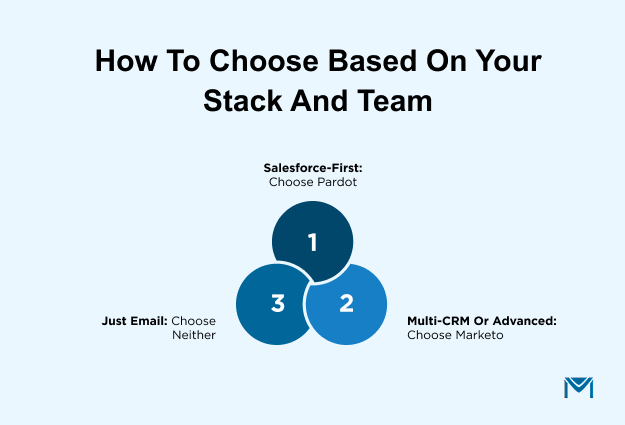
Choose Pardot If Salesforce Is Your Long-Term CRM
Pardot is the right call when your org runs Salesforce and isn’t switching CRMs in the next 3 to 5 years:
- Your data stays in one place with no external database to sync
- Your admin manages one platform instead of two
- Reporting flows into dashboards your sales team already uses
Pardot also fits when your marketing team is small, and nobody has a dedicated marketing ops background. The Engagement Studio builder is easier to learn than Marketo’s Smart Campaigns. Trailhead offers free training paths. Most teams launch their first campaigns within weeks.
Choose Marketo If You Need Advanced Orchestration or Multi-CRM Support
Marketo is the right call when your campaigns span multiple channels and need complex nurture logic. Smart Campaigns give you the automation depth Pardot’s fragmented tools can’t match.
Marketo also fits when your CRM future isn’t locked to Salesforce. It supports Microsoft Dynamics and other CRMs natively. If a CRM migration is even a possibility, Marketo keeps that option open.
If your team is under 5 people with no ops hire planned, the platform will underdeliver. You’ll pay enterprise rates for a fraction of the capability.
When Full Marketing Automation Is More Than You Need
Not every Salesforce org needs a $30,000 automation platform. If your primary gap is email execution inside Salesforce, full marketing automation solves a bigger problem than you have.
Salesforce teams that just need email can start with anative email marketing tool like MassMailer. It installs from AppExchange and runs inside your existing Salesforce org. No annual contract. No external platform to manage.
Before signing either contract, ask one question. Does your team need lead scoring and multi-stage nurture programs? If yes, pick Pardot or Marketo. If your actual need is sending better email from Salesforce, neither platform is the right starting point.
Want to see how Salesforce-native email works without the enterprise overhead?Talk to the MassMailer team and find out if it fits your setup.
Frequently Asked Questions
1. What is Pardot called now?
2. What is Marketo called now?
3. Can you use Pardot without Salesforce?
4. Can I migrate from Pardot to Marketo (or vice versa)?
5. Is Marketo or Pardot better for account-based marketing?
6. Is HubSpot a better alternative to both Pardot and Marketo?
Related Blogs
Salesforce Alternative Guide: Replace, Fix, or Stay?
Marketo vs Salesforce Marketing Cloud: Which One Fits Your Team?
HubSpot vs Mailchimp: CRM Depth, Pricing, and Fit
MassMailer Resources




MassMailer Glossary
About the Author

Siva Devaki 
Siva Devaki is the founder of MassMailer Inc., a tool that helps Salesforce users optimize email marketing. A passionate advocate for email marketing, Siva writes and hosts podcasts on the topic, sharing insights to help businesses drive revenue and enhance customer engagement through Salesforce email automation and tracking.