


Table of Contents
Choosing between Marketo and Eloqua can leave your team paying for features it rarely uses and admin work it did not plan for.
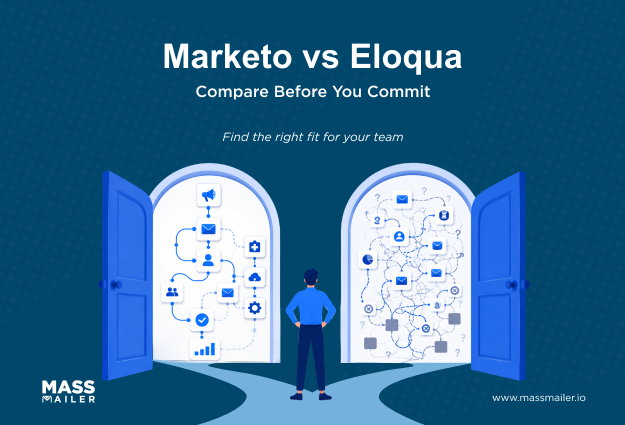
Both platforms serve enterprise B2B marketing, but they differ in campaign design, lead scoring, reporting, Salesforce data flow, setup effort, and long-term cost.
This guide compares those buying factors so you can choose the platform that fits your workflows, team skills, and data setup before you sign a contract.
Marketo vs Eloqua at a glance
Both Marketo and Eloqua serve enterprise B2B marketing teams, but they handle complexity differently. Marketo gives teams flexible campaign rules, lead nurture, AI support, and close ties to Adobe. Eloqua gives large teams more control over complex journeys, data rules, and Oracle-based marketing stacks.
| Buyer question | Adobe Marketo Engage | Oracle Eloqua |
|---|---|---|
| Who is it built for? | B2B teams that need flexible automation across leads and accounts | Large enterprises that manage complex campaigns across teams, regions, or brands |
| How do you build campaigns? | Uses Smart Campaigns, triggers, filters, and nurture programs | Uses Campaign Canvas with visual paths, steps, and decision rules |
| What does AI support? | Supports AI-assisted campaign, content, and marketing work | Uses AI for campaign planning, personalization, and optimization |
| How does lead scoring work? | Supports behavioral, demographic, and account-based scoring | Supports lead scoring, account engagement, and buying-group use cases |
| How does it work with Salesforce? | Syncs data between Marketo and Salesforce | Connects Salesforce through Eloqua's integration app |
| How does it handle data? | Supports custom fields, objects, partitions, and workspaces | Supports complex data structures and governance across large organizations |
| What can you measure? | Tracks campaign, funnel, revenue, and attribution data based on package and setup | Tracks campaign, lead, account, and revenue data based on configuration |
| What can it connect to? | Connects with Adobe products and a broad third-party app ecosystem | Connects with Oracle products and hundreds of external tools |
| What does setup involve? | Requires data mapping, CRM setup, migration, permissions, and testing | Requires data design, integration setup, migration, permissions, and testing |
| How much admin work should you expect? | Admin effort grows with scoring models, automation rules, and integrations | Admin effort grows with complex journeys, data rules, and governance needs |
| How is pricing handled? | Adobe uses custom pricing across Growth, Select, Prime, and Ultimate packages | Oracle uses quote-based pricing for Eloqua |
Adobe's currentMarketo Engage packages vary by limits and capabilities, while Oracle positionsEloqua Marketing Automation around campaign orchestration, lead management, AI, and enterprise integrations. That makes a simple license-price comparison less useful than comparing the exact features, data volume, and support each quote includes.
Marketo vs Eloqua features comparison
The Marketo vs Eloqua features comparison comes down to how each platform handles daily marketing work. Marketo uses rules, triggers, and nurture programs. Eloqua gives marketers a visual Campaign Canvas, multiple scoring models, and more control across large programs.
Campaign automation, B2B nurture, and AI
Both platforms can run multi-step B2B nurture programs. However, they use different methods to build and manage them.
- Marketo: Smart Campaigns use triggers, filters, and actions. Marketers can change scores, move leads, or alert sales when set events occur.
- Eloqua: Campaign Canvas uses a visual flow. Users add emails, forms, waits, actions, and decision steps to shape each journey.
Marketo suits teams that want detailed rule control. Eloqua works well when marketers need to see many journey paths on one screen.
Both vendors also add AI to campaign work. Adobe Marketo Engage uses AI for campaign and data tasks. Oracle Eloqua applies AI to planning, personalization, and optimization.
Eloqua vs Marketo lead scoring and segmentation
The Eloqua vs Marketo lead scoring difference becomes important when your qualification rules grow more complex.
- Marketo: Marketers score leads using behavior and profile data. Smart Campaigns can then route leads, start nurturing, or alert sales.
- Eloqua: Organizations can run several scoring models across products, regions, or business units. It also supports account and buying-group scoring.
If one score works across your sales process, Marketo gives you flexible control. If different teams need separate models, Eloqua offers a clearer fit.
Reporting and multi-touch attribution
Reporting should answer one practical question: can marketing connect activity to pipeline and revenue?
Marketo reports on campaigns, leads, opportunities, funnel stages, and revenue. Adobe also offers Marketo Measure for deeper multi-touch attribution.
Eloqua connects campaign responses with opportunity and revenue data. Marketers can also control how campaigns receive revenue credit.
Before choosing either product, ask:
- Which programs create a qualified pipeline?
- Which touchpoints influence revenue?
- Does the quoted package include the attribution model you need?
Data management, APIs, and integrations
This is where package limits start to matter.
Adobe currently gives Marketo Growth 10 users and 20,000 API calls per day. Select, Prime, and Ultimate each include 25 users and 50,000 daily API calls. Adobe also lists 10 custom data objects with up to 2 million records for Select, Prime, and Ultimate.
Marketo's REST API has separate technical limits:
- 100 API calls per 20 seconds
- 10 concurrent API calls
- 50,000 daily calls for most subscriptions, unless the package or account quota differs
Admins can check the enforced daily quota under Admin > Web Services > API Call Information.
Those limits matter when a warehouse, CRM, event tool, or product database sends large data volumes into Marketo.
Eloqua also uses APIs and custom objects for outside data. When comparing the two, estimate daily record changes and integration traffic before you sign. A connector list alone will not tell you whether your planned data flow fits the platform.
Marketo vs Eloqua pricing and total cost of ownership
Marketo vs Eloqua pricing depends on a custom sales quote. Adobe sells Marketo in four packages but does not list fixed prices. Oracle also does not show a standard Eloqua subscription price. So, buyers should compare the full cost of buying, setting up, and running each platform.
That full cost includes the license, setup, migration, training, admin work, integrations, and paid add-ons.
Marketo vs Eloqua pricing models
Adobe offers Marketo Engage in four packages: Growth, Select, Prime, and Ultimate.
Each package includes different limits and features. Adobe places some account marketing, analytics, sandbox, and attribution tools in higher tiers or paid add-ons.
Marketo Measure also changes by package. Adobe includes it with Ultimate, while lower tiers may require an extra purchase.
Oracle Eloqua also uses a sales-led pricing model. Oracle asks buyers to contact sales instead of showing a fixed subscription price.
Because of this, buyers should request both quotes with the same needs.
| Include in both quote requests | What to confirm |
|---|---|
| Database size | Current contact volume and expected growth |
| Required features | Lead scoring, account marketing, analytics, attribution, and other must-haves |
| Users | Number of marketers, admins, and other users |
| API needs | Expected data volume and connected systems |
| Test environments | Sandbox or separate environments your team needs |
| Support | Standard support, premium help, and partner services |
Adobe's package structure shows why this step matters. Marketo changes feature access and usage limits across Growth, Select, Prime, and Ultimate.
Buyer check: Send both vendors the same requirements. Then compare what each quote includes, leaves out, and charges extra for.
Implementation, training, administration, and ongoing costs
Next, look beyond the software price.
Setup work starts before launch. However, admin work, training, and integration upkeep continue throughout the contract.
Build your Marketo vs Eloqua total cost of ownership around these areas:

- Initial setup: Define your data model, lead stages, scoring rules, user access, and campaign structure.
- Migration: Move contacts, lists, templates, forms, scoring rules, and active nurture programs.
- Integration work: Map fields, connect systems, test data flows, and fix data conflicts.
- Training: Train marketers, admins, analysts, and sales users on the work they own.
- Ongoing admin: Maintain automation rules, user access, data quality, integrations, and campaign settings.
- Extra services: Add consultants, premium support, attribution tools, sandboxes, or other paid features when needed.
Internal skills can change these costs.
A lower software quote may still cost more if you need outside help for setup and support. The same applies when you need a full-time platform admin.
Underuse can also raise the real cost.
A company may pay for advanced attribution, account marketing, or complex journey tools. However, those features add little value if the team rarely uses them.
So, before you compare final proposals, ask one simple question:
Which paid features will we use often enough to justify their setup and ongoing admin work?
That question often reveals costs the license quote hides.
At this point, price only tells part of the story. For Salesforce users, the next issue is how each platform connects with CRM data. Marketo vs Eloqua for Salesforce creates different sync, data access, and admin needs.
Marketo vs Eloqua for Salesforce
Both Marketo and Eloqua use an integration layer to exchange CRM data with Salesforce. Marketo runs ongoing Salesforce sync cycles. Eloqua moves data through its Salesforce Integration App. So, buyers should compare update timing, field mapping, access rules, and error handling.
This difference matters when Salesforce holds the data that controls your audience, sales stage, owner, or message content.
Salesforce integration and CRM data access
Marketo runs outside Salesforce and keeps the two systems in sync. According toAdobe's Salesforce sync documentation, each cycle finishes and then pauses for five minutes. The first full sync can take hours or days. Later cycles process changed records.
Adobe also tracks records waiting to move between Marketo and Salesforce as a sync backlog. A large backlog can delay updates between the two systems.
Eloqua uses itsSalesforce Integration App. Oracle says the app runs scheduled Salesforce imports every 15 minutes. Admins can also start an import when needed.
Therefore, a Marketo vs Eloqua for Salesforce review should check more than connector availability:
- Update timing: How quickly must a Salesforce change reach marketing?
- Field mapping: Which CRM fields need to move between systems?
- Access: Which objects and fields can each platform read or change?
- Failures: Who checks delayed records, failed jobs, or connection errors?
- Ownership: Which system controls a value when both platforms can change it?
Here is the key buying question:
If a Salesforce value changes just before an email runs, will the marketing platform have the latest value?
That can matter for lead status, account tier, owner, product interest, or other fields used for targeting. Marketo and Eloqua both rely on data movement between separate systems.
So, compare the full data path before you choose either platform. The connector name alone tells you very little.
When a Salesforce-native marketing platform makes more sense
A Salesforce-native option creates a different setup.
Instead of copying CRM data into a separate marketing database, the email process can use Salesforce records directly. This model makes sense when Salesforce already controls most targeting, personalization, and trigger data.
MassMailer lets users send to Salesforce Campaign members, Contacts, and Leads from within Salesforce. It also records email results inside the CRM.

That approach deserves a closer look when:
- Salesforce holds most of your audience data.
- Salesforce Campaigns define who receives messages.
- CRM changes trigger many of your emails.
- Email is your main outbound marketing channel.
- Sales and marketing both need engagement data inside Salesforce.
However, Marketo or Eloqua may still fit better when you need broader enterprise marketing automation. That can include complex lead scoring, large cross-channel journeys, or deep marketing attribution. Adobe positions Marketo for omnichannel campaigns, nurture, and multi-step programs.
The next section makes that choice clearer by comparing MassMailer vs Marketo vs Eloqua across architecture, email execution, setup, and cost.
MassMailer vs Marketo vs Eloqua
MassMailer fits Salesforce-first teams that mainly need high-volume email, CRM-based personalization, and automation. Marketo fits teams that need deeper B2B nurture, scoring, and Adobe tools. Eloqua fits large organizations that need complex campaign paths and stronger control across regions or business units.
Salesforce-native vs synchronized marketing architecture
The key difference is where the work runs.
- MassMailer: Salesforce records, Campaigns, and Flows drive email activity inside the CRM.
- Marketo: A separate marketing platform handles nurture, scoring, and wider B2B automation.
- Eloqua: A separate enterprise platform manages Campaign Canvas, scoring, and large journey programs.
That difference matters when Salesforce already holds the data that controls your sends.
Email marketing, automation, personalization, and reporting
MassMailer focuses on Salesforce-based email. Teams can send to Leads, Contacts, and Campaign members while keeping engagement data tied to CRM records.
Marketo covers a broader marketing scope. It adds advanced nurture, lead scoring, account marketing, multi-step programs, and deeper attribution options.
Eloqua goes further into large enterprise orchestration. It supports visual campaign paths, multiple scoring models, and cross-channel programs.
So, match the tool to the work:
- Choose MassMailer when Salesforce drives most targeting and email activity.
- Choose Marketo when marketing needs deeper nurture and scoring.
- Choose Eloqua when several teams or regions need separate campaign and qualification logic.
Implementation complexity and total cost of ownership
Broader platforms also create more setup and admin work.
Marketo often requires scoring design, campaign setup, CRM mapping, training, and ongoing marketing operations ownership. Eloqua adds similar workarounds for journey design, integrations, data rules, and governance.
MassMailer has a narrower scope. For a Salesforce-first team, that can mean fewer systems to configure and maintain.
However, scope matters more than simplicity. If you need complex cross-channel journeys or several scoring models, Marketo or Eloqua may justify the extra work.
Which platform is the best fit for your requirements?
Use your actual workflows to make the final choice:
- Choose MassMailer when Salesforce holds your main customer data, and email is the main channel. It fits CRM-led outreach, Salesforce-based personalization, automation, and record-level engagement tracking.
- Choose Marketo when your team needs advanced B2B nurture, lead scoring, multi-step campaigns, attribution, and close Adobe alignment.
- Choose Eloqua when you manage large programs across regions, products, or business units. It suits teams that need visual campaign control, several scoring models, and Oracle ecosystem support.
Start with the workflows you plan to run during the next 12 months.
If most involve Salesforce records and email, test MassMailer with one real use case. If your plan depends on advanced nurture, buying groups, cross-channel journeys, or deeper attribution, compare Marketo and Eloqua against those exact needs.
That keeps the decision tied to real work rather than feature volume.
Marketo vs Eloqua: How to choose the right platform
The Marketo vs Eloqua choice should start with your real workflows. List what your team needs over the next 12 months, then compare each platform against those needs.
If you need advanced lead scoring, cross-channel journeys, and deep attribution, Marketo or Eloqua may fit.
However, if Salesforce already holds your audience, campaign data, and email triggers, test a Salesforce-native option first.
MassMailer lets you run high-volume email, automation, personalization, and tracking from Salesforce.
Book a MassMailer demo and test one real Salesforce email workflow before you commit to a larger marketing platform.
Frequently Asked Questions
1. Marketo vs Eloqua: Which platform is better for email deliverability?
2. Marketo vs Eloqua: Do you need a dedicated administrator?
3. Marketo vs Eloqua: What contract terms should buyers compare before signing?
4. Marketo vs Eloqua: What should you test in a proof of concept?
5. Marketo vs Eloqua: What should you check before switching platforms later?
6. Marketo vs Eloqua: Which is easier for a small marketing team to manage?
Start Your Free Trial Today
Experience MassMailer the easiest way to send personalized emails from Salesforce.
Related Blogs
HubSpot vs Mailchimp: CRM Depth, Pricing, and Fit
Brevo vs Constant Contact: Pick the Pricing Model Before the Features
Campaign Monitor vs Mailchimp: Pricing, Features, and a Third Option
MassMailer Resources


MassMailer Glossary
About the Author

Siva Devaki 
Siva Devaki is the founder of MassMailer Inc., a tool that helps Salesforce users optimize email marketing. A passionate advocate for email marketing, Siva writes and hosts podcasts on the topic, sharing insights to help businesses drive revenue and enhance customer engagement through Salesforce email automation and tracking.