
Table of Contents
Introduction
Salesforce email struggles to support membership organizations at scale because it lacks flexible campaign execution, lifecycle-based automation, and advanced segmentation across related data. As membership programs grow across chapters, tiers, and renewal cycles, teams face delays in renewal reminders, inconsistent newsletters, and limited visibility into member engagement.
Most organizations already manage member data inside Salesforce. The challenge is execution. Communication workflows become harder to maintain, targeting breaks across complex data structures, and teams rely on manual coordination to keep campaigns running.
To solve this, many organizations extend Salesforce with a native email layer like MassMailer. This allows teams to manage renewal campaigns, segment members using real-time data, and track engagement directly within Salesforce without adding operational complexity.
This guide breaks down where Salesforce email falls short for membership organizations and how teams fix these gaps in practice.
Where Salesforce email falls short for membership organizations (and how teams extend it to scale)
Salesforce email falls short for membership organizations when teams need to manage renewals, dues communication, and ongoing member engagement at scale.
Salesforce handles one-to-one communication well. However, associations must coordinate renewal cycles, dues reminders, member newsletters, onboarding journeys, and chapter updates across thousands of records.
As membership data expands, teams spend more time building recipient groups, scheduling sends, and maintaining automation than engaging members. As a result, renewal notices go out late, updates become irregular, and member retention starts to decline.
To solve this, organizations extend Salesforce with a native tool like MassMailer to run campaigns, manage targeting, and track member interactions directly inside the system.
1. Renewal reminders and dues notifications do not scale easily
Renewal communication in membership organizations depends on precise timing across structured cycles, including pre-renewal notices, grace periods, expiry alerts, and post-lapse re-engagement. These timelines vary by membership models, such as annual, rolling, or anniversary-based renewals, and often differ across chapters or member types.
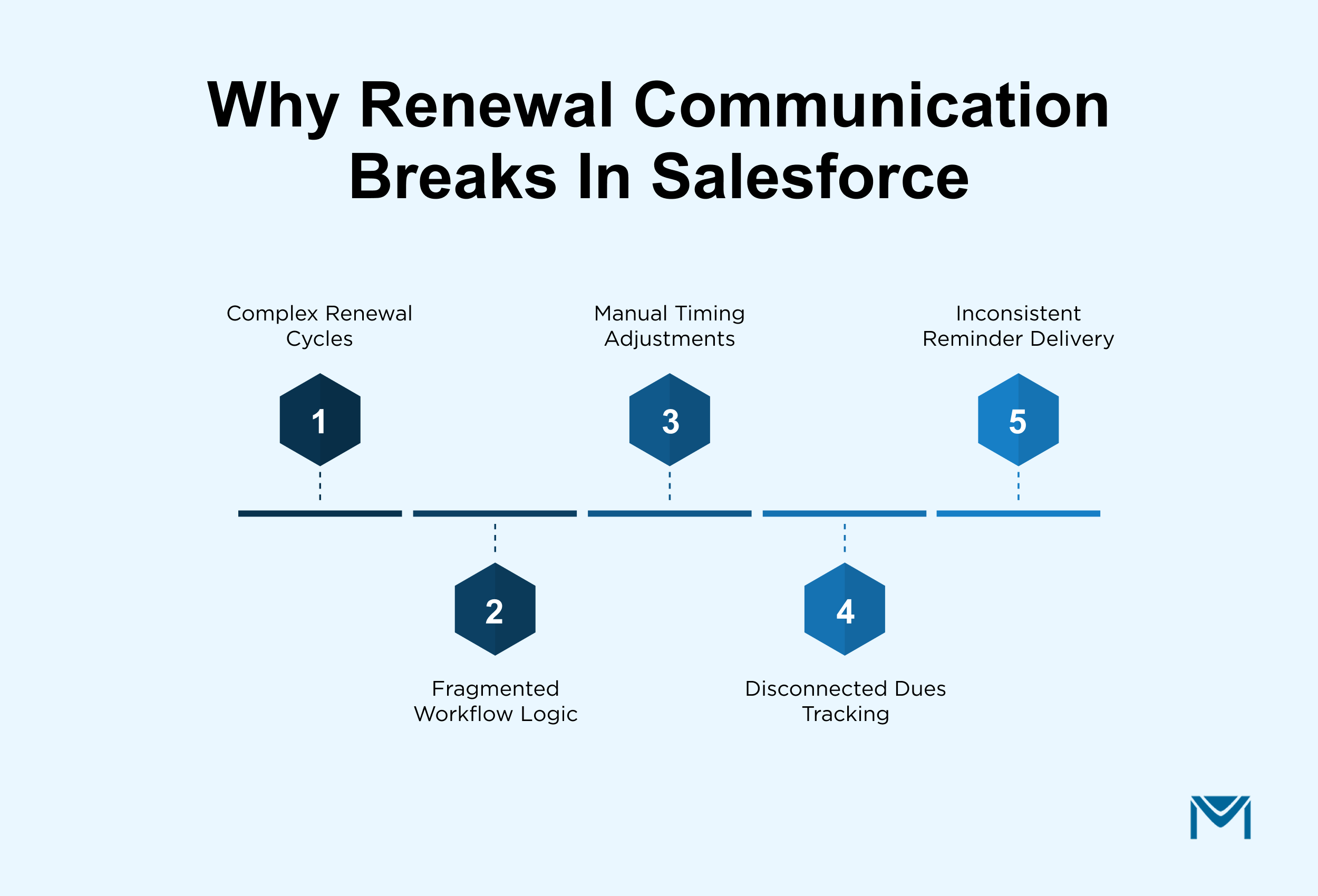
Salesforce stores renewal dates, dues status, and membership tiers across related objects. However, coordinating communication across these variables becomes difficult as renewal logic expands.
In practice, teams deal with:
- Separate workflows for different renewal cycles and membership tiers
- Manual adjustments during grace periods or partial renewals
- Disconnected processes between dues tracking and email communication
- Increasing reliance on workflow email alerts and admin intervention
These workflows often depend on multiple flow conditions and time-based triggers, which become harder to maintain as renewal rules evolve.
As a result, renewal outreach becomes unreliable. Some members receive duplicate reminders, while others are missed entirely due to gaps in timing logic.
This directly affects retention. Members often fail to renew not because of intent, but because reminders do not align with their renewal window. For organizations with large member bases, even small delays in communication can lead to measurable revenue loss.
The limitation is the lack of control over timing and coordination across the membership lifecycle.
How MassMailer solves this
Teams manage renewal communication as structured, lifecycle-driven campaigns using a Salesforce-native email integration like MassMailer.
Instead of maintaining multiple workflow paths, teams define audiences based on renewal stage, such as members approaching expiry, in a grace period, or recently lapsed. These segments reflect real-time membership data, including tier, dues status, and renewal stage.
Teams schedule and repeat campaigns for each stage, ensuring consistent timing without modifying backend logic. This allows renewal communication to align directly with dues cycles while remaining operationally manageable.
MassMailer also captures engagement through Salesforce email tracking, helping teams identify members who did not respond. These members can be included in follow-up campaigns without rebuilding workflows.
In addition, MassMailer improves email deliverability in Salesforce by managing send volume, working within Salesforce email limits, and maintaining list quality through email bounce management. This ensures renewal messages reach members reliably at scale.
As a result, teams gain control over renewal timing and execution. Communication becomes predictable, easier to manage, and aligned with retention and revenue goals across the full membership lifecycle.
2. Member segmentation breaks with complex membership data
Member segmentation in membership organizations becomes difficult when data is distributed across multiple related records. Most organizations manage members through layers such as membership objects, tiers, chapters, committees, and program participation. A single contact may belong to multiple groups or shift between active, renewing, and lapsed states over time.
Salesforce supports this structure at the data level. The limitation appears when teams try to use this complexity for targeted communication.
In practice, teams deal with:
- Membership data is spread across related objects instead of a unified targeting view
- Difficulty selecting audiences based on lifecycle stage, chapter, or program involvement
- Lists are becoming outdated as member status changes over time.
- Limited ability to use related object data inside Salesforce email campaigns
As a result, teams simplify targeting just to execute sends. They rely on static lists or reduce audience criteria, which leads to generic communication. Messages no longer reflect membership type, chapter affiliation, or current lifecycle stage.
This directly impacts engagement. Active members receive irrelevant updates, while renewing or at-risk members are not targeted with the right messaging. Over time, this reduces response rates and weakens member relationships.
The core issue is not data availability, but the inability to use that data effectively for targeting.
How MassMailer solves this
Teams work directly with complex membership data using MassMailer, a Salesforce native app designed to extend how targeting works inside Salesforce.
Instead of flattening data into static lists, teams define audiences using relationships across objects, such as membership tier, chapter, program participation, or lifecycle stage. This allows targeting to reflect how membership data is actually structured.
MassMailer also improves how this data is used within emails. Teams can personalize communication using fields from related records, extending capabilities similar to the Salesforce Lightning Email Builder while supporting multi-object data.
A typical workflow looks like this:
- Define audience criteria based on lifecycle stage or program participation
- Launch a Salesforce email campaign using live Salesforce data
- Personalize content using related membership attributes
- Analyze engagement using Salesforce email reports to refine targeting
Because targeting works directly with existing data structures, teams no longer need to simplify segmentation to execute campaigns. Engagement signals remain tied to member records, improving visibility through systems similar to email logging.
For membership organizations, this makes segmentation usable in practice. Teams can target active, renewing, and lapsed members accurately without rebuilding logic, leading to more relevant communication and better engagement outcomes.
3. Newsletters and member communication lack consistency across chapters and programs
Membership organizations rely on structured communication to keep members informed across chapters, committees, and programs. This includes newsletters, policy updates, event announcements, and community outreach.
As organizations expand, communication ownership spreads across regional teams, chapters, or departments. Each group manages outreach independently, which creates inconsistencies in format, timing, and messaging.
In practice, teams deal with:
- Chapter-level emails that follow different formats and branding standards
- Program updates are sent without a defined schedule or cadence.
- Limited oversight into how communication is executed across teams
- Difficulty managing high-volume outbound email consistently
Over time, this leads to fragmented member experiences. For example, one chapter may send structured monthly newsletters, while another sends irregular updates. Members receive uneven communication depending on their affiliation, which reduces clarity and trust.
This is not just an execution issue. It becomes a governance problem. There is no centralized control over how communication is planned, structured, or delivered across the organization.
As a result, engagement drops. Members expect consistent updates tied to programs, events, and membership value. When communication varies across chapters, it weakens participation and reduces the impact of outreach.
How MassMailer solves this
Organizations solve this by introducing structured communication governance within Salesforce using MassMailer.
Instead of managing communication independently across teams, organizations define standardized campaign frameworks for newsletters, announcements, and updates. This ensures every message follows a consistent structure while still allowing local teams to manage content.
MassMailer extends Salesforce email marketing by enabling controlled execution across departments without breaking alignment.
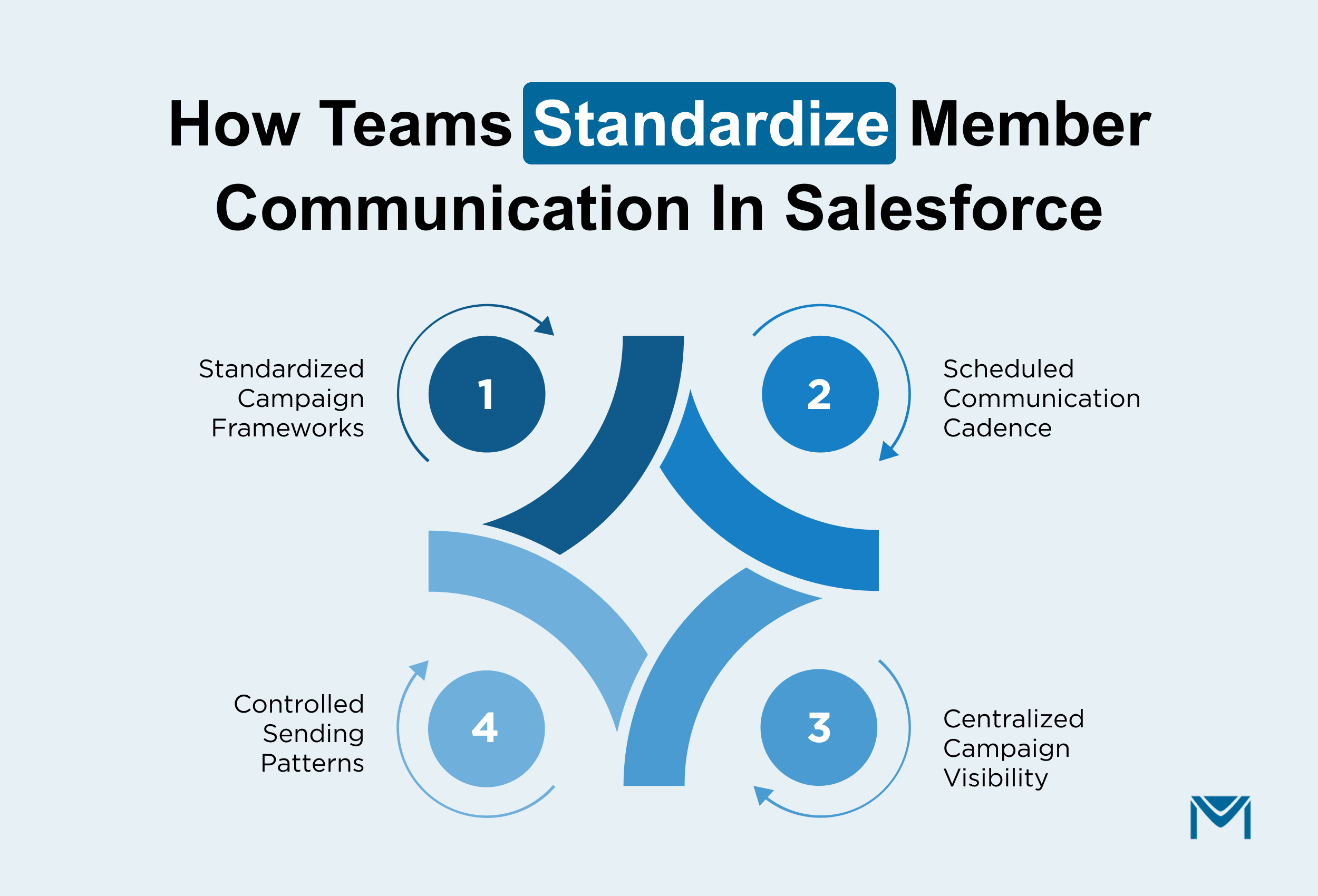
Teams can:
- Standardize newsletter formats across chapters and programs
- Schedule recurring communication with a defined cadence
- Maintain centralized visibility across campaigns.
- Manage sending patterns aligned with Salesforce email deliverability trends.
A typical workflow includes defining a common newsletter structure, assigning ownership across teams, scheduling recurring communication, and reviewing performance trends to refine strategy.
This approach shifts communication from fragmented execution to coordinated governance. Teams no longer rely on manual coordination across departments, and members receive consistent, predictable updates.
For membership organizations, this improves engagement by ensuring communication remains aligned across chapters while scaling efficiently.
4. Manual processes slow down onboarding and ongoing member engagement
Onboarding in membership organizations requires timely, structured outreach across multiple touchpoints, including welcome emails, program introductions, and early participation prompts. This early experience directly influences long-term retention.
In Salesforce, onboarding often depends on backend setup. While this supports basic logic, it becomes difficult to manage as onboarding varies across programs, chapters, and entry points.
In practice, teams deal with:
- Onboarding flows tied to Salesforce workflow automation that require technical setup
- Delays when updates depend on admin or developer availability
- Separate onboarding paths for different membership programs or entry sources
- Limited flexibility when adjusting drip sequence timing or messaging
For example, members entering through different programs require tailored onboarding journeys. Managing these variations through backend logic slows execution and increases dependency on technical resources.
As a result, onboarding becomes rigid. Even small updates, such as refining welcome messaging or adjusting sequence timing, require system changes instead of quick edits. This delays outreach and reduces early member response, when engagement matters most.
The same limitation affects ongoing interaction. Follow-ups, lifecycle messaging, and reactivation efforts depend on system changes rather than direct control.
How MassMailer solves this
Teams run onboarding and engagement as flexible, sequence-driven campaigns using MassMailer.
Instead of relying on backend setup, marketing and membership teams manage outreach directly within Salesforce. This approach builds on Salesforce email automation, but removes the need for technical updates for every change.
Onboarding can be structured around lifecycle stage, join source, or program type. Messaging and timing can be adjusted quickly without modifying backend logic.
A typical workflow includes identifying new members, launching a timed drip sequence, and continuing outreach based on member interaction. Because communication runs as campaigns, updates can be made without disrupting existing processes.
MassMailer also improves visibility through Salesforce activity tracking, helping teams understand how members respond at each step and refine sequences over time.
This shifts control from technical systems to operational teams. For organizations managing multiple programs, onboarding becomes faster, more adaptable, and easier to maintain, leading to stronger early engagement.
5. Limited tracking reduces visibility into member engagement
Membership organizations rely on clear interaction data to understand how members respond to newsletters, event invitations, and renewal communication across chapters and programs.
Salesforce captures basic activity, but it does not provide a clear view of how members engage over time. Teams can see individual actions, but they struggle to connect those actions to membership status, participation, or renewal behavior.
In practice, teams deal with:
- Limited visibility into how members respond across chapters, programs, and events
- Difficulty identifying inactive members before renewal deadlines
- Disconnected data that does not reflect real member activity
- Reporting that shows metrics but does not guide next actions
As a result, teams continue sending communication without knowing what is working. Active members are not prioritized, and at-risk members are missed until it is too late. This directly affects renewals and participation.
The issue is not the lack of data, but the inability to turn it into clear next steps.
How MassMailer solves this
MassMailer helps teams capture and use member interaction data directly inside Salesforce.
It records opens, clicks, bounces, and unsubscribes, and connects this activity to each member record. This allows teams to understand how members respond across different programs and stages of the membership lifecycle.
Instead of reviewing static reports, teams can:
- Identify disengaged members early using patterns similar to Salesforce email open rate
- Prioritize follow-ups based on real interaction behavior.
- Improve data quality using Salesforce email verification.
- Validate contact records through mass verify email in Salesforce
MassMailer also connects engagement activity with membership data, making it easier to see how communication influences renewals, event participation, and program involvement.
This changes how teams act on data. Instead of reviewing past performance, they use real-time signals to decide what to do next.
For membership organizations, this leads to more targeted follow-ups, earlier intervention before renewal deadlines, and stronger member engagement driven by actual behavior.
Case study: how a membership organization scaled communication in Salesforce using MassMailer
Many membership organizations reach a point where Salesforce manages member data well, but communication does not scale with it. Campaigns become harder to execute, segmentation breaks across related records, and newsletters lose consistency across programs.
Sandy Hook Promise faced a similar situation while managing communication across donors, educators, and program participants within Salesforce. As their outreach grew, they struggled to execute high-volume communication in a consistent and repeatable way. Data stored in custom objects could not be easily used for targeting or personalization, and campaign execution required ongoing technical support. This created a gap between the data they had and the communication they needed to deliver.
Instead of changing systems, they extended Salesforce with MassMailer to handle communication directly within their existing workflows. This allowed their teams to build campaigns using Salesforce reports, use data from custom objects for personalization, and run repeatable outreach without depending on technical resources. Non-technical users could create and send newsletters, event updates, and program communication without relying on admin intervention.
As a result, communication became structured and easier to manage at scale. Outreach was consistent across audiences, segmentation reflected real-time Salesforce data, and campaigns could be executed faster without rebuilding workflows. MassMailer became part of their day-to-day operations, helping them maintain high-volume communication without losing control over quality or timing.
For membership organizations, this reflects a common shift. Salesforce remains the system of record for member data, but communication requires an execution layer that can handle scale, structure, and flexibility. Extending Salesforce in this way allows teams to turn membership data into consistent, targeted communication without adding operational complexity.
Conclusion
Salesforce email for membership organizations works when communication is simple. But as renewal cycles, member tiers, chapters, and programs grow, execution becomes the real challenge. Missed reminders, inconsistent newsletters, and limited visibility into member behavior are not system failures. They are execution gaps.
MassMailer closes this gap by turning Salesforce into a complete communication layer. It allows you to run renewal campaigns, segment members using real-time data, manage onboarding journeys, and track engagement without relying on complex workflows or external tools.
If your team is already managing membership data in Salesforce, the next step is not adding another platform. It is improving how you execute communication within it.
See how your current workflows can run more efficiently inside Salesforce. Explore the MassMailer demo and test how it fits your membership communication setup.
Frequently Asked Questions
1. How can membership organizations automate renewal emails in Salesforce?
2. Can Salesforce handle member segmentation across chapters and programs?
3. How do you send newsletters to different member groups in Salesforce?
4. What is the best way to track member engagement in Salesforce emails?
5. How can non-technical teams manage email campaigns in Salesforce?
6. How do you improve email deliverability in Salesforce for large member lists?
Start Your Free Trial Today
Experience MassMailer the easiest way to send personalized emails from Salesforce.
Related Blogs
MassMailer Resources

MassMailer Glossary
About the Author

Siva Devaki 

Siva Devaki is the founder of MassMailer Inc., a tool that helps Salesforce users optimize email marketing. A passionate advocate for email marketing, Siva writes and hosts podcasts on the topic, sharing insights to help businesses drive revenue and enhance customer engagement through Salesforce email automation and tracking.