


Table of Contents
Key Takeaways
- At $15,000 per year minimum, Pardot bundles lead scoring, Engagement Studio, forms, landing pages, and email. Most small Salesforce teams only configure the email.
- Pardot’s Growth tier caps your database at 10,000 prospects for $1,250 per month. The Plus tier jumps to $2,750.
- Campaign execution in Pardot adds 3 to 4 extra steps per send compared to sending directly from Salesforce campaign records.
- Salesforce’s development investment has shifted toward Marketing Cloud Next, leaving Pardot with incremental updates and a widening feature gap.
- If your team primarily sends email campaigns from Salesforce data, a native AppExchange tool covers that need at a fraction of Pardot’s cost.
Introduction
Salesforce Pardot either becomes your B2B team’s pipeline engine or a $15,000-a-year line item for email sends. The strengths and weaknesses of Pardot for B2B marketing depend entirely on how much your team configures.
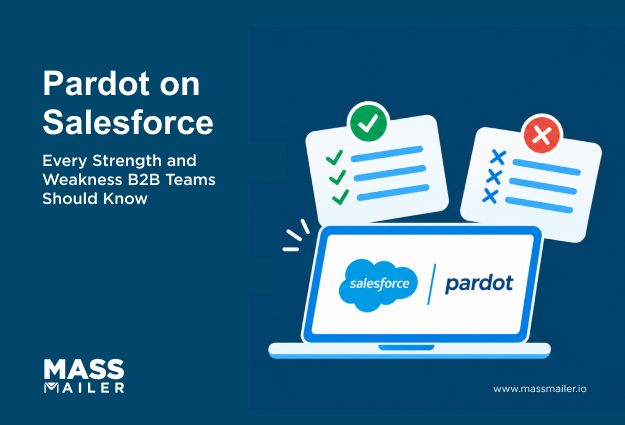
Native CRM sync, lead scoring, and Engagement Studio deliver when your sales cycle involves multiple stakeholders. However, teams that primarily run email campaigns from Salesforce data pay for automation features they never open. Engagement Studio, forms, landing pages, and social connectors sit unused while the invoice renews. A three-person marketing team feels that gap more than anyone.
This guide covers Pardot’s core B2B strengths, the operational weaknesses that surface after setup, the pricing gap, and when a native Salesforce email tool fits better.
Core strengths of Salesforce Pardot for B2B teams
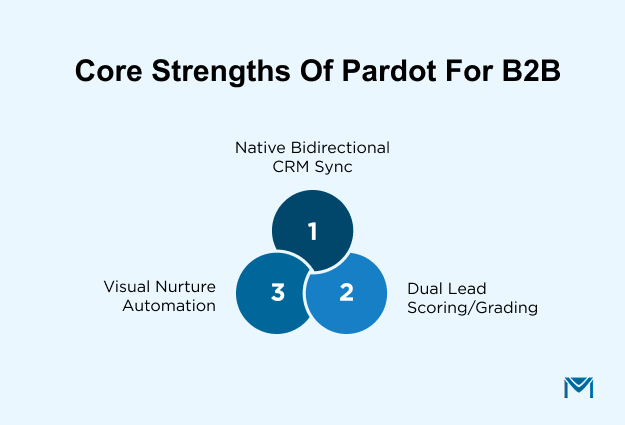
Salesforce Pardot’s core B2B strengths are native CRM integration, dual lead qualification, and visual nurture automation.
- Bidirectional CRM sync eliminates the integration tax: Standalone platforms like HubSpot and Marketo connect to Salesforce through API connectors. Those connectors need maintenance, break during updates, and introduce sync delays. Pardot skips all of that. Instead, email opens, page visits, and form fills appear on the same record your rep works from. For teams sending marketing email from Salesforce, this native sync is the strongest reason to consider Pardot.
- Lead scoring and grading help when your sales cycle needs them: The score tracks prospect engagement like opens, clicks, and downloads. The grade tracks prospect fit like job title, company size, and industry. Together, they tell sales which prospects to call first. This matters most for teams running 3-to-6 month sales cycles with multiple decision-makers. If your team primarily sends campaigns and handles follow-ups directly, scoring and grading may not be worth configuring yet.
- Engagement Studio fits complex nurture sequences: The visual builder lets you create branching paths that adjust based on what each prospect does. No custom code required. Still, the builder delivers value only when your team has time to design, test, and maintain multi-step sequences. A team sending segmented campaigns without long drip sequences will rarely open them.
The question most Salesforce teams face is whether their day-to-day work actually requires all three.
Key weaknesses and limitations of Pardot for B2B marketing
Pardot’s biggest B2B weaknesses are prospect record caps, campaign execution overhead, and reporting gaps. These friction points surface after your team finishes setup and starts running campaigns.
Prospect record caps and Salesforce sending limits
Pardot’s Growth tier caps your database at 10,000 prospects. Every email recipient must exist as a Pardot prospect record, even for a one-time campaign. Once you cross that threshold, the next tier jumps to$2,750 per month. Salesforce also enforces its own 5,000-per-day mass email cap on top of Pardot’s limits.
For a small marketing team sending weekly campaigns to a growing list, these two ceilings compound fast. Teams that need tosend high-volume campaigns from Salesforce data hit this wall within the first year.
Campaign execution takes more steps than most teams expect
Sending one email campaign in Pardot means working across multiple screens and waiting for data to sync to Salesforce. Compared to sending directly from Salesforce campaign records, this adds 3 to 4 extra steps per send. For a team running 8 to 10 campaigns per month, those extra steps cost hours of admin work.
Across650+ Capterra ratings, implementation complexity ranks among the most cited pain points. Even routine tasks require more setup than expected. The email builder itself is functional but limited. Anything beyond a basic template requires custom HTML and a developer.
Reporting gaps between Pardot and Salesforce CRM
Pardot’s base reporting does not flow into standard Salesforce dashboards.Capterra reviews consistently mention this as one of the platform’s weakest areas. The B2B Marketing Analytics add-on closes some of that gap. However, Salesforce locks it behind thePlus tier at $2,750 per month.
For teams on the Growth plan, marketing data lives in Pardot while sales data lives in Salesforce. Instead of one view, your team checks two separate platforms to answer a single question about campaign performance.
Pardot’s product direction and what it means for B2B teams
Pardot is stable and fully supported in 2026. However, Salesforce’s development investment has shifted toward Marketing Cloud Next, its newer AI-first platform. For teams evaluating Pardot today, three things shape the long-term picture.
- The platform is not being discontinued: Salesforce still sells Pardot, ships updates, and added consent sync with Marketing Cloud Next in the Summer 2026 release. Existing implementations continue to work as expected.
- The pace of new features has slowed: Marketing Cloud Next receives the majority of Salesforce’s marketing R&D. Pardot gets incremental refinements. HubSpot and Marketo ship new capabilities faster, and the gap widens with each release cycle.
- The newer editions add capability and complexity together: Account Engagement+ editions now bundle a Marketing Cloud Next license. For a small marketing team, this means learning a second platform on top of Pardot. AI-powered segmentation and two-way messaging require that second platform. The bundled license adds capability and complexity at the same time.
If your team plans to use Pardot for two or more years, factor this trajectory into the decision. A platform that receives slower investment creates risk for teams locked into annual contracts.
Pardot pricing vs. actual feature usage in B2B
Most B2B teams evaluating Pardot already pay for Salesforce CRM.Pardot adds a minimum of $15,000 per year on top of that existing spend.
Before the first campaign goes out, your team absorbs two costs the license price does not show.
First, Pardot setup takes weeks to months. Scoring rules, nurture tracks, and CRM field mapping all need configuration before your first send. Your team or a paid consultant handles that work.
Second, the configuration work does not stop after launch. Scoring models need tuning as your pipeline changes. Nurture sequences need updates as your messaging evolves. Small teams without a dedicated Pardot admin carry this load alongside their daily campaign work.
Anative Salesforce email tool installs from the AppExchange and sends the first campaign the same day. No implementation project. No separate annual license. For a three-person marketing team, the gap between the two paths shows up in both cost and time-to-first-send.
This cost gap shapes the decision between Pardot and a native email tool.
When to choose Pardot vs. a native Salesforce email tool
Choose Pardot when your B2B sales cycle needs lead scoring, grading, and multi-step nurture automation. Choose a native Salesforce email tool when your primary need is campaign execution from CRM data.
Pardot fits your team when
- Your sales cycle runs 3 to 6 months with multiple decision-makers at the table.
- Lead scoring and grading drive how your team hands prospects to sales.
- Your marketing team builds and maintains branching nurture sequences in Engagement Studio.
- Campaign attribution reporting tied to Salesforce opportunities is a core requirement.
A native Salesforce email tool fits better when
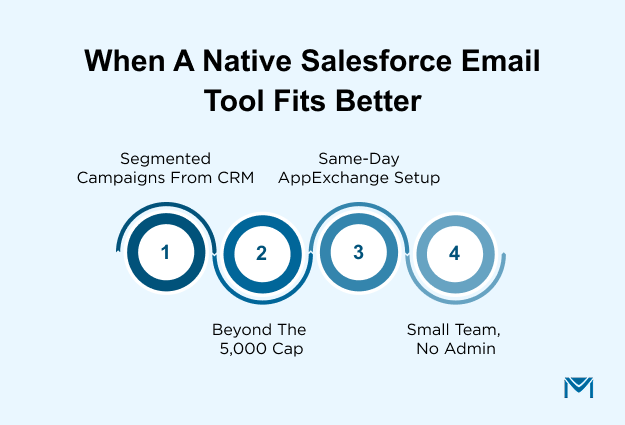
- Your primary need is sending segmented campaigns from Salesforce contacts and leads.
- You need to send beyond the 5,000-per-day mass email cap without switching platforms.
- Same-day setup from the AppExchange matters more than a multi-month implementation.
- Your team has 1 to 5 people and no dedicated marketing automation admin.
In practice, the overlap between these paths is smaller than most evaluation guides suggest. Pardot is a marketing automation platform built for complex sales cycles. A native email tool is asending engine built into Salesforce. These serve different jobs.
Most small marketing teams evaluating Pardot need the sending engine more than the full automation suite. For teams on this path, MassMailer handles email execution inside Salesforce. No separate platform or connector. No implementation project.
If this path fits your team,see how it works with your Salesforce data.
Frequently Asked Questions
1. Does Pardot require Salesforce CRM?
2. Is Pardot worth it for small B2B teams?
3. How does Pardot compare to HubSpot for B2B marketing?
4. Can Pardot be used for B2C marketing?
5. How long does Pardot take to implement?
6. What Salesforce license do you need for Pardot?
Start Your Free Trial Today
Experience MassMailer the easiest way to send personalized emails from Salesforce.
Related Blogs
Best Constant Contact Alternative for Salesforce (2026 Guide)
iContact Alternative for Salesforce: Why MassMailer Fits Better
MassMailer Resources



About the Author

Siva Devaki 
Siva Devaki is the founder of MassMailer Inc., a tool that helps Salesforce users optimize email marketing. A passionate advocate for email marketing, Siva writes and hosts podcasts on the topic, sharing insights to help businesses drive revenue and enhance customer engagement through Salesforce email automation and tracking.