

MassMailer vs Constant Contact
Native Salesforce Email vs Constant Contact: Send Directly from Salesforce Without Connector Hassles

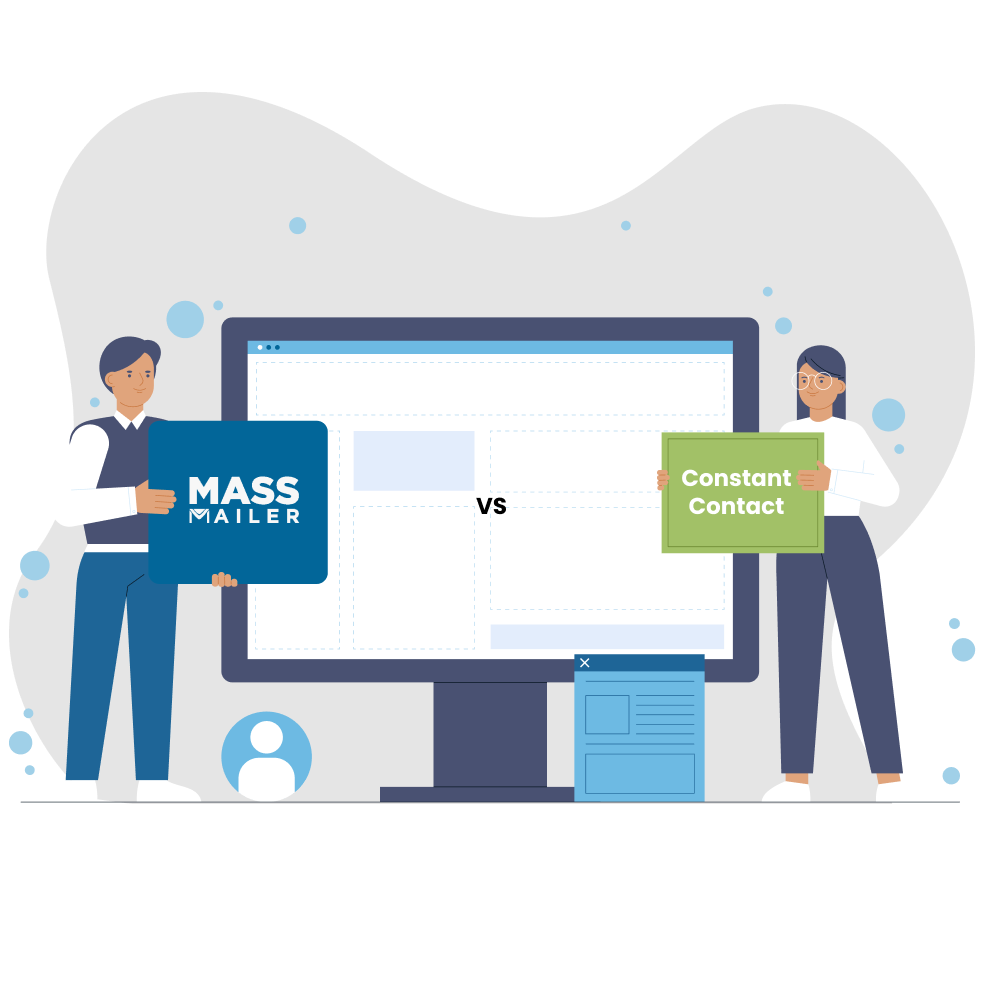
MassMailer vs Constant Contact: Email Marketing Inside Salesforce or Outside It
For Salesforce-led teams, email is rarely “just marketing.” It’s part of follow-ups, campaigns, reporting, and day-to-day execution.
That’s why the MassMailer vs Constant Contact conversation often comes up.
MassMailer is a Salesforce-native email tool. It is designed for teams that want to send and track emails directly from CRM records. On the other hand, Constant Contact is a standalone email marketing platform. It is widely used for list-driven campaigns and template-based outreach.
Both support email communication, but they support very different workflows. This page compares MassMailer vs Constant Contact side by side. We examine how each tool integrates with Salesforce, where operational trade-offs appear, and which model works better for different teams.

Salesforce-Centric Email vs External Sync-Based Email
For Salesforce-led teams, email effectiveness depends on how tightly it is embedded into the CRM. Native access reduces manual effort, prevents data drift, and ensures communication reflects real-time record changes. Connected platforms introduce sync dependencies that can affect speed and accuracy.
| Feature | What It Is | MassMailer | Constant Contact |
|---|---|---|---|
| Integration Type | How the tool connects to Salesforce | Native Salesforce App (installed directly from AppExchange; operates inside the Salesforce org) | External integration configured from Constant Contact or via third-party tools; no native AppExchange app |
| Salesforce Objects Supported | CRM records that can be used for sending | Leads, Contacts, Campaign Members, Custom Objects | Primarily Contacts and Leads (via sync); limited Salesforce object depth |
| Real-Time Data Sync | Whether updates reflect instantly | Real-time (no sync required) | Sync-based; timing depends on connector |
| Email Sending from Salesforce Records | Send directly from CRM records | Supported | Not supported |
| Campaign Member Emailing | Use Salesforce Campaign Members as recipients | Fully supported | Requires syncing lists into Constant Contact |
| Sync Reliability & Error Handling | Visibility into sync issues | Native Salesforce logging | Connector-dependent |
| Setup & Ongoing Admin Effort | Initial and ongoing maintenance | AppExchange install; minimal admin overhead since data and activity remain inside Salesforce | Requires external configuration and ongoing sync monitoring; deeper Salesforce feedback loops require additional tooling |
| Salesforce Activity Logging | Whether email engagement is logged directly on Salesforce records | Native logging on Leads, Contacts, Campaign Members, and custom objects | Limited and sync-dependent; engagement primarily lives in Constant Contact unless custom integrations are built |

Inbox Placement, Sender Reputation, and Deliverability Control
High-volume or time-sensitive emails are only effective if they reach inboxes reliably. At the same time, deliverability depends on a multitude of factors such as sender reputation list hygiene, etc. This is particularly crucial when when sending from CRM data.
| Feature | What It Is | MassMailer | Constant Contact |
|---|---|---|---|
| IP Type | Dedicated or shared sending IPs | Supports dedicated IPs and IP pools | Primarily shared IPs |
| Domain & IP Warm-Up | Gradual reputation building | Supported | Platform-managed |
| Email Authentication | SPF, DKIM, DMARC | Supported | Supported |
| Email Validation & List Hygiene | Detect invalid or risky addresses | Built-in validation | Basic list management tools |
| Bounce Handling & Suppression | Automatic handling of failed emails | Salesforce-native suppression | Platform-managed suppression |
| Spam Filtering Controls | Risk mitigation tools | Deliverability controls built into sending workflows | Platform-level controls |
| Duplicate Email Suppression | Prevent multiple sends to same address | Native duplicate suppression | List-based duplicate handling |

Sending Limits, Scale, and Long-Term Volume Flexibility
As communication volume grows, platform limits and pricing models determine whether teams can scale smoothly or hit constraints during critical periods.
| Feature | What It Is | MassMailer | Constant Contact |
|---|---|---|---|
| Daily / Monthly Sending Limits | Maximum send volume | Based on plan and provider reputation | Plan-based monthly limits |
| Salesforce Email Governor Limit Bypass | Overcome native Salesforce limits | Supported | Not applicable (emails sent outside Salesforce) |
| Batch Sending & Scheduling | Queue and time campaigns | Supported inside Salesforce | Supported inside Constant Contact |
| High-Volume Campaign Support | Ability to handle large sends | Designed for CRM-driven volume | Supported within plan limits |
| 1:1 Email Sends from CRM | Individual emails tied to records | Supported | Not Supported |
| Follow-Up & Reminder Sends | CRM-driven follow-ups | Salesforce-based triggers | Automation runs within Constant Contact |

CRM-Driven Targeting vs List-Based Campaigns
Relevance drives engagement. For Salesforce-led teams, the ability to target audiences based on live CRM data determines how accurate, timely, and trustworthy communication feels to recipients.
| Feature | What It Is | MassMailer | Constant Contact |
|---|---|---|---|
| Using Salesforce Reports as Audiences | Select recipients directly from CRM reports | Fully supported | Not supported |
| Dynamic Audience Updates | Audiences update automatically as data changes | Real-time, record-driven | Requires manual or scheduled list sync |
| List-Based vs Record-Based Targeting | How recipients are defined | Record-based (Salesforce objects) | List-based (email contacts) |
| Support for Custom Objects | Target non-standard CRM records | Supported | Not supported |
| Tagging & List Management | Organising recipients | Salesforce fields and reports | Tags and lists inside Constant Contact |
| Duplicate Record Handling | Prevent duplicate sends | Native duplicate suppression | List-level duplicate handling |
| Audience Sync Dependency | Reliance on data sync | None | Required for Salesforce data |

Building Email Templates and Composing Mails
Email creation impacts both speed and consistency. Where the editor lives (and how deeply it connects to data) affects collaboration, personalisation, and operational efficiency.
| Feature | What It Is | MassMailer | Constant Contact |
|---|---|---|---|
| Template Builder Location | Where emails are created | Inside Salesforce | External Constant Contact platform |
| Drag-and-Drop Editor | Visual email editing | Supported | Supported |
| HTML / Code Editor | Custom HTML control | Supported | Supported |
| Personalisation & Merge Fields | Dynamic content insertion | Salesforce field-based merge | Contact field-based merge |
| Saved Templates & Reusable Blocks | Reuse layouts and content | Supported | Supported |
| A/B Testing Support | Test subject lines or content | Supported | Supported |
| Brand Consistency Controls | Maintain visual standards | Salesforce templates and governance | Brand templates within platform |

Attachments, Files, and Operational Email Content
Many teams send more than newsletters. Contracts, invoices, reports, and personalised documents are part of everyday communication. Such documents are highly prominent amongst sales, operations, and service teams.
| Feature | What It Is | MassMailer | Constant Contact |
|---|---|---|---|
| Static Attachments | Same file sent to all recipients | Supported | Supported (via file links/hosting) |
| Dynamic, Record-Based Attachments | Personalised files per record | Fully supported | Not supported |
| Salesforce Files Integration | Use CRM-stored files | Supported | Not supported |
| Document Storage Location | Where files are stored | Salesforce Files / MassMailer Docs | Constant Contact file library |
| Automated Document Generation | Create documents from record data | Supported (MassMailer Docs) | Not available |
| Attachment Size & Limits | File constraints | Governed by Salesforce | Platform-defined limits |

Workflow and Marketing Automation
Automation determines whether teams save time or create more work. For Salesforce-led organisations, the key difference lies in where automation is triggered—from CRM events or from an external marketing platform.
| Feature | What It Is | MassMailer | Constant Contact |
|---|---|---|---|
| Salesforce Workflow / Flow Support | Trigger emails from Salesforce automation | Fully supported | Not supported |
| Triggered Emails from CRM Events | Send emails based on record changes | Native, real-time | Requires data sync and manual triggers |
| Drip Campaigns & Follow-Ups | Time-based automated sequences | Supported inside Salesforce | Supported inside Constant Contact |
| Multi-Step Marketing Automation | Branching journeys and conditions | Salesforce-driven sequences | Supported via automation paths |
| Cross-Channel Automation | Email plus other channels | Email-focused | Email and limited social |
| Dependency on External Automation Engine | Need to leave Salesforce | None | Required |

Analytics and Reporting
Accurate reporting depends on where engagement data lives. When metrics sit outside Salesforce, teams lose context and attribution, especially at the individual record level.
| Feature | What It Is | MassMailer | Constant Contact |
|---|---|---|---|
| Open Tracking | Track email opens | Supported | Supported |
| Click Tracking | Tracks link clicks | Supported | Supported |
| Bounce Tracking | Monitor delivery failures | Logged in Salesforce | Logged inside Constant Contact |
| Unsubscribe Management | Handle opt-outs | Synced to Salesforce records | Managed in platform lists |
| Bot Activity Filtering | Remove false engagement signals | Supported | Standard filtering |
| Salesforce-Native Reporting | Build reports in CRM | Fully supported | Not supported |
| Campaign-Level vs Record-Level Insights | Granularity of data | Both supported | Campaign-level focus |

Lead Capture and Front-of-Funnel Marketing Assets
Some organisations need full-funnel marketing assets. Others rely on Salesforce as the system of record and prefer communication to stay CRM-driven. The difference affects tooling, data flow, and ownership.
| Feature | What It Is | MassMailer | Constant Contact |
|---|---|---|---|
| Form Builder | Create signup or inquiry forms | Not available | Supported |
| Landing Page Builder | Build standalone pages | Not available | Supported |
| Pop-Ups & Signup Widgets | On-site lead capture | Not available | Supported |
| Salesforce Lead Mapping | Map submissions to CRM | N/A (Native integration) | Requires connector and mapping |
| Multi-Step Forms | Complex form flows | Not supported | Supported |
| External Asset Dependency | Reliance on non-CRM tools | Salesforce-driven workflows | Platform-dependent |

Pricing Structure and Cost Predictability Over Time
Pricing models shape long-term cost more than feature lists. As databases grow and communication volume increases, teams need predictability, and not surprise upgrades or penalties tied to contact counts.
| Feature | What It Is | MassMailer | Constant Contact |
|---|---|---|---|
| Pricing Basis | How pricing is calculated | Email volume and user licenses | Contact-based tiers |
| Cost Impact of Large Databases | Effect of list growth | Predictable as volume scales | Costs rise as contacts increase |
| Add-Ons & Feature Gating | Paid feature unlocks | Minimal | Advanced automation, reporting, and tools gated by plan |
| Integration Costs | Additional setup expense | None (native Salesforce app) | Third-party integration setup and maintenance |
| Free Trial Availability | Try-before-buy option | Available | Available |
| Predictability at Scale | Budget stability over time | High | Variable with list growth |

Day-to-Day Usability for Teams
Adoption speed affects ROI more than feature depth. Tools that align with existing workflows reduce training, friction, and resistance, especially across non-marketing teams.
| Feature | What It Is | MassMailer | Constant Contact |
|---|---|---|---|
| Learning Curve | Time to become productive | Low for Salesforce users | Low for marketing users |
| UI Location | Where users work | Inside Salesforce | External platform |
| Admin Configuration Complexity | Setup and maintenance effort | Simple AppExchange install | Connector setup and field mapping |
| User Roles & Permissions | Access control model | Salesforce-based | Platform-based |
| Day-to-Day Workflow Efficiency | Operational flow | High for CRM-led teams | High for standalone marketing teams |

Implementation, Support, and Salesforce Readiness
Implementation speed and ongoing support directly affect time-to-value. Salesforce-led teams benefit most from support that understands CRM-native workflows.
| Feature | What It Is | MassMailer | Constant Contact |
|---|---|---|---|
| Support Channels | Available help options | Email support | Email, chat, phone (plan-dependent) |
| Salesforce-Specific Expertise | CRM-native guidance | Strong | Limited |
| Documentation Quality | Help resources | Salesforce-focused guides | Broad marketing documentation |
| Training & Webinars | Learning resources | Product walkthroughs | Marketing-focused tutorials |
| Implementation Time | Time to first send | Days | Days to weeks (with connector) |
Why Teams Choose MassMailer Over Constant Contact

Matthew Longoria
Great product, great support. Would recommend
We use massmailer daily with no issues. Plenty of support anytime it is needed and amazing customizability. Love the product and happy to be using them. Would recommend for anyone looking to use a mass e-mailing system.

Lakis Juzwa
Fantastic mass mailing solution from within Salesforce!!!
We finally got the mass mailing solution that is perfectly integrated with Salesforce. We no longer need to export our database to use external mass mailing solutions.

Harriet Newhouse
Effortless Email Campaigns with Excellent Support
MassMailer is straightforward to use and offers excellent customer service. Its built-in integrations with SF make it especially convenient for tracking within campaigns.

MassMailer vs Constant Contact: Which Tool Is Right for You?
By now, the difference between MassMailer and Constant Contact should be clear. Both are capable email platforms, but they serve fundamentally different operating models.
Choose MassMailer if:
- Salesforce is your primary system of record and action
- You want email sending, tracking, and reporting inside the CRM
- Real-time data accuracy and record-level visibility matter
- You send high volumes of email and want predictable costs
- Multiple teams (sales, operations, service) rely on the same data
Choose Constant Contact if:
- You need a standalone marketing platform
- Forms, landing pages, and list growth tools are central to your strategy
- Your workflows live outside Salesforce
- Marketing operates independently from CRM user
In short, MassMailer is built for Salesforce-first teams, while Constant Contact is designed for standalone marketing workflows
The right choice depends on where your data lives and where your teams work. In case you’re still on the fence, here’s a detailed video on MassMailer vs Constant Contact that will further enlighten you:

Next Step: Experience the Difference in Real-Time
Choosing the right email platform isn’t about feature checklists. It’s about fit.
If your organisation runs on Salesforce, the real test is simple:
Can your teams send, track, and act on email without leaving the CRM or stitching systems together?
That’s where a hands-on trial matters.
- Try MassMailer to experience Salesforce-native email sending, real-time engagement tracking, and CRM-driven workflows inside your org
- Explore Constant Contact if you’re evaluating a standalone marketing platform with built-in forms, landing pages, and list-centric campaigns.
Use this comparison as a guide. Then, use the trials to validate how each tool performs in your actual workflows.
Frequently Asked Questions
Is MassMailer built specifically for Salesforce users?
Yes. MassMailer is a Salesforce-native application that works directly with CRM records, reports, campaigns, and workflows.
Does Constant Contact integrate with Salesforce?
Constant Contact does not have a native Salesforce AppExchange application. It integrates with Salesforce through an external sync configured from the Constant Contact platform or via third-party integration tools.
Can I send emails directly from Salesforce records with both tools?
Only MassMailer supports sending emails directly from Salesforce records. It creates, sends, and logs emails within Salesforce. Constant Contact requires data syncing with Salesforce. It then sends the email from the Constant Contact interface.
How do the two tools handle Salesforce data sync?
MassMailer operates natively inside Salesforce. So, there is no data sync involved. While sending emails, it refers to live CRM data. Constant Contact relies on an external integration to pull Salesforce data. It can result in data inconsistencies.
Does Constant Contact support CRM-driven automation?
Constant Contact supports marketing automation. However, in the case of Salesforce-based triggers, Constant Contact depends on synced data and connector rules.
Can MassMailer support operational emails?
Yes. MassMailer supports operational, transactional, and time-sensitive emails tied to Salesforce records.
Which tool offers better visibility inside Salesforce?
MassMailer logs engagement metrics directly on Salesforce records. For Constant Contact, the engagement data is contained within its dashboards.
How quickly can teams get started with each tool?
MassMailer typically takes days to deploy via AppExchange. Constant Contact setup may take longer due to connector configuration and data mapping.
Do both tools support compliance and opt-out management?
Yes. Both tools support unsubscribe handling. MassMailer gains an edge for managing consent and opt-outs directly within Salesforce records.
Which tool is a better fit for non-marketing teams?
Constant Contact is primarily marketing-focused. MassMailer fits teams that already work inside Salesforce. This offers coverage to sales, operations, and service.
MassMailer Resources

Start Your Free Trial Today
Experience MassMailer the easiest way to send personalized emails from Salesforce.