
Salesforce Email for Beta Programs: Recruiting, Onboarding & Feedback Workflows
A beta program that recruits the right participants and collects feedback at defined milestones produces three returns: product improvements informed by real workflows, early adopters who serve as reference customers at launch, and adoption data that validates GA readiness. Salesforce email for beta programs uses CRM data to identify and recruit the right participants, automate onboarding and feedback sequences, and manage the GA transition that converts beta investment into launch momentum.
Identifying and Recruiting Beta Participants from Salesforce Account and Contact Fields
Account fields provide the targeting criteria: plan tier identifies customers eligible for the new feature, feature adoption stage identifies customers who have mastered the foundational capabilities it builds on, and industry and use case fields identify customers whose workflow matches the primary use case the feature serves. Combining these criteria produces a targeted recruitment list without manual account-by-account evaluation. The invitation email leads with the customer's specific qualification—framing the invite as recognition of their expertise rather than a generic request for time.
Onboarding Beta Participants with Structured Activation Email Sequences in Salesforce
A structured onboarding sequence ensures every participant experiences the feature in a defined order. Day one: a welcome email confirming access and beta window expectations. Day three: a getting-started guide through the first activation steps. Day seven: a single check-in—"Have you had a chance to try it yet?"—with two response options. Participants who have tried it receive capability-deepening content; those who have not receive a re-engagement sequence. Branching at day seven prevents drop-off from identical emails regardless of activation status.
Collecting Structured Beta Feedback Through Salesforce-Triggered Survey Emails
Feedback collected at defined milestones produces comparable, quantifiable input segmented by participant profile and use case. A midpoint survey on day fifteen covers ease of activation, workflow fit, and missing capability—the most actionable dimensions before GA. An end-of-beta survey on day twenty-eight covers the full experience plus a willingness-to-recommend question. Participants who have not submitted receive a reminder on day thirty.
Managing Beta Cohort Communication and Participant Segmentation in Salesforce
A beta cohort is not homogeneous—some activate immediately, others take two weeks to log in, and others use the feature in unanticipated ways. Account-level data tracks participation signals: first use date identifies early versus delayed activators, a use-case flag highlights unexpected usage patterns worth exploring, and an engagement score counting survey responses, feature activations, and support interactions identifies high-engagement participants for post-beta advocacy asks. High-engagement participants receive a mid-beta acknowledgment that primes the advocacy ask at graduation.
Managing Beta Graduation and General Availability Transition Emails in Salesforce
The graduation email converts a participant's program investment into a GA launch relationship. A graduation email that summarizes what changed in the feature based on their feedback and confirms continued access at GA reinforces a sense of partnership with the product team. For participants who indicated high willingness-to-recommend, a follow-up advocacy email fires three days after graduation—giving them time to experience the full GA product before being asked to advocate for it.
Measuring Beta Program Email Effectiveness: Activation Rate, Feedback Quality, and GA Outcomes
Beta program measurement connects to three outcomes: activation rate (share of enrolled accounts that used the feature within the beta window), feedback completeness (survey submission rates at midpoint and end-of-beta), and GA adoption lift (feature activation rates among beta graduates versus same-tier non-participants in the first 60 days after release). Segmenting activation by day-seven response branch shows whether the re-engagement sequence is recovering non-activating participants. The
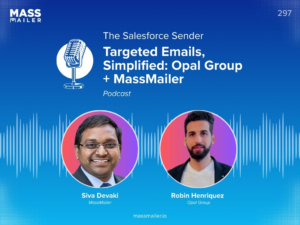
Opal Group success story and Sandy Hook Promise podcast illustrate how structured, CRM-native communication programs produced measurable engagement and adoption outcomes for organizations running systematic outreach from Salesforce data.
Run Your Entire Beta Program From Salesforce—Recruit From Usage-Qualified Account Segments, Guide Activation With Structured Onboarding Sequences, Collect Feedback at Defined Milestones, and Convert Graduates Into Advocates
MassMailer triggers beta recruitment emails from Salesforce account tier and adoption fields, runs branching onboarding sequences, delivers survey emails at midpoint and end-of-beta, and fires graduation and advocacy emails calibrated to each participant's engagement—all inside Salesforce without a separate beta management platform. Install MassMailer from the AppExchange.
Key Takeaways
- Beta recruitment uses three account criteria: plan tier (eligible for the new feature), feature adoption stage (has mastered foundational capabilities the feature builds on), and industry and use case match. The recruitment email leads with the customer's specific qualification—framing the invite as recognition of expertise outperforms generic invitation copy.
- Onboarding starts at enrollment: day one (welcome and access confirmation), day three (first-steps guide), day seven (binary check-in: "Have you tried it yet?"). Day-seven branching routes activators to capability-deepening content and non-activators to a re-engagement sequence—preventing drop-off from identical emails regardless of activation status.
- Midpoint survey fires at day fifteen: ease of activation, workflow fit, and missing capability. End-of-beta survey fires at day twenty-eight with full experience coverage plus a willingness-to-recommend question. Participants who have not submitted receive a reminder on day thirty.
- Three signals drive cohort segmentation: first use date (early versus delayed activators), a use-case flag (unexpected workflow patterns worth exploring), and an engagement score (survey responses, feature activations, and support interactions). High-engagement participants receive a mid-beta acknowledgment that primes the post-graduation advocacy ask, producing higher case study participation than a cold advocacy request at GA launch.
- The graduation email summarizes what changed in the feature based on the participant's feedback and confirms continued access at GA. For high willingness-to-recommend participants, a follow-up advocacy email fires three days after graduation—case study request, AppExchange review, or customer panel invitation—giving them time to experience the full GA product before being asked to advocate.
- Three metrics measure effectiveness: activation rate (share of enrolled accounts that used the feature within the beta window, segmented by day-seven branch), feedback completeness (survey submission rates at midpoint and end-of-beta), and GA adoption lift (feature activation rate among beta graduates versus same-tier non-participants in the first 60 days after GA release).