
Send List Email in Salesforce: How It Works, Limits & Tips
If your team sends bulk emails from inside Salesforce, Send List Email is the feature making it happen. Introduced in Lightning Experience in Winter '18, it replaced the Classic "Mass Email" wizard with a cleaner interface that lets users select recipients from any contact or lead list view and send a personalized template in a few clicks—without leaving the CRM. But it comes with a 500-recipient-per-send cap, a shared 5,000-email daily organizational limit, and tracking gaps that leave teams flying partially blind. Understanding exactly what Send List Email does—and where it stops—is the foundation of any smart Salesforce email strategy.
What Send List Email Is and How It Replaced Classic Mass Email
Salesforce offered bulk email functionality since the Classic era under the label "Mass Email." With the transition to Lightning Experience, Salesforce retired the Classic interface and renamed the feature "Send List Email" to reflect its updated workflow: bulk sends now originate directly from list views on the Contact and Lead objects rather than a dedicated wizard.
The Lightning version surfaces inside the list view UI—users select records using checkboxes, open a dropdown menu, and click "Send List Email." A compose window then lets users pick a Lightning email template, preview merge field population, and send. The feature is also accessible from within a Salesforce Campaign by selecting campaign members—making it useful for coordinated marketing sends tied to campaign ROI tracking. Salesforce Ben's guide on sending mass emails in Salesforce Lightning notes that the feature removed the need for a separate admin wizard, placing bulk sending directly in the hands of front-line reps and marketers.
Step-by-Step: How to Use Send List Email in Lightning Experience
The Send List Email workflow follows the same sequence whether the send originates from a list view or a campaign.
- Open the Contacts or Leads tab and navigate to the list view containing your target recipients. Create a filtered view if needed using criteria such as industry, lead source, or campaign membership.
- Select recipients by checking individual record checkboxes or using select-all for the visible page. Each send is capped at 500 recipients—plan multiple sends for larger lists.
- Click the dropdown arrow at the top right of the list view and select "Send List Email." This opens the compose panel in Lightning.
- Choose a Lightning email template. Merge fields in the template populate automatically from each recipient's Contact or Lead record. Visualforce templates are not supported.
- Review the recipient count and merge field preview, then click Send. Emails dispatch immediately—Send List Email does not support native scheduling.
For Campaign-based sends, navigate to the Campaign record, select Campaign Members, and follow the same steps. Campaign-associated sends enable campaign performance tracking through member status updates and Campaign reports.
Recipient Limits, Object Restrictions, and the 5,000-Email Daily Cap
Send List Email operates under two distinct constraints that admins must communicate clearly to every bulk email user.
The first is the per-send limit of 500 recipients. Each Send List Email operation dispatches to a maximum of 500 contacts or leads at once. Larger lists require segmentation into multiple sends, each consuming from the shared daily allocation. There is no batching option that automatically breaks a 2,000-contact list into four sends—the user must manually execute each batch.
The second is the 5,000-email organizational daily ceiling. Salesforce list email limits share this pool with every other mass email activity in the org—campaigns, workflow alerts, and Flow sends all draw from the same allocation. The limit resets on a rolling 24-hour window based on Greenwich Mean Time. According to Salesforce's mass email limitations documentation, Developer Edition and trial orgs are capped at 10 external recipients per day, making Send List Email non-functional for production testing.
Object restrictions add a third constraint: Send List Email works only with Contacts, Leads, Person Accounts, and internal users. Custom objects are not supported. Organizations managing recipients in custom data models—event registrants, membership records, or program participants—must evaluate native AppExchange email solutions that extend bulk sending to any Salesforce object.
How Send List Email Handles Opt-Out, Personalization, and Templates
Send List Email has three built-in behaviors that matter operationally: automatic opt-out filtering, merge-field personalization, and Lightning-only template support.
Opt-out filtering is automatic. Salesforce silently excludes any recipient whose Email Opt Out field is checked before dispatching a list email. The user is not notified which records were suppressed—the system delivers to eligible recipients and reports the final count. This behavior satisfies the FTC's CAN-SPAM Act suppression requirements for standard list sends, though Apex-triggered sends require manual suppression logic.
Personalization operates through merge fields embedded in the template. Fields such as {!Contact.FirstName} or {!Lead.Company} populate from each recipient's record at send time, enabling email personalization at scale without custom code—recipients receive messages referencing their name, company, or other CRM data, improving open and reply rates relative to identical-content broadcasts.
Template support is restricted to Lightning email templates—Visualforce templates are excluded. Organizations maintaining large Visualforce template libraries from Classic must migrate designs to Lightning format before using Send List Email. The MassMailer email template builder provides a drag-and-drop environment for building Lightning-compatible, mobile-responsive templates without HTML expertise.
Where Send List Email's Tracking Falls Short
Send List Email logs an Activity History record on each recipient's Contact or Lead after a send, recording the email subject, template name, send timestamp, and sender. This gives reps a basic outreach timeline. What it does not provide is engagement data: Salesforce does not natively capture whether individual recipients opened the email, clicked a link, or forwarded it.
The absence of per-recipient engagement tracking creates a real operational blind spot. Sales reps cannot prioritize follow-up based on who opened or clicked—they cannot identify the contacts who opened the email three times versus those who ignored it entirely. Email analytics remain limited to delivery confirmation and bounce counts, available through Campaign reports if the send was Campaign-associated, or through Setup → Email Log Files for raw send data.
Email Log Files provide a downloadable CSV covering 30 days of send activity but require manual export, contain no engagement data beyond send status and bounce reason, and cannot be filtered without external processing. Teams needing open rates, click maps, or A/B test results must deploy a native email platform that logs this data as Salesforce Activity records in real time. See our guide on tracking emails in Salesforce for the full breakdown.
When to Move Beyond Send List Email to a Native Email Solution
Send List Email works well for low-to-mid-volume targeted sends: prospecting batches of 50 to 200 contacts, event invitations, or segmented announcements where basic delivery confirmation satisfies reporting needs. It is a clean, zero-configuration option for teams that already have Salesforce and need quick bulk outreach without adding a new tool.
It becomes the wrong tool when any of four conditions apply: daily volume approaches 5,000 emails across the org; recipients live in custom objects rather than standard Contacts and Leads; campaign optimization requires open rates, click data, or A/B testing results; or email automation—drip sequences, triggered follow-ups, and scheduled campaigns—is a core workflow requirement.
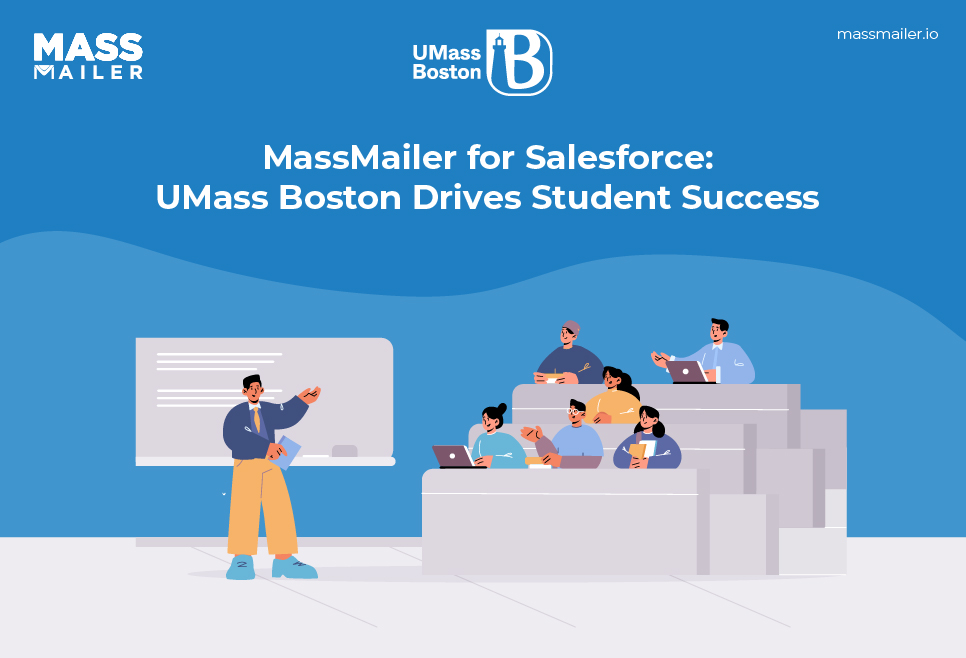
UMass Boston communicated with more than 16,000 students per cycle—a volume exceeding the 5,000-ceiling by three times and requiring 32-plus manual batches to approximate with Send List Email. After deploying a native Salesforce email app, those communications ran as single automated campaigns with real-time engagement tracking logged directly in Salesforce. The UMass Boston case study documents the transition. RPOA faced similar constraints managing high-volume outreach to membership segments—see the RPOA case study for details. In both cases, the upgrade meant installing a native AppExchange solution and retiring manual batching workflows.
Send More Than 5,000 Emails a Day—Right From Salesforce
MassMailer is a 100% native Salesforce app that removes the Send List Email ceiling entirely. No middleware, no CSV exports, no manual batching. Every send logs engagement—opens, clicks, bounces—directly to Activity Timeline. Schedule a personalized demo to see exactly how it fits your Salesforce org and sending volume.
Key Takeaways
- Send List Email replaced Classic mass email in Lightning Experience from Winter '18—it enables bulk sends directly from Contact and Lead list views without a separate configuration wizard.
- Each Send List Email operation is capped at 500 recipients per send, and all sends share the 5,000-email daily organizational limit with campaigns, automations, and workflow alerts.
- Opt-out filtering is automatic—Salesforce silently excludes contacts and leads with Email Opt Out checked, satisfying CAN-SPAM suppression requirements without requiring manual list cleaning.
- Send List Email supports only Lightning email templates; Visualforce templates are explicitly excluded, requiring template migration for teams transitioning from Classic mass email.
- Activity History logging records send details per recipient, but Send List Email provides no per-recipient open or click tracking—engagement data requires a native email platform or external ESP.
- Custom objects are not supported by Send List Email; organizations that manage recipients in custom data models require an AppExchange email solution that sends to any Salesforce object.