


Table of Contents
Introduction
Trying to send an email in Salesforce Flow works well until you need to include related records.
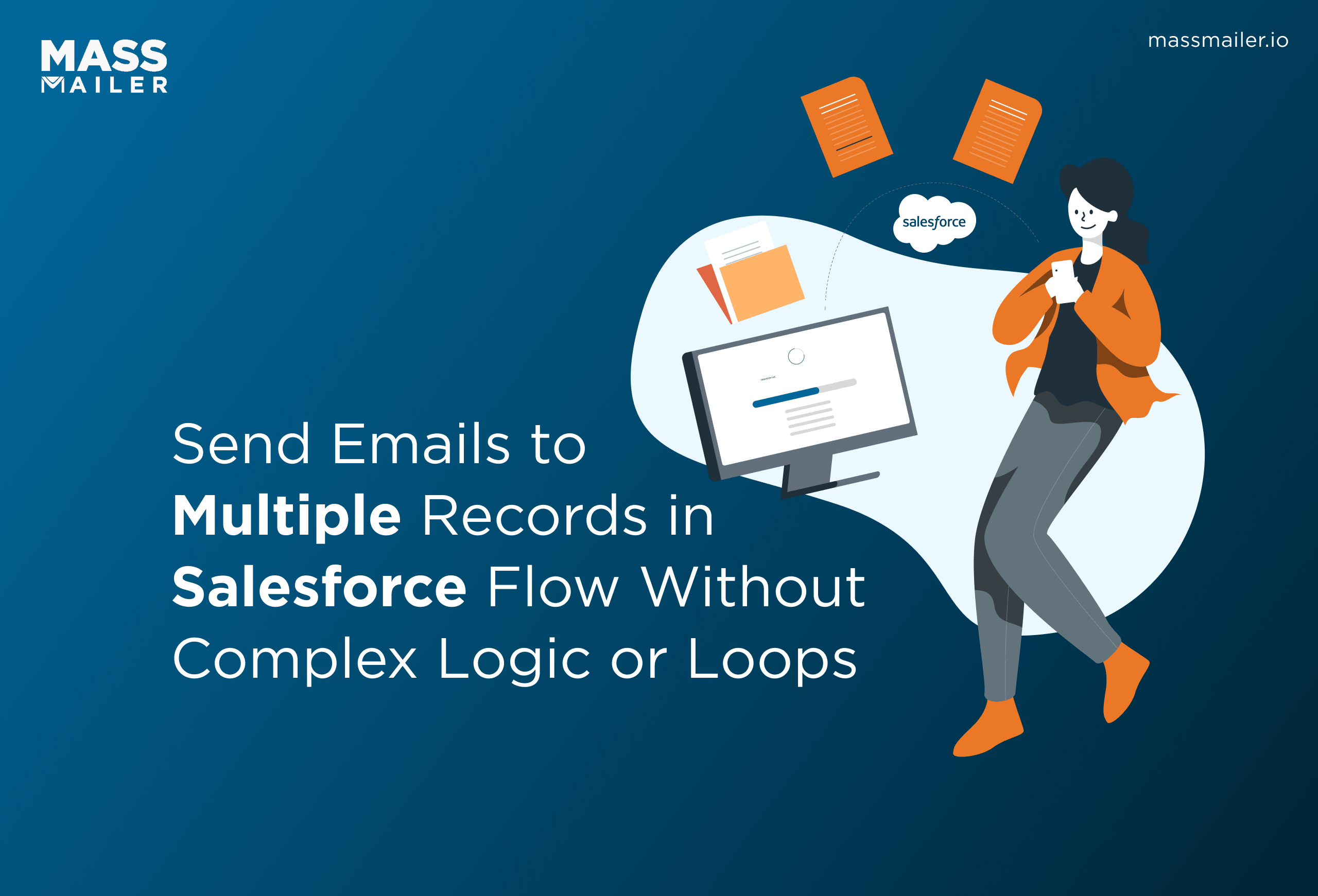
For example, if your Flow triggers on an Account and you want to email all related Contacts, Salesforce doesn’t support this directly. You have to use Get Records to fetch child records, loop through them, and trigger an email action for each one.
This is where things get complex. You’re managing collections, loops, and execution limits inside Flow Builder, which makes the automation harder to scale and maintain.
This is a common challenge when building email automation in Salesforce using parent-child relationships.
In this guide, you’ll learn how to handle this scenario properly and how teams simplify this workflow for more reliable execution.
How to Send Email in Salesforce Flow (Quick Answer)
To send an email in Salesforce Flow, you use Flow Builder to trigger a flow, retrieve related records (if applicable) using Get Records, and execute an Email Action for each record.
For parent-child scenarios, this requires looping through related records and handling each email individually, which can quickly add complexity inside the flow.
For more scalable, template-driven execution within Flow, teams often use tools like MassMailer to simplify bulk email processing.
How MassMailer extends Salesforce Flow for email automation
When you try to send emails to multiple related records in Salesforce Flow, the setup quickly becomes operationally heavy. You build loops, manage collections, and configure email actions repeatedly. This works for smaller use cases, but as volume grows or logic evolves, maintaining consistent Salesforce email automation becomes difficult.
The challenge is not triggering emails; it’s managing how they are sent at scale within Flow.
MassMailer addresses this by shifting the sending logic into a single Flow action. Instead of designing every step of delivery, you define the trigger and pass the records. This aligns better with how teams run structured Salesforce email marketing workflows without overcomplicating automation.
1. Sending emails to child records at scale
In a typical setup, sending emails to child records means looping through each record and triggering emails one by one. As the number of related records increases, this approach becomes harder to manage and more sensitive to email limits, especially when running a Salesforce mass email campaign.
MassMailer replaces this pattern by allowing you to pass a collection of records into a single action, where all emails are processed together.
- Removes the need to loop through each child record manually
- Handles bulk sending across related objects in one step
- Keeps the workflow easier to debug and extend
Instead of building logic around iteration, you focus on defining the audience and trigger. This makes it easier to run consistent Salesforce email campaigns without increasing workflow complexity.
2. Using MassMailer Apex action in Flow Builder
MassMailer integrates as an Apex action directly inside Flow Builder, so you can use it within your existing automation structure. This is especially useful when your workflows already include steps like Salesforce activity tracking or conditional branching.
Instead of sending emails through multiple native actions, you invoke one action that handles the delivery layer within Salesforce.
- Available as a native Apex action inside Flow Builder
- Fits into existing workflow logic without restructuring
- Executes within Salesforce, without external dependencies
Compared to native approaches, where email handling is spread across multiple steps, this keeps everything centralized. It also makes it easier to combine email delivery with broader workflows like Salesforce email outreach, without adding sync delays or extra systems.
3. Key inputs required for execution
In native Flow setups, configuring emails across multiple records often means repeating mappings and actions. With MassMailer, the entire send is controlled through a defined set of inputs passed into one step.
You configure the inputs once, and the system applies them across all records.
- Sender details and email configuration
- Recipient mapping (Lead, Contact, or custom object)
- Parent-child relationship logic
- Template selection using Salesforce email templates
This approach simplifies personalization and ensures consistency, especially when workflows depend on reusable templates or performance insights like Salesforce email tracking.
Instead of rebuilding the same configuration in every workflow, you standardize how emails are sent across the system.
Why does this change how teams build Flow-based email automation
MassMailer does not add more steps to Flow. It removes the most complex part, how emails are executed across records.
Instead of:
- Looping through records
- Managing limits and repeated actions
- Maintaining multiple email configurations
You:
- Pass records once
- Trigger a single action
- Let the system handle delivery
This shift is most noticeable when workflows involve multiple related records per trigger. At that point, native Flow setups become harder to scale reliably.
Teams typically adopt this approach when they need predictable, repeatable email workflows that work across objects without constant maintenance.
Step-by-step: Send email in Salesforce Flow to child records using MassMailer
Before building the flow, make sure two things are in place.
First, your email setup should support delivery and tracking; emails may not reach inboxes or get recorded properly.
Second, your parent and child objects must have a clear relationship so the flow can retrieve the correct records.
This ensures your automation runs on valid data and avoids common issues like missing recipients or failed sends.
Step 1: Define the flow trigger
Start by creating a record-triggered flow on the parent object, such as Account or Opportunity. This step decides when the process runs and ensures emails are tied to real business events.
- You should choose whether the flow runs when a record is created, updated, or both.
- You should define entry conditions so the flow runs only when specific criteria are met.
- You should select the correct optimization setting to handle related records efficiently.
For example, triggering the flow when a deal moves to a new stage ensures emails go out at the right moment. This keeps communication relevant and avoids unnecessary sends.
This setup is commonly used in structured email outreach workflows. It also fits well with lifecycle-based automation used by teams working in Salesforce for marketers, where timing depends on meaningful record changes.
Step 2: Fetch related records
After the trigger runs, use the Get Records element to pull the child records linked to the parent. This step defines your recipient list and directly affects delivery quality.
- You should select the correct related object, so only relevant records are included.
- You should apply filters to exclude records with missing or invalid email fields.
- You should store the results in a collection variable for further processing.
For example, filtering only active records with valid email addresses ensures you don’t send emails to unusable contacts. This reduces bounce rates and improves overall performance.
MassMailer strengthens this step by working with cleaner recipient data and controlled sending. It helps reduce failed deliveries and protects your sender's reputation by avoiding repeated sends to invalid contacts.
Step 3: Process records (loop or collection)
In native Flow setups, you prepare records using a loop so each record can be handled individually. This step is required, but it often adds unnecessary complexity.
- You should iterate through each record to ensure all recipients are included.
- You should assign or update the fields needed for the email.
- You should prepare a collection that will be used in the next step.
As the number of records increases, this approach becomes harder to manage. Flows take longer to run, and troubleshooting becomes more difficult.
This pattern is similar to how records are handled in setups like email to case Salesforce, where precision matters but logic can grow quickly. It also becomes limiting when handling larger data sets or content-heavy emails, especially under constraints like email attachment size limits.
Step 4: Execute MassMailer action
Instead of placing email actions inside the loop, use the Salesforce Email Apex action in MassMailer to handle sending in one step. This removes the need to manage delivery logic manually.
- You should add the MassMailer action inside Flow Builder.
- You should pass the full collection of records into the action.
- You should configure the sender and basic email settings before execution.
This replaces multiple email steps with a single action. It reduces the number of elements in your flow and makes the process easier to manage.
This approach aligns with how teams run bulk communication using Salesforce mass email strategies. Compared to native options like flow email alerts, this method avoids duplication and keeps your workflow easier to maintain.
Step 5: Map template and fields
Next, define how your email should look and how data should be mapped for each recipient. This ensures consistency across all messages.
- You should select a reusable email template that fits your use case.
- You should map the recipient and sender fields correctly.
- You should configure merge fields to personalize each message.
Using templates helps standardize communication while still allowing personalization. It also reduces the need to recreate content for every workflow.
This keeps your messaging consistent across all recipients and removes the need to rebuild email content for every new flow, while aligning with Salesforce email best practices for structured and personalized communication.
Step 6: Test and activate
Before activating the flow, test everything using debug tools. This ensures the workflow behaves correctly before it runs in production.
- You should run test scenarios using sample records.
- You should verify that emails are sent only to the intended recipients.
- You should check that all fields and mappings work as expected.
Testing helps you catch issues early, such as incorrect filters or missing data. It also prevents delivery problems that can happen due to poor setup.
This is especially important when working with new sending setups, where factors like IP warming affect performance. It also helps avoid issues caused by spam filters, including risks related to spam traps.
What good looks like in production
A well-built workflow should run without constant fixes. Emails should trigger at the right time, reach the correct recipients, and follow a consistent format.
- Emails are triggered by clear business events.
- All related records are processed without manual intervention.
- Templates and configurations stay consistent across workflows.
- The system continues to perform reliably as volume grows.
This structure replaces fragile, loop-heavy setups with a cleaner and more scalable approach that is easier to maintain over time.
When to use Salesforce Flow vs MassMailer for email automation
Use Salesforce Flow when emails are sent one record at a time. Use MassMailer when one action needs to send emails to multiple recipients or reuse the same message across records.
The difference is not just capability; it is how quickly your workflow becomes hard to manage as it scales.
When Salesforce Flow is enough
Salesforce Flow works best when email sending stays simple and tied to a single record without dependencies on related data.
- Flow handles one-to-one email triggers cleanly.
- It works well when no related records or collections are involved.
- It fits internal alerts or low-volume external communication.
- It keeps workflows easy to read when no iteration is required.
For example, sending a notification when a case is updated or when an opportunity changes stage can be handled cleanly within Flow.
If your workflow stays at this level, introducing another layer will not improve the outcome.
When MassMailer becomes necessary
Salesforce Flow starts to break down when one action needs to send emails to multiple related records or repeat the same logic across recipients.
- One trigger sending emails to multiple recipients requires loops and repeated actions in Flow.
- Reusing the same message across records leads to duplicated configuration.
- Workflow steps increase just to control how emails are sent.
At this stage, you are no longer building automation. You are maintaining execution logic.
MassMailer removes this overhead by handling email delivery in a single step inside Flow. Instead of building loops and assignments, you pass the records and execute once.
If this shift is not made, workflows tend to become harder to debug, easier to break, and more time-consuming to maintain.
Choosing based on scale and workflow complexity
You can decide quickly by looking at how your workflow behaves in practice.
| Scenario | Recommended Approach | Why |
| One record triggers one email | Salesforce Flow | Simple, direct execution |
| One record triggers multiple emails | MassMailer | Avoids loops and repeated logic |
| Same message used across many records | MassMailer | Centralized message control |
| Small, isolated processes | Salesforce Flow | Minimal setup required |
If your workflow depends on more than one recipient per trigger, native Flow will start introducing complexity.
That is typically the point where teams switch, not for new features, but to avoid maintaining fragile workflows and to keep execution reliable.
Conclusion
Sending emails in Salesforce Flow feels simple at first. But once your workflow starts handling multiple recipients, things get messy. You end up rebuilding the same emails, adding extra steps, and checking everything before every send just to make sure nothing breaks.
The problem is not sending emails. It is getting them out reliably without adding more work each time.
MassMailer fixes this by taking that effort out of your hands. Instead of managing loops, repeated steps, and manual checks, you trigger one action, and the emails go out the way they should across all related records. The workflow becomes easier to manage, easier to trust, and much easier to scale.
If your team is already spending time fixing flows, rechecking campaigns, or rebuilding the same logic again and again, that is a clear sign your current setup is slowing you down.
Book a MassMailer demo now and see how you can simplify your Salesforce email workflows immediately.
The longer you stay with a setup that needs constant fixing, the more time you lose. This is the point where you switch to something that just works.
Frequently Asked Questions
1. Can Salesforce Flow send bulk emails to multiple records?
2. How do you avoid hitting limits when sending emails in Salesforce Flow?
3. Can you use email templates dynamically in Salesforce Flow?
4. What is the best way to send emails to related records in Salesforce?
5. Why do email workflows become hard to maintain in Salesforce Flow?
6. How can you scale email automation inside Salesforce without rebuilding workflows?
Start Your Free Trial Today
Experience MassMailer the easiest way to send personalized emails from Salesforce.
Related Blogs
Salesforce Email Services: Setup, Types, and Limitations
Salesforce Cold Email in 2026: Tools, Setup Tips & Compliance Risks
MassMailer Resources



MassMailer Glossary
About the Author

Siva Devaki 

Siva Devaki is the founder of MassMailer Inc., a tool that helps Salesforce users optimize email marketing. A passionate advocate for email marketing, Siva writes and hosts podcasts on the topic, sharing insights to help businesses drive revenue and enhance customer engagement through Salesforce email automation and tracking.