

MassMailer vs Adobe Marketo Engage
Native Salesforce Email vs Adobe Marketo Engage: Go Live in Days, Not Months, Without Enterprise Licensing
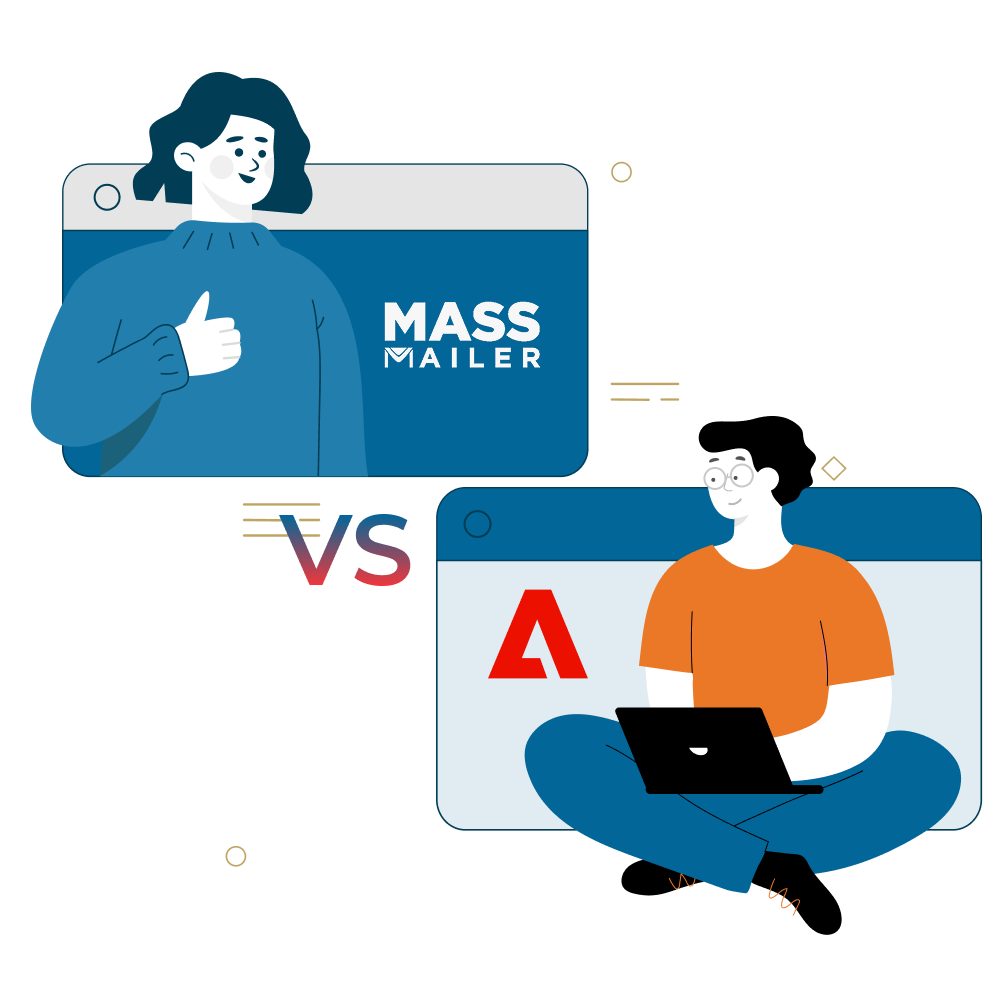

CRM-Native Email vs Enterprise Automation: MassMailer vs Adobe Marketo Engage
Modern organizations have figured out the art of sending emails. However, they struggle with where email should live.
Some teams need email to behave like an operational system. They want it to react to CRM changes, send documents, and trigger follow-ups. Others need email to act as a growth engine that orchestrates nurture journeys, scores leads, and feeds the pipeline at scale.
MassMailer and Adobe Marketo Engage sit on opposite ends of this spectrum. One is designed to make Salesforce itself the email engine. The other is designed to run large-scale marketing automation on top of it.
This MassMailer vs Adobe Marketo Engine comparison looks at where each tool creates leverage and where trade-offs appear.

Where Email Executes and How Salesforce Data Is Used
Email accuracy depends on whether messages are driven by live CRM data or by a separate marketing database. When execution happens inside Salesforce, every status change, owner update, and field edit is immediately reflected in what gets sent.
When execution happens elsewhere, syncing becomes a dependency. It introduces delay, reconciliation work, and governance risk. This is especially important when email supports revenue operations, not just marketing campaigns.
| Feature | What it is | MassMailer | Adobe Marketo Engage |
|---|---|---|---|
| Email execution location | The system that actually sends emails | Inside the Salesforce org | Marketo Engage infrastructure |
| Primary data source | Where recipient and engagement data are stored | Salesforce CRM records | Marketo lead and activity database |
| Real-time data reflection | Whether CRM updates affect email immediately | Yes, live record data | No, relies on Salesforce sync |
| Send from Salesforce records | Ability to send email from Lead, Contact, Opportunity, etc. | Fully supported | Not supported |
| Campaign Member support | Use Salesforce Campaign Members as recipients | Native | Requires syncing into Marketo |
| Custom object targeting | Ability to use non-standard Salesforce objects | Fully supported | Possible via schema mapping and sync |
| Activity logging location | Where opens, clicks, and bounces are recorded | On Salesforce records | In Marketo, synced back selectively |
| Data duplication risk | Whether two databases must be kept in sync | None | Inherent (Salesforce and Marketo DB) |

Audience Definition, Segmentation, and Data Control
Who receives an email is as important as what it says. CRM-driven targeting prioritizes operational accuracy and ownership by sales and ops teams. Marketing-driven segmentation prioritizes behavioral modelling, enrichment, and campaign optimization. Your choice of model affects how quickly audiences adapt to reality.
| Feature | What it is | MassMailer | Adobe Marketo Engage |
|---|---|---|---|
| Audience source | Where recipient lists are defined | Salesforce objects and reports | Marketo lead lists |
| Salesforce reports as audiences | Using CRM reports to select recipients | Fully supported | Not supported |
| List-based targeting | Segments built from static or dynamic lists | Not required | Core to how Marketo works |
| Behavioral segmentation | Targeting based on opens, clicks, visits, and form fills | Salesforce activity-driven | Advanced behavioral logic |
| Attribute grouping | Combining fields into structured profiles | Salesforce object model | Lead and custom attribute sets |
| Historical behavior | Use past engagement for targeting | Limited by CRM history | Deep behavioral history |
| Custom field and object use | Target using extended data models | Native | Requires mapping into Marketo |
| Duplicate handling | How identical emails or contacts are treated | Salesforce duplicate logic | One lead per email address |

Automation Triggers, Journeys, and Execution Flow
Automation determines whether email scales cleanly or becomes fragile. Some teams automate around CRM events like stage changes or approvals. Others build long, branching journeys driven by behavior, scoring, and timing. The trigger model defines how responsive, complex, and maintainable your email programs can be.
| Feature | What it is | MassMailer | Adobe Marketo Engage |
|---|---|---|---|
| Trigger source | What causes an email to be sent | Salesforce record events and flows | Lead behavior, filters, programs |
| Salesforce Flow integration | Native use of CRM automation | Fully supported | Via sync and API events |
| Record-based triggers | Emails sent when CRM fields change | Real-time | Requires data sync |
| Time-based sequences | Scheduled follow-ups and delays | Salesforce scheduling | Native nurture programs |
| Multi-step journeys | Chained email logic | CRM-native sequences | Advanced engagement programs |
| Conditional branching | If/else logic in workflows | Salesforce logic | Visual decision rules |
| Cross-channel automation | Email tied to other channels | Email-centric | Email, web, ads, scoring |
| Automation ownership | Who builds and maintains workflows | Salesforce users | Marketing operations teams |

Deliverability, Sender Reputation, and Inbox Control
Email only creates value when it reaches the inbox. Sender reputation, authentication, bounce handling, and suppression rules all influence whether messages are delivered, delayed, or blocked.
As volumes rise, even small missteps can impact domain reputation and future campaigns. Teams need both protection and visibility into how sending behavior affects deliverability.
| Feature | What it is | MassMailer | Adobe Marketo Engage |
|---|---|---|---|
| IP model | Whether the email is sent from shared or dedicated IPs | Supports dedicated IPs and IP pools | Dedicated IPs available on higher plans |
| Domain and IP warm-up | Controlled ramp-up of new senders | Supported | Supported |
| Email authentication | SPF, DKIM, DMARC alignment | Fully supported | Fully supported |
| Email validation | Detecting invalid or risky addresses | Salesforce-native validation | List hygiene and validation tools |
| Bounce handling | Automatic management of hard/soft bounces | Salesforce-native suppression | Platform-level suppression |
| Duplicate suppression | Prevent sending to the same email twice | Salesforce duplicate logic | Lead-level deduplication |
| Spam risk controls | Protection against reputation damage | Workflow-level safeguards | Platform-level deliverability controls |
| Reputation visibility | Insight into sending health | Via Salesforce + Email Monitor | Via Marketo deliverability reports |

Email Creation, Personalization, and Brand Governance
Email creation is not just about design. It affects how quickly teams can launch, how accurately messages reflect CRM data, and how consistently brands are represented. It’s crucial to balance creative freedom with governance and data-driven personalization. This is especially true when multiple teams and campaigns are involved.
| Feature | What it is | MassMailer | Adobe Marketo Engage |
|---|---|---|---|
| Template builder location | Where emails are created | Inside Salesforce | Marketo Email Editor |
| Drag-and-drop editor | Visual email building | Supported | Advanced visual editor |
| HTML / code editor | Direct markup control | Supported | Supported |
| Personalization source | Data used for merge fields | Salesforce fields and objects | Marketo lead and custom fields |
| Dynamic content | Conditional content per recipient | Salesforce-driven rules | Advanced segmentation rules |
| Reusable blocks | Modular content components | Supported | Supported |
| Brand governance | Controls for layouts and standards | Salesforce templates | Brand templates and approvals |
| A/B testing | Subject line or content testing | Supported | Advanced testing |
| AI content tools | AI-assisted copy and subject lines | Not a core focus | Supported via Adobe Sensei |

Attachments, Documents, and Operational Email Support
Not all emails are campaigns. Sales, finance, operations, and service teams send documents that must match specific records and customers. When attachments are static or detached from CRM data, errors and manual work creep in. Strong document handling allows email to support real business execution, not just promotion.
| Feature | What it is | MassMailer | Adobe Marketo Engage |
|---|---|---|---|
| Static attachments | Same file sent to every recipient | Supported | Supported |
| Dynamic attachments | Record-specific files per recipient | Fully supported | Not supported |
| Salesforce Files integration | Using CRM-stored documents | Native | Limited |
| Automated document generation | Create files from CRM data | Supported (MassMailer Docs) | Not available |
| Document storage | Where files are managed | Salesforce Files | Marketo asset library |
| Permission control | Who can access the attached files | Salesforce security model | Platform-level permissions |
| Operational email fit | Suitability for non-marketing use | Strong | Limited |
| Auditability | Ability to trace document sends | Salesforce record history | Campaign-level tracking |

Analytics, Reporting, and Performance Visibility
Email data is only useful when teams can act on it. For Salesforce-led organizations, engagement must be visible against records, opportunities, and campaigns. Such visibility triggers follow-ups or decisions.
Marketing platforms, on the other hand, focus on campaign performance and optimization. Where metrics live determines who can use them and how fast action happens.
| Feature | What it is | MassMailer | Adobe Marketo Engage |
|---|---|---|---|
| Open tracking | When and who opens an email | Logged on to Salesforce records | Logged in Marketo activity logs |
| Click tracking | Which links were clicked | Per-record tracking | Per-lead and campaign tracking |
| Bounce tracking | Delivery failure visibility | Stored on Salesforce records | Stored in Marketo |
| Unsubscribe handling | Opt-out enforcement | Synced to Salesforce fields | Managed at the lead level |
| Record-level engagement | View full email history on a single CRM record | Native | Requires Salesforce sync and activity history |
| Campaign-level reporting | Aggregate performance across sends | Salesforce reports and dashboards | Advanced campaign analytics |
| Salesforce-native reporting | Build reports without exports | Fully supported | Limited via synced activities |
| Data export and sharing | Sharing metrics with stakeholders | Salesforce exports | CSV and dashboard exports |

Lead Capture, Funnel Entry, and Growth Tools
Some organizations treat email as one channel inside a broader acquisition engine. Others rely on Salesforce as the system of record and prefer leads to enter upstream. Built-in forms, landing pages, and progressive profiling accelerate list growth, but they also introduce new data ownership and sync complexity.
| Feature | What it is | MassMailer | Adobe Marketo Engage |
|---|---|---|---|
| Form builder | Create signup and inquiry forms | Not available | Supported |
| Landing page builder | Host conversion-focused pages | Not available | Supported |
| Progressive profiling | Capture data across multiple visits | Not supported | Supported |
| Lead ownership | Where captured leads primarily live | Salesforce CRM | Marketo lead database |
| Salesforce lead injection | Push captured leads into CRM | Native | Supported via sync |
| Multi-step forms | Conditional or adaptive forms | Not supported | supported |
| Attribution tracking | Source and campaign tracking | Salesforce campaigns | Built-in attribution models |
| Funnel dependency | Reliance on non-CRM assets | Minimal | Core to the platform |

Pricing Structure, Licensing, and Cost Predictability
Cost models shape how platforms scale over time. Some tools grow with volume, others with database size, modules, or users. As marketing and operational usage increases, teams need to know what will drive cost and whether spending will remain predictable or become tied to complexity.
| Feature | What it is | MassMailer | Adobe Marketo Engage |
|---|---|---|---|
| Pricing basis | Primary cost driver | Email volume and users | Lead count and platform editions |
| Database growth impact | Cost as records increase | No direct cost increase | Costs rise as the lead database grows |
| High-volume predictability | Budget stability at scale | High | Moderate |
| Feature gating | Limits by plan level | Minimal | Advanced features in higher tiers |
| Add-on dependency | Need for extra paid modules | Limited | Common |
| Entry cost | Initial investment | Lower | High |
| Cost transparency | Ease of forecasting spend | Straightforward | Often complex |

Governance, Permissions, and Enterprise Control
Governance becomes vital when multiple users participate in email execution. Features surrounding permissions, approvals, and audit trails ensure accountability. They also help with risk mitigation. This is especially important in regulated environments or where multiple teams interact with customer communication.
| Feature | What it is | MassMailer | Adobe Marketo Engage |
|---|---|---|---|
| Permission model | How access and actions are controlled | Salesforce roles and profiles | Marketo user roles |
| Record-level enforcement | Respecting CRM visibility rules | Fully enforced | Not record-based |
| Approval workflows | Review before send | Salesforce-based approvals | Platform-level approvals |
| Audit trail | Who sent what and when | Native Salesforce audit history | Activity and change logs |
| Environment separation | Test vs production | Salesforce sandboxes | Separate Marketo instances |
| Compliance enforcement | Consent and policy controls | CRM-driven logic | Platform-based compliance tools |
| Risk containment | Limiting the blast radius of mistakes | Strong via CRM permissions | Strong via enterprise tooling |

Organizational Fit, Adoption, and Day-to-Day Use
Even powerful platforms fail when teams struggle to adopt them. The right tool aligns with how people already work. Daily usability, role fit, and change management effort often matter more than feature depth.
| Feature | What it is | MassMailer | Adobe Marketo Engage |
|---|---|---|---|
| Primary user profile | Who the tool is built for | Salesforce users across teams | Marketing operations teams |
| Learning curve | Time to become productive | Low for CRM users | Moderate to high |
| Daily workflow location | Where users work | Inside Salesforce | Marketo interface |
| Cross-team accessibility | Sales, ops, service usage | Strong | Limited |
| Change management effort | Rollout complexity | Low | High |
| Operational flexibility | Support for varied use cases | High for CRM-driven work | High for marketing automation |
| Best-fit organization | Ideal operating model | Salesforce-first | Marketing-led enterprises |

Typical Use Cases and Workflows
Most organizations look beyond mere features while choosing tools. They decide based on how well a platform supports their dominant workflows. Understanding where each tool is strongest prevents overbuying, underutilization, or forcing teams into the wrong operating model.
| Dimension | What it represents | MassMailer | Adobe Marketo Engage |
|---|---|---|---|
| Best for | Core use case | CRM-driven execution | Full-funnel marketing automation |
| Email role | How email is used | Operational and campaign sends | Nurture, scoring, lifecycle marketing |
| Data authority | Source of truth | Salesforce CRM | Marketo lead database |
| Speed to value | Time to impact | Days | Weeks to months |
| Cost control | Predictability at scale | High | Variable |
| Complexity tolerance | Ability to manage layered systems | Low | High |
| Organizational maturity | Typical adopter | Salesforce-first teams | Salesforce-first teams |

MassMailer vs Adobe Marketo Engage: Which One Is Right for You?
MassMailer and Adobe Marketo Engage both power email at scale. But they are built for very different operating models.
Choose MassMailer if:
- Salesforce is your primary system of action, not just a data source
- Email supports daily execution, such as follow-ups, notifications, operational updates, and CRM-driven campaigns
- Sales, operations, service, and admin teams all send emails from Salesforce
- Real-time accuracy, record-level visibility, and auditability matter
- You want predictable costs as volume grows, without adding marketing-automation modules
Choose Adobe Marketo Engage if:
- Email is a component of a broader, full-funnel marketing strategy
- You rely on lead scoring, grading, and multi-stage nurture programs
- Marketing owns execution in a dedicated platform
- Campaign orchestration, attribution, and lifecycle reporting are central
- Your organization is prepared for higher complexity and enterprise licensing
In short, MassMailer works best for Salesforce-first execution. On the other hand, Adobe Marketo Engage aligns well when you need marketing-led automation at scale.

Final Step: Try Before You Buy
Feature lists point you in the right direction. Real usage confirms the right choice.
If Salesforce runs your daily operations, try MassMailer and experience what happens when email lives entirely inside the CRM. From sending and tracking to automation, reporting, and governance, MassMailer puts you in the driver’s seat.
If your focus is full-funnel marketing, long-cycle lead nurturing, and attribution across channels, explore Adobe Marketo Engage. Experience how its automation and lifecycle tools perform.
This comparison is just a guide to get you started. You’ll have to let real workflows decide.
Start your MassMailer trial today and experience Salesforce-native email in action.
Frequently Asked Questions
Is MassMailer a replacement for Adobe Marketo Engage?
No. They solve different problems. MassMailer is built for Salesforce-native email execution tied to CRM records. Marketo Engage is designed for full-funnel marketing automation, lead management, and lifecycle orchestration.
Can both tools send emails directly from Salesforce records?
Only MassMailer can. Emails are sent directly from Leads, Contacts, Campaign Members, and custom objects inside Salesforce. Marketo sends emails from its own platform after Salesforce data is synced in.
Which tool is better for sales and operations teams?
MassMailer. It allows non-marketing teams to send, track, and act on emails without leaving Salesforce. Marketo is primarily built for marketing users running campaigns and nurture programs.
How do the two tools differ in lead management?
Marketo Engage offers advanced lead scoring, grading, and lifecycle stages designed for marketing qualification. MassMailer relies on Salesforce’s native lead and opportunity model rather than maintaining a separate marketing database.
Does Marketo provide capabilities that MassMailer does not?
Yes. Marketo includes built-in lead scoring, behavioral tracking, nurture programs, and marketing attribution across the funnel. These particularly help marketing-led growth teams.
How does reporting differ between the two platforms?
MassMailer logs all engagement directly on Salesforce records and reports. Marketo provides powerful marketing dashboards inside its own platform, with Salesforce visibility dependent on sync and integration setup.
Which tool handles CRM-driven, time-sensitive email better?
MassMailer. Because it runs inside Salesforce, it reflects record changes instantly and is well-suited for operational and transactional messages. Marketo is optimized for planned marketing journeys rather than real-time CRM actions.
How do pricing models compare as databases grow?
MassMailer pricing is based on email volume and users, not contact count. Marketo pricing increases as lead and contact volumes grow, along with edition-based feature tiers.
Can both tools scale for high-volume sending?
Yes, but in different ways. MassMailer supports high-volume CRM-driven sending while bypassing Salesforce email limits. Marketo supports very large marketing campaigns but operates outside the CRM.
How long does implementation usually take?
MassMailer typically goes live in days via Salesforce AppExchange. Marketo implementations usually take longer due to data modelling, integration setup, and marketing workflow design.
Can organizations use both Marketo and MassMailer together?
Yes. Some companies use Marketo for marketing automation and lead nurturing, while using MassMailer for operational and CRM-driven email inside Salesforce.
Which platform is better for Salesforce-first organizations?
MassMailer is usually the better fit when Salesforce is the central system of action and email supports daily execution. Marketo is better for organizations running marketing-led growth programs at enterprise scale.
MassMailer Resources

MassMailer Glossary
Start Your Free Trial Today
Experience MassMailer the easiest way to send personalized emails from Salesforce.