




Table of Contents
Introduction
Email deliverability is a top concern for any marketing team using Salesforce. On average, about 10.5% of marketing emails end up in spam folders, and about 16.9% never reach the inbox at all. This is largely due to poor IP reputation, which can flag your emails as spam.
IP warming is the process of gradually building trust with inbox providers, ensuring that your emails are delivered reliably. Without the right tools, your emails risk getting lost in the shuffle, even if your content is top-notch.
By implementing a proper IP warming strategy, you can improve your sender reputation and boost email deliverability. Let’s explore how you can optimize this process and set your Salesforce campaigns up for long-term success.
Challenges of Salesforce IP Warming Without the Right Tools
Salesforce IP warming is crucial for ensuring your emails reach the inbox. However, without the right tools, the process can become inefficient and error-prone. Here are the main challenges you may face:
- Inconsistent email volume: Gradually increasing send volume is critical to avoid spam filters. Without automation, this process becomes slow, leading to inconsistencies that can harm your IP reputation.
- Manual performance tracking: Monitoring bounce rates, open rates, and complaints manually can be time-consuming. This process increases the risk of missing trends, which directly affects your deliverability strategy.
- Targeting inactive users: Sending emails to inactive or unengaged users lowers engagement rates and harms your sender reputation. This increases the likelihood of your emails being marked as spam.
Without automation tools like MassMailer, managing these challenges becomes even more difficult, increasing the risk of damaging your IP reputation and email deliverability.
IP Warming Strategic Planning for Salesforce
IP warming is a critical component of email deliverability in Salesforce. A strategic approach ensures that your emails build trust with inbox providers over time. Let’s break down the key elements of planning an effective IP warming strategy for Salesforce:
1. Audience Segmentation Strategy
Effective audience segmentation ensures that your emails go to the right users at the right time during the IP warming process. Targeting engaged users first is essential for maintaining high deliverability and a healthy sender reputation.
- Target engaged users first: Focus on users who have previously interacted with your emails. This increases the likelihood of positive engagement, reducing the chances of your emails being flagged as spam.
- Avoid inactive users: Sending emails to inactive users can result in higher bounce rates and spam complaints. This damages your IP reputation and increases the risk of your emails being sent to spam.
- Gradual inclusion of users: As your IP warms up, gradually include less engaged users. This ensures that you're not overwhelming inbox providers while still building a strong sender reputation.
By strategically segmenting your audience, you ensure that IP warming is efficient and that your engagement rates remain high, laying the groundwork for better email deliverability.
2. Send Cadence and Batching Planning
Planning your send cadence and batching is critical for maintaining a gradual and consistent increase in send volume during the IP warming process.
- Start slow and increase gradually: Begin with a low volume of emails and increase the volume gradually over 4-6 weeks. This helps avoid overwhelming inbox providers, which could flag your emails as spam.
- Batch your sends: Send emails in smaller batches rather than all at once. This allows you to monitor engagement in real-time and make adjustments if necessary.
- Adjust based on performance: Monitor key metrics such as bounce rates and spam complaints. If performance drops, slow down your sends; if engagement is high, gradually increase volume.
Maintaining a steady cadence and batching your sends ensures that your IP warming process stays smooth and your emails are trusted by inbox providers.
3. Aligning IP Warming with Broader Email Campaigns
Your IP warming process should align with your ongoing email campaigns to ensure consistency and maximized engagement.
- Integrate with ongoing campaigns: Use the same email templates and strategies for both warming emails and regular campaigns. This ensures that IP warming doesn't feel separate from your broader email marketing efforts.
- Coordinate with promotions: Avoid sending promotional emails until your IP warming process is well-established. This prevents high-risk campaigns from damaging your sender reputation.
- Monitor results: Track the performance of both IP warming and regular campaigns. Use this data to optimize your IP warming strategy and adjust your broader email marketing efforts as needed.
Aligning IP warming with broader email campaigns ensures that your email strategy remains cohesive, while also improving deliverability.
By focusing on audience segmentation, maintaining the right send cadence, and aligning your IP warming efforts with broader campaigns, you ensure that your email campaigns will consistently land in the inbox. This approach leads to better engagement, improved sender reputation, and ultimately more successful email campaigns.
Monitoring and Reporting for Salesforce IP Warming
Effective monitoring and reporting are key to the success of your IP warming strategy in Salesforce. By tracking key metrics in real-time, you can quickly adjust your approach and ensure optimal email deliverability. Here’s how to monitor and report on your IP warming efforts effectively.
1. Key Performance Indicators (KPIs) to Monitor
To evaluate the success of your Salesforce IP warming, tracking specific key performance indicators (KPIs) is essential. These metrics provide insights into how well your emails are performing and whether adjustments are needed.
- Bounce rates: Bounce rates are an early warning signal during IP warming. If bounce rates spike suddenly after a volume increase, it usually means the ramp-up is happening too fast, or list quality needs review. When this happens, slowing volume growth helps protect IP reputation before inbox providers lose trust.
- Open rates:Open rates help validate whether inbox providers are accepting your emails. If open rates steadily improve or remain stable as volume increases, it signals that your IP warming pace is safe. If open rates decline sharply, it’s often a sign to pause expansion and reassess audience targeting.
- Spam complaints: Spam complaints are one of the most sensitive signals during IP warming. Even small week-over-week increases suggest inbox providers are losing confidence. When complaints rise, reducing send volume and narrowing to highly engaged users helps prevent long-term reputation damage.
- Engagement rates: Click-through rates and downstream engagement confirm whether emails are reaching the right audience. Strong engagement indicates healthy warming progress, while declining engagement suggests it’s time to slow volume growth or refine segmentation before scaling further.
Monitoring these KPIs regularly allows you to adjust your approach in real-time, ensuring better deliverability and maintaining a healthy IP reputation.
2. ISP-Specific Deliverability Insights
Different inbox providers (ISPs), such as Gmail, Outlook, and Yahoo, each have their own filters and requirements for email delivery.
Inbox placement performance varies significantly across regions, reflecting how mailbox providers apply different filtering and reputation thresholds. According to Validity’s 2023 Email Deliverability Benchmark, inbox placement rates range widely across markets, showing how sender reputation and warming discipline influence results globally.
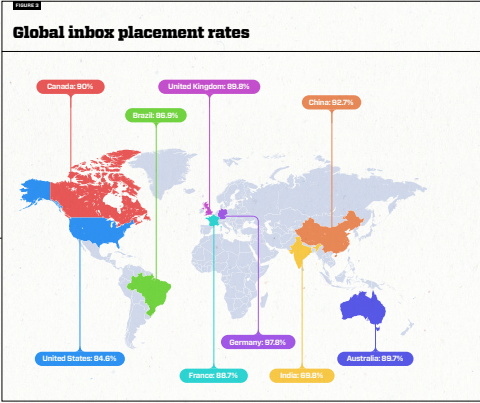
Tailoring your IP warming strategy to account for ISP-specific considerations helps ensure better deliverability.
- Gmail: If a company using Salesforce was warming up their IP, they might see that Gmail prioritizes engagement metrics. A boost in open rates and clicks could signal a successful warming strategy for Gmail users.
- Outlook: Outlook places a heavy emphasis on domain reputation. Gradual volume increases, and a consistent sending pattern are crucial to ensuring that your emails don’t end up in spam.
- Yahoo: With Yahoo, sending consistency is key. If you send emails at irregular intervals, your IP warming efforts may not be as effective. Consistent sending will improve your reputation.
By regularly tracking KPIs, understanding ISP-specific deliverability, and using real-time insights into engagement and complaints, you can optimize your IP warming efforts for better email deliverability and improved sender reputation.
As IP warming scales, maintaining this level of control becomes difficult to manage manually. Tracking volume changes, engagement shifts, and complaint signals across campaigns requires constant monitoring and disciplined execution.
At this stage, many Salesforce teams look for automation that helps apply these best practices consistently, without adding operational overhead.
How MassMailer automates and streamlines the IP warming process
MassMailer automates key aspects of the IP warming process in Salesforce, improving email deliverability by reducing manual errors and ensuring a consistent, efficient approach. Here’s how MassMailer streamlines the process:
- Automated Volume Control: MassMailer ensures that send volume increases gradually over time, adjusting sending frequency and volume at a controlled pace. This prevents sudden spikes that could trigger spam filters and negatively affect your IP reputation.
- Targeting Engaged Users: By using engagement-based segmentation, MassMailer ensures that your emails reach only users who are likely to engage. This reduces the risk of high bounce rates and spam complaints, helping maintain a healthy sender reputation.
- Real-time Performance Tracking: MassMailer provides real-time insights into critical metrics like bounce rates, open rates, and spam complaints, allowing you to adjust your strategy based on live data. This helps you stay on track and refine your approach as needed.
For example, The Bay Club, a leading lifestyle resort company, faced challenges with Salesforce’s daily email send limits. After adopting MassMailer, they were able to send larger email campaigns directly within Salesforce without hitting those limits. The company streamlined its email workflows, automated scheduling, and improved engagement rates with MassMailer's flexible templates. This directly impacted their email deliverability and overall sales productivity.
By automating these processes, MassMailer ensures your IP warming strategy is efficient, consistent, and delivers better results.
If you want to see a visual walkthrough of Salesforce IP warming, watch this short MassMailer video that explains the core concepts and best practices
Conclusion
Salesforce IP warming directly impacts how reliably your emails reach the inbox. When it is rushed or handled manually, even strong campaigns can suffer from low engagement and poor placement. When it is planned well and monitored closely, IP warming becomes a long-term advantage rather than a recurring risk.
Successful teams treat Salesforce IP warming as a repeatable process. They plan to send volume carefully, focus on engaged audiences, and watch deliverability signals as volume scales. Just as importantly, they rely on systems that make this process easier to control and harder to break as email programs grow.
If you want to reduce deliverability risk and warm IPs with confidence, the next step is seeing how the process works in practice.
MassMailer helps Salesforce teams manage IP warming safely by automating volume control, prioritizing engaged audiences, and surfacing deliverability signals in real time.
See how MassMailer fits into your Salesforce setup with a walkthrough, or explore how teams use it to warm IPs without disrupting ongoing campaigns.
Frequently Asked Questions
1. What is Salesforce IP warming?
2. Why is IP warming important in Salesforce Marketing Cloud?
3. How long does Salesforce IP warming usually take?
4. What metrics should you monitor during Salesforce IP warming
5. What happens if IP warming is done incorrectly in Salesforce?
6. Can tools help automate Salesforce IP warming?
Start Your Free Trial Today
Experience MassMailer the easiest way to send personalized emails from Salesforce.
Related Blogs
Salesforce Email Blacklist Removal for Gmail: Step-By-Step Fix
Salesforce Email Deliverability Trends Every Team Must Know
MassMailer Resources

About the Author

Siva Devaki 

Siva Devaki is the founder of MassMailer Inc., a tool that helps Salesforce users optimize email marketing. A passionate advocate for email marketing, Siva writes and hosts podcasts on the topic, sharing insights to help businesses drive revenue and enhance customer engagement through Salesforce email automation and tracking.