



Table of Contents
Introduction
Salesforce emails rarely fail in obvious ways. Campaigns send successfully, lists look healthy, and no system errors appear. Yet open rates fall, replies slow down, and emails quietly stop landing in inboxes. In most cases, the root cause is sender reputation.
Salesforce evaluates every sender based on historical sending behavior, engagement patterns, and trust signals tied to your IP and domain. The challenge is timing and visibility. Sender reputation does not collapse overnight, and Salesforce does not clearly surface early risk indicators.
As a result, teams often notice deliverability problems only after performance has already dropped. This creates confusion, delayed action, and repeated troubleshooting cycles. This guide explains how Salesforce evaluates email sender reputation and how reputation issues actually surface. It also covers why these issues are difficult to diagnose and how teams prevent reputation damage before inbox placement breaks.
How Salesforce Evaluates Email Sender Reputation
Salesforce evaluates email sender reputation by reflecting how mailbox providers assess sender trust across IP addresses, domains, engagement behavior, and authentication signals over time. Salesforce does not assign a standalone sender reputation score. Instead, it surfaces deliverability outcomes based on how mailbox providers interpret long-term sending behavior.
1. Salesforce-specific signals used to assess sender trust
Salesforce email sender reputation is determined by cumulative sending patterns rather than individual campaign results. Mailbox providers evaluate how consistently a sender behaves across Salesforce email sends. As a result, sender trust is shaped by historical behavior over weeks and months, not short-term performance spikes.
2. IP reputation vs domain reputation in Salesforce
IP reputation measures the trustworthiness of the sending IP address used for Salesforce emails. Domain reputation reflects how mailbox providers evaluate trust in the email sending domain itself. Salesforce email sender reputation depends on both signals working together. A strong domain cannot fully compensate for a weak IP reputation, and a clean IP cannot offset long-term domain trust issues.
3. Engagement and authentication signals reflected from mailbox providers
Mailbox providers rely on engagement signals such as opens, clicks, replies, and deletion behavior to evaluate sender trust. Consistently low engagement signals that Salesforce emails are unwanted, which gradually erodes the sender's reputation even when delivery succeeds. Authentication alignment through SPF, DKIM, and DMARC confirms sender identity and protects Salesforce email sender reputation from silent trust degradation.
4. Shared IP vs dedicated IP reputation considerations
When Salesforce emails are sent from shared IPs, sender reputation is influenced by the collective behavior of multiple senders. This introduces indirect risk if other senders weaken IP trust. With dedicated IPs, sender reputation is fully controlled by one account, but inconsistent sending discipline directly impacts deliverability. In both models, long-term monitoring is critical to protect Salesforce email sender reputation.
If you want a clearer, visual explanation of how shared IP and dedicated IP reputation behave in real-world sending scenarios, this walkthrough breaks down how mailbox providers evaluate trust across both models and why reputation outcomes can differ even when campaigns look similar.
Watch the video to understand shared IP vs dedicated IP reputation in Salesforce email sending.
What Causes Salesforce Email Sender Reputation to Decline
Salesforce email sender reputation declines when mailbox providers lose trust in a sender’s long-term behavior, not because of a single failed campaign. Reputation erosion happens gradually as sending patterns, engagement signals, and identity trust shift over time, eventually affecting inbox placement and deliverability.
1. Changes in sending volume and cadence over time
Mailbox providers expect consistent sending behavior from Salesforce email senders. Sudden increases in volume, irregular schedules, or long periods of inactivity followed by spikes signal risky behavior. Even when emails are technically delivered, an inconsistent cadence weakens sender trust and contributes to reputation decline.
2. Engagement decay and mailbox provider trust erosion
Engagement is one of the strongest indicators of sender reputation. When opens, clicks, and replies decline steadily, mailbox providers interpret Salesforce emails as less wanted. This engagement decay reduces sender trust over time, even if content quality and targeting appear unchanged.
3. Rising bounces, spam complaints, and list quality issues
Bounce rates and spam complaints directly impact Salesforce email sender reputation. Hard bounces signal invalid recipients, while spam complaints indicate negative user intent. Over time, poor list hygiene compounds these signals and accelerates reputation damage across both IP reputation and domain reputation.
If you want a deeper understanding of how bounce behavior affects Salesforce email sender reputation, this guide from MassMailer explains how bounce management directly influences list quality and long-term deliverability.
4. Authentication misalignment and sender identity problems
Authentication issues weaken the sender's reputation even when emails continue to be sent. Misaligned SPF, DKIM, or DMARC records create uncertainty around sender identity. These problems often occur silently during domain changes or system updates, gradually eroding mailbox provider trust without obvious delivery failures.
If you want more context on how SPF, DKIM, and DMARC alignment influences sender identity and trust in Salesforce, this guide breaks down email authentication and its impact on deliverability.
How these factors translate into inbox placement changes
As sender reputation declines, mailbox providers usually adjust inbox placement rather than blocking emails outright. Salesforce emails begin landing in Promotions or Spam folders, engagement becomes uneven, and similar campaigns start producing inconsistent results across regions.
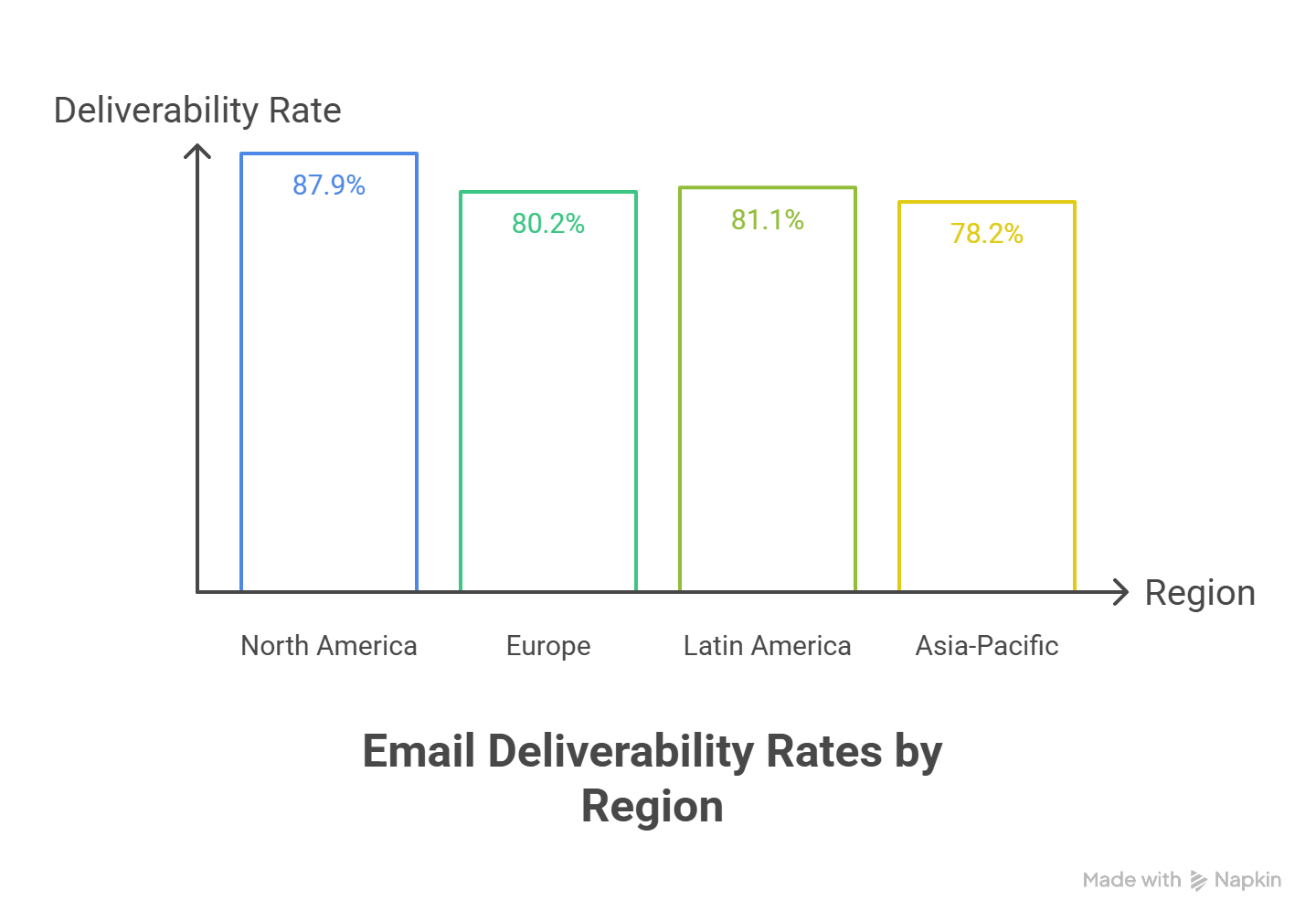
This variation is visible in industry benchmarks, which show email deliverability rates of 87.9% in North America, 80.2% in Europe, 81.1% in Latin America, and 78.2% in Asia-Pacific, highlighting how sender reputation influences inbox placement differently around the world.
Because Salesforce does not surface sender reputation health directly, teams often rely on tools like MassMailer to connect these subtle placement changes back to underlying reputation risk before deliverability breaks.
Why Sender Reputation Problems Are Hard to Diagnose in Salesforce
Sender reputation problems are hard to diagnose in Salesforce because reputation health is inferred indirectly through outcomes, not shown as a clear, measurable signal. Teams see engagement and delivery results, but they lack visibility into how mailbox providers actually assess sender trust behind the scenes.
1. Limits of native Salesforce reporting for sender reputation
Salesforce reporting focuses on email activity and campaign performance rather than sender reputation health. Metrics like sends, opens, and clicks show what happened after delivery, not why inbox placement changed. As a result, teams cannot easily trace declining performance back to sender reputation trends.
2. Absence of direct IP and domain reputation indicators
Salesforce does not surface IP reputation or domain reputation as first-class indicators. Teams cannot see whether the sender's trust is stable, weakening, or already at risk. Without direct visibility into these reputation signals, sender trust issues remain hidden until mailbox providers adjust inbox placement.
3. Time lag between reputation damage and performance impact
Sender reputation damage does not impact deliverability immediately. Mailbox providers evaluate behavior over time, which creates a delay between risky sending patterns and visible inbox placement changes. This lag makes it difficult for teams to connect past actions with current performance issues.
4. Why engagement metrics alone hide early reputation risk
Engagement metrics often decline gradually and unevenly, which makes early reputation risk easy to overlook. Opens and clicks may fluctuate for many reasons unrelated to sender trust. Without connecting engagement trends to underlying reputation signals, teams misinterpret early warning signs as temporary campaign issues.
This lack of visibility is a common challenge for Salesforce teams. On SoftwareFinder, MassMailer is consistently rated highly by users for making deliverability and engagement signals easier to track inside Salesforce. Reviewers frequently highlight improved list accuracy, reliable tracking, and early visibility into bounces and engagement shifts, helping teams identify sender reputation risk before inbox placement noticeably declines.
How Teams Proactively Protects Email Sender Reputation in Salesforce
Teams proactively protect email sender reputation in Salesforce by maintaining steady sending discipline, monitoring long-term behavior, and reducing risk before deliverability declines.
1. Monitoring sender and domain behavior over time
First, teams track sender behavior across weeks and months rather than judging individual campaigns. They focus on long-term performance patterns to identify gradual reputation drift instead of reacting to short-term campaign noise. This trend-based approach helps teams recognize early changes tied to IP reputation and domain reputation before inbox placement is affected.
2. Enforcing consistent sending patterns and safeguards
Next, teams protect sender reputation by keeping sending volume predictable and evenly distributed. Consistent cadence reduces sudden spikes that mailbox providers often flag as risky behavior. In addition, teams align targeting and scheduling to prevent sharp engagement swings that can weaken sender trust over time.
3. Preventing silent sender reputation degradation
Finally, teams prioritize prevention by acting before visible deliverability issues appear. Small, sustained changes in performance are treated as early warning signs rather than isolated anomalies. This approach is used by many tools, like MassMailer, helping teams protect Salesforce email deliverability by addressing risk early instead of reacting after inbox placement breaks.
Taken together, these practices help teams stay ahead of sender reputation risk rather than responding after performance declines. However, maintaining consistent discipline and long-term visibility becomes difficult as Salesforce email volume, teams, and domains scale. This is why teams often rely on dedicated tools like MassMailer to monitor sender reputation continuously and reduce risk before deliverability is impacted.
Conclusion: Build and Protect Salesforce Email Sender Reputation with Confidence
Salesforce email sender reputation determines whether your emails reach inboxes or quietly lose visibility over time. As email volume grows, relying on delayed engagement metrics makes it harder to protect deliverability and harder to diagnose risk early. Teams that treat sender reputation as an ongoing signal, not a post-issue metric, stay ahead of inbox placement problems and avoid costly recovery cycles.
MassMailer helps teams move from reactive troubleshooting to proactive sender reputation management inside Salesforce. With clear reputation visibility, early risk detection, and continuous monitoring of IP, domain, content, and authentication signals, teams gain the control Salesforce does not natively provide. This makes it easier to protect deliverability, maintain trust with mailbox providers, and scale email programs without surprises.
If Salesforce email performance matters to your pipeline, it’s time to stop guessing. See your Salesforce email sender reputation clearly and protect inbox placement before it breaks. Explore MassMailer’s Email Reputation Monitoring and start improving deliverability today.
Frequently Asked Questions
1. What is Salesforce's email sender reputation?
2. How do I check my email sender reputation in Salesforce?
3. What causes Salesforce email sender reputation to drop?
4. How long does it take to recover Salesforce email sender reputation?
5. Does shared IP vs dedicated IP affect Salesforce sender reputation?
6. Why are sender reputation issues hard to diagnose in Salesforce?
Start Your Free Trial Today
Experience MassMailer the easiest way to send personalized emails from Salesforce.
Related Blogs

MassMailer Resources




About the Author

Siva Devaki 

Siva Devaki is the founder of MassMailer Inc., a tool that helps Salesforce users optimize email marketing. A passionate advocate for email marketing, Siva writes and hosts podcasts on the topic, sharing insights to help businesses drive revenue and enhance customer engagement through Salesforce email automation and tracking.